Independent comparisons. We may earn from shop links. More info

Drill bit for stainless steel

Updated: 2026-10-23

You are drilling a 304 bracket or a 316 sheet, and the last HSS bit came out blue while the hole went shiny and hard. A drill bit for stainless steel has to keep cutting. If it rubs, 304 (1.4301) and 316 (1.4401) work-harden, and more pressure makes the next bite worse. The [metal drill bit comparison](/hub/drilling-and-accessories/metal-drill-bit) holds the nine amazon.co.uk listings. None of them is a clean stainless pick. A qualifying purchase can earn a commission at no extra cost to you.

You are drilling a 304 bracket or a 316 sheet, and the last HSS bit came out blue while the hole went shiny and hard. A drill bit for stainless steel has to keep cutting.

Our top picks

On this page

Why 304 and 316 glaze

Austenitic grades work-harden when a drill rubs instead of cutting. The surface under a dwelling bit becomes harder than the metal you started with. Dwell is the fault: pausing, or re-entering so gently that the edge rubs. BSSA says a standard HSS drill can still be suitable if it is sharp, preferably short, and never allowed to rub. Thürmer specifies HSS-E, a 135° split point, cutting oil, 8–12 m/min, no dwell, and no tiny pilot. Cutwel and Hilti put about 5% cobalt on stainless you cut regularly. If the hole is already glassy, stop. General clamping is on how to drill metal.

The bit that earns its place

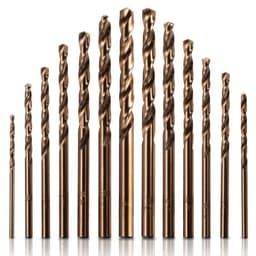
HSS-Co or HSS-E is the alloy: M35 at about 5% cobalt, or M42 at about 8%. Hilti’s UK set states 5% cobalt, a 135° split point, DIN 338, and stainless up to 1100 N/mm², if you use the right speed and cutting oil. M42 is not mandatory for a 304 bracket. A 135° point is geometry, not the cobalt. A gold titanium nitride coat can sit on plain HSS or on cobalt, and it leaves the lip when you regrind. Black oxide on the Bosch PointTeQ sets here is a finish on HSS, not Bosch’s HSS-Co range. Sort the words on HSS vs cobalt drill bits before you pay for a word the packet does not mean.

Speed, oil, and depth

Stay inside 8–12 metres per minute. Revolutions follow rpm = (m/min × 1000) ÷ (π × mm). About 320 rpm is 10 m/min on a 10 mm bit. Figures for about 12 m/min put a 3 mm bit near 1,270 rpm, a 6 mm bit near 640 rpm, and a 10 mm bit near 380 rpm. Low gear and a chip you can see are the practical check. Cutting oil is part of the cut. Past about three diameters deep, reduce speed and feed. BSSA’s peck is about three to four times the diameter, then about twice, then about one diameter, with chips cleared. Rotary only.

Pilots, punches, and thin sheet

Thürmer says not to start stainless with a tiny pilot. A small blunt pilot hardens a cone in the middle of the hole. BSSA warns that a heavy conical centre punch can itself harden the surface. A light three-cornered mark is the safer dimple. On thin sheet, support the exit with a backing piece. For a large hole in that sheet, a step drill or a hole saw is the exit. You still clamp, still use oil, and still stay slow.

What this amazon.co.uk sample does not settle

None of the nine listings is a clean stainless pick. The Bosch PointTeQ sets are black-oxide HSS. Bosch’s HSS-Co range on the GB site was about £24.68 to £68 including VAT on 22 October 2026, and those sets are not in the saved listings. shengbenhao claims M35 and 5% cobalt at £16.87, and its size bullet skips 6.0 mm. Greywolf claims cobalt, shows Generic in the brand field, and has 24 reviews at 3.9. A weekly user belongs in the named HSS-Co band. A one-off bracket can use a cobalt claim here only if the size you need is listed and you still keep the speed and the oil. Above about 45 HRC, stop.

Common questions

Can I drill 304 stainless with a normal HSS bit?
BSSA says a sharp, preferably short HSS drill can cut stainless if it never rubs. Thürmer still specifies HSS-E, a 135° split point, oil and 8–12 m/min. If you have already blunted an HSS bit and glazed the hole, the next step is the alloy and a cutting feed, not more pressure on the same edge. HSS is not "never", and it is not the comfortable choice once the surface has work-hardened.
Is M35 enough, or do I need M42?
M35, about 5% cobalt, is the grade Hilti and Cutwel put on stainless. M42 is about 8% and suits hotter, harder work. It is not mandatory for a 304 bracket. Neither grade survives a dwelling bit or a dry cut. Oil and speed still do the work the percentage cannot do on its own.
What speed is safe for a 6 mm hole in stainless?
Inside 8–12 m/min, a 6 mm bit is about 640 rpm at the 12 m/min figure, and lower if you sit nearer 8–10 m/min. About 320 rpm is the 10 m/min figure for 10 mm, not for 6 mm. A cordless drill in high gear will overshoot this. Low gear and a visible chip are the check. These numbers are not a British Standard.
Why did the hole go glassy and the bit stop cutting?
The lip rubbed and the stainless work-hardened. A pause on the surface, a blunt edge, or a re-entry that kisses the metal before it cuts will do it. Oil and a lower speed will not rescue a hole that is already hard if you keep dwelling. You need a sharp edge, a cutting feed from the moment you touch, and no hammer mode.
Should I start with a tiny pilot in stainless?
No. Thürmer warns against a tiny pilot because it rubs and hardens the centre. BSSA also warns that a heavy conical punch can harden the start. Use a light three-cornered mark so the 135° point does not walk, then let the finishing size cut. A deep punch copied from mild steel is the wrong habit on 304 or 316.

Related pages

Sources

Public sources from the research digest, dated 22 October 2026. Shelf prices, stars and review counts are the amazon.co.uk figures saved on 19 October 2026.

  1. Thürmer Tools, Drills FAQ (retrieved 22 October 2026)
  2. DeWalt UK, DT5912-QZ HSS-R set (retrieved 22 October 2026)
  3. Bosch Professional GB, PointTeQ HSS sets (retrieved 22 October 2026)
  4. Bosch Professional GB, HSS-Co twist drill bit sets (retrieved 22 October 2026)
  5. HSE, HSG129 health and safety in engineering workshops (retrieved 22 October 2026)
  6. The Personal Protective Equipment at Work Regulations 1992 (retrieved 22 October 2026)
  7. BSSA, speeds and feeds for drilling stainless steels (retrieved 22 October 2026)
  8. Heller, HSS-Co DIN 338 drill bits (retrieved 22 October 2026)