Independent comparisons. We may earn from shop links. More info

How to use a demolition hammer

Updated: 2026-10-23

The usual mistake is to lean on the chisel, start in the middle, and keep going until your hands buzz. A demolition hammer, or a rotary hammer in chisel mode, works from an edge with the weight of the tool, and it stops when the material or your grip says so. This is the sequence for a corded breaker you have hired or bought, using the tools in the [demolition hammer comparison](/hub/drilling-and-accessories/demolition-hammer). Products Compared used public UK guidance and those amazon.co.uk listings from 19 October 2026, not a lab test. A qualifying purchase through our links can earn a commission at no extra cost to you.

The usual mistake is to lean on the chisel, start in the middle, and keep going until your hands buzz.

Our top picks

On this page

Before you plug it in

UK mains are nominally 230 V. A BS 1363 plug is stated only on the Draper Expert 81077 title. Hire breakers are often 110 V and need a transformer. A 230 V tool in a 110 V site lead will not run. Breaking concrete makes silica dust, and none of these listings include extraction. Gloves do not block vibration. SDS-Plus, SDS-Max, SDS-hex and 30 mm hex do not share steels. The Einhell TC-DH 43 is SDS-hex. The JCB 21-DH1700 is 30 mm hex. The Draper, the JCB 21-DH1300 and the Einhell TE-DH 32 are SDS-Max. Pull the collar, wipe the shank, add a little grease, and check that the chisel can still slide. A dry shank chatters. Change mode only when the tool is switched off.

Which chisel first

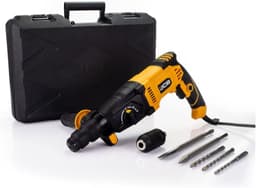
Choose the chisel for the first blow, not for the whole day. WHC Hire's sheet uses a pointed chisel to open dense material and a flat chisel to follow a line. Do not start with a wide blade on an unbroken face. The Enventor 12 J box lists a pointed 18 mm chisel, and one reviewer had to buy a wider blade for tiles. That is normal. The pointed steel opens a pocket. The flat steel dresses it.

How to break

Start at an edge or a corner, on material you have not broken, with the cable behind you. BuildWiz suggests about 30 to 45 degrees. A vertical chisel on a flat slab skates. Let the hammer do the work. Reviewers of the 14.6 kg Einhell say the weight does the job if you do not force it. Do not lever with the chisel. If it sticks, switch off and start the next bite beside the jam. The trigger lock on the Draper and the JCB 15 J is for guiding the tool, not for walking away. A rotary hammer follows the same edge and the same light pressure, and it is still the wrong machine for a thick slab. Demolition use stopped the HYCHIKA after about 30 minutes and left the chisel stuck.

When to stop

These listings do not publish m/s², so there is no safe minute-count for a named model. HSE groups regular hammer use beyond about 15 minutes a day as likely above the 2.5 m/s² A(8) action value, and beyond about an hour as likely above the 5 m/s² A(8) limit, using 18 m/s² for demolition or rotary hammers and 14 m/s² for breakers when you have no measurement. Tingling is the signal to switch off. If the room is a cloud and you have no suitable respirator, you are breathing silica. The Control of Noise at Work Regulations 2005 use 80, 85 and 87 dB(A). We do not have a decibel figure for these ASINs. Stop for steel you did not expect, or within 0.5 m of a suspected cable or pipe. HSE's CIS65 says not to use a power tool in that half-metre. Structural work, and a 110 V site without a transformer, are a professional or a hire desk.

Common questions

Where do I start on the material?
Start at an edge or a corner, on solid footing, with the cable behind you. A start in the middle of a slab gives the chisel nowhere to break out, so it punches or sticks. DIY Doctor and the hire sheets agree on the edge even when they disagree on the size of each bite.
Should I use a pointed chisel or a flat chisel first?
Use the point to open dense concrete, then the flat chisel to follow a line or to dress the face. WHC Hire's order is point, then flat, and neither is a lever. A wide blade on an unbroken surface bounces and slows you down.
How hard do I push?
Hard enough to keep the tip in contact, and no harder. Reviewers of the 14.6 kg Einhell say the weight does the work. If the chisel skates, change the angle towards 30–45 degrees rather than adding your bodyweight. Forcing a stuck steel is how shanks jam.
Do I grease the shank?
Yes, on an SDS chuck. Wipe it, add a little of the grease in the kit if the box included any, seat the chisel and check that it still moves in the collar. A dry shank chatters. The Draper bullets do not list grease, even though a reviewer describes a pot in the box, so check what you actually received.
Can I lock the trigger and walk away?
No. The lock on the Draper and the JCB 21-DH1300 keeps the switch on while both hands guide the tool. An unattended breaker walks, and the chisel keeps hitting whatever it last touched. Switch off before you clear rubble or change mode.
When should a professional take over?
When the work is structural or reinforced, when a service is unmarked or inside 0.5 m, or when the only supply is 110 V and you have no transformer. Also stop if the tool you own is a 3.5–6 J rotary hammer and the slab is not opening. Hiring a breaker for that floor is a better next step than a longer session on the drill.

Related pages

Sources

Public UK sources from the research digest, last checked on 19 October 2026. Shelf prices and star lines are the amazon.co.uk figures in the display file.

  1. HSE vibration regulations (retrieved 19 October 2026)
  2. HSE vibration risk table (retrieved 19 October 2026)
  3. HSE construction vibration (retrieved 19 October 2026)
  4. Control of Noise at Work Regulations 2005 (retrieved 19 October 2026)
  5. HSE CIS36, silica dust (retrieved 19 October 2026)
  6. HSE CIS65, buried services (retrieved 19 October 2026)
  7. BuildWiz SDS breaker guide (retrieved 19 October 2026)
  8. TradePoint 110 V demolition breaker weekend hire (retrieved 19 October 2026)