Bosch combi drill vs SDS
You have a Bosch GSB and a mark on a concrete lintel, and the hammer symbol makes the job look possible. The decision is the mechanism, not the newton-metre number. Use the GSB for screws, wood, metal and ordinary plug holes inside the diameter Bosch states. Change to an SDS-plus rotary hammer for concrete, engineering brick, or a long run of harder holes. Listings are on the [Bosch professional cordless combi drill comparison](/hub/drilling-and-accessories/bosch-professional-cordless-combi-drill). This page does not invent a GBH price. Collar numbers stay on the [how to use](/hub/drilling-and-accessories/bosch-professional-cordless-combi-drill/sub/bosch-professional-cordless-combi-drill-how-to-use) page.
You have a Bosch GSB and a mark on a concrete lintel, and the hammer symbol makes the job look possible. The decision is the mechanism, not the newton-metre number.
You have a Bosch GSB and a mark on a concrete lintel, and the hammer symbol makes the job look possible. The decision is the mechanism, not the newton-metre number. Use the GSB for screws, wood, metal and ordinary plug holes inside the diameter Bosch states. Change to an SDS-plus rotary hammer for concrete, engineering brick, or a long run of harder holes. Listings are on the Bosch professional cordless combi drill comparison. This page does not invent a GBH price. Collar numbers stay on the how to use page.
Our top picks
| Badge | Product | Masonry line | Hammer | Change tool if | Note | Price | Offer |
|---|---|---|---|---|---|---|---|
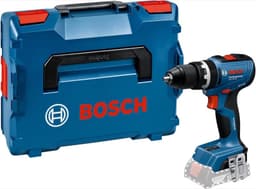
| Best overall |  Bosch Professional Bosch GSB 18V-110 C in L-BOXX | 16 mm stated | Ratchet in the chuck | Concrete or engineering brick | 9.4 | about £186.00 | View offer |
| Alternative |  Bosch Professional Bosch 12V set: GSB 12V-15 and GDR 12V-105 | 10 mm stated | Ratchet in the chuck | Beyond ordinary plug holes | 8.8 | about £239.99 | View offer |
| Best value |  Bosch Professional Bosch GSB 18V-65 body in an L-BOXX | Combi, no joule rating | Ratchet in the chuck | Hard brick, many holes | 8.4 | about £84.99 | View offer |


On this page
Two different hammers
What these Bosch combis are rated for
Brick plugs versus lintels
Noise and dust while you decide
Common questions
Can this combi drill concrete?
What size plug hole is fair for a GSB?
Why does an SDS need different bits?
Is the 110 C’s hammer the same as a GBH?
My combi is loud and slow in engineering brick. Is it faulty?
Can I put an SDS bit in the keyless chuck?
Related pages
Sources
Public UK and manufacturer sources, last checked on 19 October 2026. Shelf prices and star lines are the amazon.co.uk figures for this set.
- Bosch Professional GB: GSB 18V-110 C (retrieved 19 October 2026)
- Bosch Professional GB: GSB 18V-65 (retrieved 19 October 2026)
- Bosch Professional: GSB 18V-25 manual (retrieved 19 October 2026)
- Bosch Professional GB: GSB 12V-15 (retrieved 19 October 2026)
- AMPShare UK (retrieved 19 October 2026)
- Control of Vibration at Work Regulations 2005, regulation 4 (retrieved 19 October 2026)
- Control of Noise at Work Regulations 2005, regulation 4 (retrieved 19 October 2026)
- HSE RR1182: noise and vibration of power tools (retrieved 19 October 2026)