Auger drill for planting bulbs
A trowel is slow once you have a bag of tulips and an 18 V drill in the shed, and an auger drill for planting bulbs only helps if the hole matches the bulb. The shaft length is not the planting depth. A 150 mm fence-post machine is the wrong width for a crocus. This page stays with bulbs, plugs and small plants in soil you can work. Joists and specified fence posts stay on the main [auger drill comparison](/hub/drilling-and-accessories/auger-drill). Listings were checked on 19 October 2026, with the RHS guide to planting bulbs. We did not plant a trial border. A qualifying purchase can earn a commission at no extra cost to you.
A trowel is slow once you have a bag of tulips and an 18 V drill in the shed, and an auger drill for planting bulbs only helps if the hole matches the bulb. The shaft length is not the planting depth.
A trowel is slow once you have a bag of tulips and an 18 V drill in the shed, and an auger drill for planting bulbs only helps if the hole matches the bulb. The shaft length is not the planting depth. A 150 mm fence-post machine is the wrong width for a crocus. This page stays with bulbs, plugs and small plants in soil you can work. Joists and specified fence posts stay on the main auger drill comparison. Listings were checked on 19 October 2026, with the RHS guide to planting bulbs. We did not plant a trial border. A qualifying purchase can earn a commission at no extra cost to you.
Our top picks
| Badge | Product | Diameter | Shaft on the title | Planting fit | Note | Price | Offer |
|---|---|---|---|---|---|---|---|
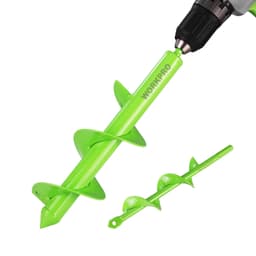
| Best overall |  WORKPRO WORKPRO green set, 4 x 22 cm and 8 x 30 cm | 40 mm and 80 mm | 220 mm and 300 mm | Bulbs on the 40 mm bit | 9.0 | about £13.99 | View offer |
| Alternative |  WORKPRO WORKPRO green set, 4 x 42 cm and 9 x 40 cm | 40 mm and 90 mm | 420 mm and 400 mm | Extra reach, not a deeper tulip | 9.0 | about £16.99 | View offer |
| Alternative |  Thrink Thrink 30 mm x 60 cm planting auger | 30 mm | About 600 mm | Only if the shank grips | 9.0 | about £7.99 | View offer |


On this page
Depth comes from the bulb, not the shaft
About 3 cm, about 4–8 cm, and when 10 cm is already wide
Damp soil, dry clay and stones
After the hole
Common questions
How deep should a tulip go if the auger is 60 cm long?
Is 3 cm wide enough for daffodils?
Will a drill auger work in heavy clay?
What happens if the flight hits a stone?
Do you need the 150 mm Einhell for a border?
Should the bulb go in nose up after the hole is drilled?
Related pages
Sources
Public UK sources from the research digest, last checked on 19 October 2026. Shelf prices and star lines are the amazon.co.uk figures in the display file.
- HSE: PUWER overview (retrieved 19 October 2026)
- HSE: hand-arm vibration in tree work (retrieved 19 October 2026)
- HSE INDG480: hand-arm vibration (retrieved 19 October 2026)
- Control of Vibration at Work Regulations 2005 (retrieved 19 October 2026)
- Consumer Rights Act 2015 (retrieved 19 October 2026)
- Electrical Safety First: drills (retrieved 19 October 2026)
- RHS: planting bulbs (retrieved 19 October 2026)
- Einhell UK: GP-EA 18/150 Li BL Solo (retrieved 19 October 2026)