Independent comparisons. We may earn from shop links. More info

How to lock a garden gate with a chain

Updated: October 2026

You have a short chain on the path, and you want the gate to stay shut when someone leans on it. How to lock a garden gate with a chain starts with the gate closed, a loop that cannot be lifted off, then a padlock through the links. The sets in our [grating security chain comparison](/hub/door-and-window-security/grating-security-chain) are about 50 cm to 61 cm. A loose loop lets two leaves slip the chain, and a carabiner is a clip. If the post moves, stop. Peter F. used the listing lengths. There was no lab test. A qualifying purchase can earn a commission at no extra cost to you.

You have a short chain on the path, and you want the gate to stay shut when someone leans on it.

Our top picks

On this page

Measure with the gate shut

Shut the gate before you judge the chain. An open leaf makes the gap look smaller than the loop you will need, and these chains have little spare length. Hold the chain where you mean to fix it, with the leaf latched, and see whether the end links meet with the chain close to the timber. If they meet only when you drag the gate past the post, the chain is too short. A 100 mm post and a stile of about 70 mm can use most of a 60 cm Sterling chain once the slack is taken up. Yarlung, at about 61 cm, drew UK reviews saying it was too short unless the anchor was already touching. Maxmoc at about 50 cm and ODDerZZii at about 51 cm have less still. Buying extra length to be safe creates the slack that lets a double leaf spread. Length before thickness is the order in what security chain for a garden gate.

One leaf around the post

On a single garden gate the loop passes around the gate and the slamming post, then closes on itself. Keep it close-fitting so the chain cannot be lifted off the top of the gate. A chain that drapes to knee height can be slipped upward even when the padlock is shut. Jacksons, writing about field gates, makes the same point: loop through the gate and the post, and keep the fit close. Pass the shackle through the end links with no spare loop you could work larger. Sterling’s listing says both 30 mm and 48 mm, so try the shackle before you commit. If it will not enter, that set does not fit. Pliers will ruin the lock. The plastic cover can stiffen the chain. Cutting it off does not thicken the 4 mm steel. A carabiner at each end, which is how Maxmoc is supplied, opens for anyone at the gate. Use that as a daytime latch on a cage if you accept it. For a side gate you lock at night, close the loop with the keyed padlock.
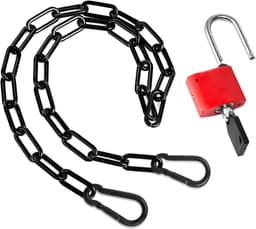
Maxmoc Maxmoc gate chain, 2 pack

Testsieger

Maxmoc Maxmoc gate chain, 2 pack
9.2/10about £6.99

Two leaves and the slip-off

Each leaf of a double gate can move, so a chain wrapped around both can look tight and still go slack when the leaves are pushed apart. Signet Locks calls that wrap the common cheap method, and says the chain must be short enough that the leaves cannot be pushed apart. Lock & Key’s note says the same: do not rely on a chain around two leaves if spreading them creates slack. Take the slack up so the chain cannot be lifted off, and stop before you tension it like a tow strap. Bar-tight chain loads the hinges, and it is still not a graded assembly. Add lockable drop bolts so one leaf is fixed before the chain holds the other. Jacksons suggests that pairing. Prefer a closed shackle, which ProtectUK mentions for a security gate. Count the keys before you snap the lock shut. ODDerZZii reviews include a lock that arrived with no key, and a plastic body broken on arrival. Try the key over the kitchen table, with the chain still loose. If you close a keyless lock on the gate, you have fastened a leaf you cannot open.

Stop when the gate is the problem

The chain does not repair the gate. If the post rocks, the hinge screws turn in soft wood, or you can lift the gate off its pins, fix that before you buy another 60 cm of chain. A chain around a rotten post holds the rot. Height, anti-lift hinges and the England planning limits sit on the garden gate chain lock page. A cellar lightwell needs plates and a release from inside. Looping a gate chain around a grate is the wrong fitting. The reasons are on the cellar grate lock chain page. Call a competent person if the gate may be a fire exit, if the building is listed, if an insurer named a grade, or if the post moves. The Fire Safety Order 2005, article 14, requires non-domestic emergency doors to open easily and immediately, so a keyed chain does not belong on that route.

Common questions

Where does the chain go, the post or both leaves?
On one leaf, loop the chain around the gate and the slamming post so it cannot be lifted off, then padlock the links. On two leaves, a chain around both is the common cheap method, and it only works if the leaves cannot be pushed apart to make slack. Fix one leaf with lockable drop bolts, then chain the other to the fixed leaf or to a post.
How tight is tight enough?
Tight enough means the chain cannot be lifted off and the leaves cannot spread into a gap. It does not mean bar-tight, like a tow strap, which loads the hinges every time you shut the gate. Take up the slip-off slack and leave the chain able to flex. If you can still push the leaves apart under the chain, it is too long for that gate.
Will a 60 cm chain reach?
Often only just. The chains in this comparison are about 50, 51, 60 and 61 cm. A 60 cm chain around a 100 mm post and a stile can come up short once the gate is shut and the loop is close. Yarlung reviews said about 61 cm was too short unless the anchors touched. Measure with the gate shut. If the ends miss, move the anchors closer or choose a longer chain.
Can I use the carabiners only?
You can use them as a latch. Maxmoc is supplied that way, with a carabiner at each end and no keyed padlock. Anyone who can reach the clip can open it. For a side gate you intend to lock, put a padlock through the links. A carabiner left on the outside is an open invitation, not a second lock.
The shackle will not pass the link. What then?
The padlock has to match the end link. Sterling’s listing states both 30 mm and 48 mm, so the shackle in the box may not be the one you planned. Do not file the link or force the shackle. Return the set, or use a closed-shackle padlock you have checked in that link on the table. A lock that does not pass is a lock for a different chain.
When do I stop and fix the post instead?
Stop when the post moves, the hinge screws spin, or the leaf lifts off the pins. A chain cannot make that gate honest, and another loop will fail in the same place. Repair or replace the post and fit hinges that cannot be lifted off, then measure again. If the opening is a lightwell grate or a possible fire exit, stop and get advice rather than padlocking it shut.

Related pages

Sources

Public UK sources used for this page in October 2026. Prices, stars and review counts are the amazon.co.uk figures on the four listings. No listing is treated as BS EN 12320, Sold Secure, Secured by Design or LPS 1175. The 10 mm line is ACE Security’s guide, not a test of these chains.

  1. ProtectUK: fences and gates (retrieved October 2026)
  2. Secured by Design: secure your home garden (retrieved October 2026)
  3. BSI: BS EN 12320:2021 padlocks and padlock fittings (retrieved October 2026)
  4. Regulatory Reform (Fire Safety) Order 2005, article 14 (retrieved October 2026)
  5. Consumer Rights Act 2015 (retrieved October 2026)
  6. ACE Security: padlocks guide (Collections Trust PDF) (retrieved October 2026)
  7. Signet Locks: how to lock a double gate (retrieved October 2026)
  8. Chain Supplies: information about chains (retrieved October 2026)