Plastic or wooden window box: choose by the sill

Plastic or wooden window box: buy the light trough if the walls stay straight and it drains, or the 15 cm pine box only if you will line the slats first.
On this page
In short
You are choosing a plastic or wooden window box for a sill that cannot take a screw, and the two listings in front of you are not the same object. Buy the plastic trough when the box stays light, the walls stay straight once the compost is wet, and you can see drainage holes. Buy the pine box when you need about 15 cm of soil and you will line the slats yourself.
What each box is actually selling
The plastic window box comparison is a trough. On 15 October 2026 that shelf showed a Whitefurze 90 cm at £8.90 and a pair of 60 cm troughs at £8.99. Empty, they are light enough to carry in one hand. A wood-effect planter in that set, including the B2C listing, is coloured plastic. The grain is a mould. If you wanted pine, that page has not sold you pine.
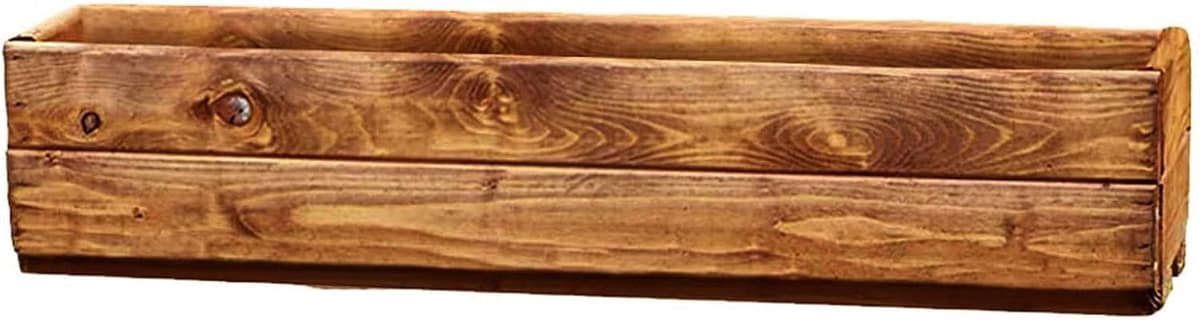
The wooden window box comparison is a different object. The Hortico 76 cm window box, ASIN B0B7XBG5KF, was listed at £26.99, at 76 × 23 × 15 cm, about 24.5 litres, and 3.5 kg empty. The base is slats. No liner comes in the box. Reviewers say soil drops through those gaps. A second listing, B0D841LL9X, repeats the same review text. That is one shared write-up, not two trials, so do not add the counts and call it twice the evidence.
Glass-reinforced plastic, often called GRP, turned up on other shop pages, not in these amazon.co.uk sets. Those prices started from £85.80 including VAT, with one made-to-order trough around £115, and drainage was often a menu choice. Do not fold those figures into either comparison. Nothing here was load-tested or grown for a season, and no British Standard for a domestic window box turned up on 15 October 2026.
Drainage and a trough that bows
Plastic window box drainage is the first test, and stiffness is the second. The Royal Horticultural Society says a container needs drainage holes, because roots in a box are more exposed than roots in the ground. Take any saucer off before winter, or it holds water against the base. Peat-free compost is what the RHS points you to for containers. Neither point stiffens a thin plastic wall.
UK reviews often say the 90 cm Whitefurze at £8.90 bows once it is filled. Wet compost pushes a long span outward. Fill it on the path and look along the rim before it goes on the sill. If the sides have moved, send it back. The 60 cm troughs at £8.99 are a shorter span. They can still be flimsy, and they are not the same complaint.
If the base is solid, you are buying a tray. A shallow decorative tray is not a soil trough, whatever the title says. Pour a jug of water through before any compost goes in. If two size lines on one listing disagree, keep both and do not average them into a length the page never stated. Under the Consumer Rights Act 2015, sections 9 to 11, goods have to match the description. These prices were read on 15 October 2026 and they move.
Depth, a liner, and the wood words
About 15 cm is enough compost to plant into, rather than a shell you stand a nursery pot inside. The Hortico's 15 cm side and 24.5 litre line are why that pine trough is in the choice. A wooden listing under about 8 cm high and about 500 g is a different product. That cutoff is a rule of thumb from the wood comparison only, not a national standard. Skip it if you wanted a soil trough.
Slats need a wood window box liner you supply. The Hortico does not include one, and reviewers say soil drops through. A sheet still needs holes of its own, or it becomes a bath inside a wooden frame. Punch those holes over a bin, not over the sill. An open base means the liner is part of the cost, even though it is not in the £26.99.
Pine, Scandinavian redwood, anti-rotten and weather resistant are not a treatment class. In this set, Scandinavian redwood means pine. None of those phrases is Use Class 3 or BS 8417. The Wood Protection Association treats outdoor timber above ground as Use Class 3 under BS EN 335, and BS 8417 is the preservation code. Ask for the class in writing. No listing here stated one. A yearly reseal is a rule of thumb from one buyer's guide, not a tested life. The Creosote Regulations 2003 keep creosote out of ordinary home use.
Weight, the sill, and where not to drill
Quote the empty window box weight only. The plastic troughs are the light option at those shelf prices. The Hortico is 3.5 kg before compost, water, or plants. Wet compost, not the carton, is the load on the sill and on any bracket. This page does not state a filled weight in kilograms, because that figure was not measured. A thin uPVC nose can still be the wrong support for a full 90 cm trough.
Do not drill a uPVC sill for either box. Garden News is plain about that: a screw through the plastic is a leak and a crack, not a bracket. Their rule of thumb is fixings into the brickwork about every 45 cm, and that spacing is not a calculation for your wall. A commercial buyer's guide puts the length at about 75 to 100 percent of the window width, again as a rule of thumb. A 90 cm trough overhangs a narrow casement. A 60 cm trough on a wide bay can look short.
If you rent, get written permission before any screw goes into the wall. Shelter England's guidance on improvements is where that sits. A listed facade needs conservation advice before brackets go in. Leave an escape window clear. Measure the opening first. A trough, a bracket, or a line of compost across it is in the way if that window is how you would get out.
Which box to buy
Buy the plastic trough if the sill wants a light box, the walls stay straight when the compost is wet, and you can see drainage holes. Prefer the 60 cm pair at £8.99 when the 90 cm Whitefurze at £8.90 worries you. Fill it on the ground and send it back if the sides move.
Buy the pine trough if you need about 15 cm of soil and you will line the slats. The Hortico at £26.99 is that shape. A wood-effect plastic listing is not a cheaper version of it. The pine earns its place only if the timber is fit for outdoor use above ground, the liner drains, and you renew the coating. Skip a wooden box under about 8 cm high and about 500 g when you wanted soil rather than a sleeve for pots.
Skip both if you wanted fibreglass or a self-watering window box. GRP from about £85.80 is a third product, those shop prices are not these Amazon prices, and neither listing describes a reservoir. Skip both if you wanted the window more secure. A trough does not lock a handle, which is a job for the window handle comparison, not for compost. Skip both if the only fixing you can imagine is a screw in the uPVC sill.
Products Compared read the amazon.co.uk listings on 15 October 2026, with the RHS, the Wood Protection Association, and the statutes named above. We did not lab-test or grow either box for a season. If you buy through a product link on a comparison, we may earn a commission at no extra cost to you.
Common questions
Will a wooden box last longer than plastic outdoors?
Why do reviews say a cheap trough bends when it is full?
My pine box has slats. Do I need a liner?
Can I screw either box to a uPVC sill?
Are the fibreglass boxes on Google the same as these Amazon boxes?
Is a window box any kind of security?

Products Compared publishes British-English buying guides based on amazon.co.uk listings and public UK sources. We do not run a lab and we do not invent test scores.
Related articles

Window boxes through a British winter
Take the saucer off before frost, and do not drill a uPVC sill to pin a winter trough down.

Lock the window before an alarm or a film
A window box does not lock the sash. Fit a proper lock before a siren or a roll of film.

When a window draught seal has failed
A perished seal is a draught at a window that still locks. A planter on the sill will not close it.