Tinted front car windows law: leave the house roll off

Tinted front car windows law: front glass must pass most of the light. A house mirror roll counts with the glass, and it is the wrong product for that job.
On this page
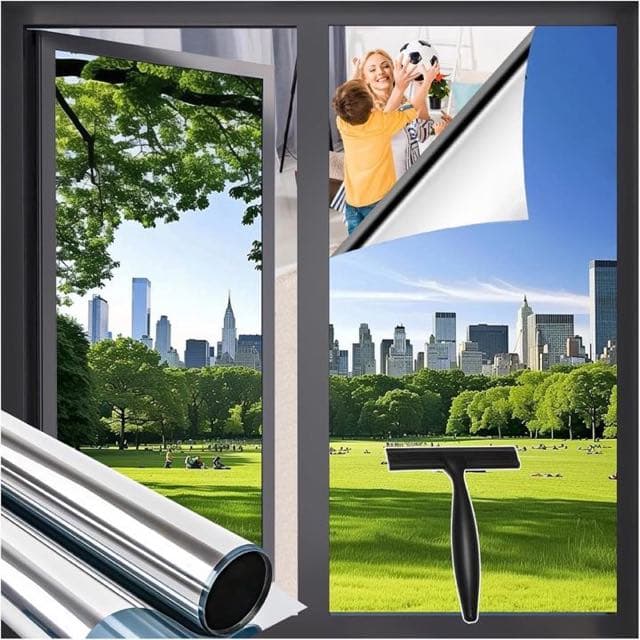
The roll is still in the packet on the passenger seat, silver side out, and the front side window is the piece of glass you can reach without moving the car. The tinted front car windows law is about how much light still comes through the finished windscreen and the finished front side windows once anything is stuck to them. In Great Britain, a vehicle first used on or after 1 April 1985 needs at least 75% of light through the windscreen and at least 70% through the front side windows. A vehicle first used before that date needs at least 70% through both. Household mirror film is inside that figure, because Construction and Use regulation 32(11A) treats film on the glass as part of the glass.
On 16 October 2026 we used the GOV.UK tinted-window page, Construction and Use regulation 32, MOT manual section 3, nidirect, and Highway Code Annex 6. The house rolls are about 40 cm to 90 cm wide, from about £6.99 on amazon.co.uk. We metered no pane, and one listing's percentage is not a laboratory result for the set. A qualifying purchase through our links can earn us a commission at no extra cost to you.
In short
Front glass has to let most of the light through, and the percentage is measured on the finished window. Film stuck to the glass is part of that window under Construction and Use regulation 32(11A). A household mirror roll is the wrong product for the windscreen and the front side windows.
The front glass has a light minimum
GOV.UK states the limit as a minimum of light through the finished glass. For a vehicle first used on or after 1 April 1985, at least 75% of light must pass the windscreen and at least 70% must pass the front side windows. For a vehicle first used before that date, the minimum is at least 70% through both.
That split is Great Britain. nidirect, for Northern Ireland, requires at least 75% through the front windscreen and at least 70% through the front side windows. That page does not set out a lower windscreen figure for a vehicle first used before 1 April 1985, so this article does not add one. If the car is kept in Northern Ireland, use that pair of figures. The Republic of Ireland sits outside this page.
nidirect says most modern vehicles have a slight factory tint, and that adding more on the front is likely to fail. That does not mean every modern car sits at exactly 70%. Figures of 35% and 20% are American darkness grades, not a UK allowance, and none of the pages we used gives a legal sun-strip height. Leave the windscreen and both front side windows bare of this roll.
Film on the glass is part of the glass
The meter reads the finished window. Paragraph (11A) of regulation 32, inserted from 1 January 2004 by S.I. 2003/3145, applies the visual-transmission rules to any tint, film, or other material on the windscreen or window. Static cling and peel-and-stick both count while they are on the glass.
GOV.UK says it is illegal to fit or sell glass, or a vehicle already fitted with glass, that breaks the rules. If a piece is already on a front side window, take it off before the car is used or sold. Highway Code Annex 6 says you must not use a vehicle with excessively dark tinting on the windscreen or on any front window to either side of the driver. Factory tint is described there as complying. The annex points to section 42 of the Road Traffic Act 1988 and to regulation 32, and it says windows must be kept free from obstructions to vision.
Those pages set a minimum of light through the finished front glass. They do not ban every pale automotive film that still leaves the window inside the percentage. This silver roll is a building product for a room, and a fitter's quote for a different film is not a reading for the packet on the seat.
This roll is a house product
A 40 cm width can cover much of a front side window, which is why the packet feels usable on the drive. The law asks how much light comes through the finished glass. Leftover centimetres on the roll do not create a margin.
They are a daytime mirror. The brighter side reflects and the darker side sees through. The Window Film Company, writing about one-way privacy, says there is no true two-way film. When the inside is brighter, the mirror reverses and people outside can see in. Interior lamps and a low sun change which face of a car window is brighter, so a living-room roll does not settle into a stable tint on door glass.
Gufoltie claims 10% visible light transmission. That is one listing's claim, not a laboratory result for the set. Ten percent, as that listing states it, is already far below 70% on a front side window. These rolls are not EN 12600 safety film.
A passed MOT is a view check
Section 3.2 of the MOT inspection manual checks the windscreen and the windows on either side of the driver's seat. Excessive tint is a defect, but a failure is justified only if the driver's view is significantly affected.
A minor exists where tint does not adversely affect the view. A major exists where visibility through the swept area, or of an obligatory external mirror, is seriously affected. That is a view check, not a light meter set to 75% or 70%.
One trade page says tint under the percentage fails the MOT. Another says the MOT ignores tint. Section 3.2 can mark excessive tint and still pass a window whose view is good enough, without proving 70% of the light is getting through. The police or the Driver and Vehicle Standards Agency measure with light equipment, and in Northern Ireland the Driver and Vehicle Agency examiners do that measurement. An MOT pass does not prove the light limit.
Rear glass still has to show the road
GOV.UK, Highway Code Annex 6, and nidirect do not set a visible light transmittance limit for the rear windscreen or the rear passenger windows. That is the official position on a percentage. It is not a fitting instruction for this roll, and it is not a legal workaround for film you cannot put on the front.
The film is a daytime mirror, and it reverses when the inside is brighter, so a rear screen can mirror the cabin or the road as the light changes. You still need that glass for junctions, reversing, and the interior mirror. Annex 6 requires windows kept free from obstructions to vision, and MOT section 3.3 expects an obligatory mirror to show the rear. Leave this packet off the back glass.
What an official page names if you are stopped
GOV.UK names three outcomes when front glass breaks the light rules: a prohibition notice, a penalty notice, or a court summons. That page does not state a fine in pounds, a number of points, a darkness band, or a set number of days to put the glass right. In Northern Ireland, nidirect names a prohibition, a fixed penalty, or a court summons, and it says police or Trading Standards can prosecute the sale of a vehicle with heavily tinted front windows.
In Great Britain it is illegal to fit or sell non-compliant glass, or a vehicle already fitted with it, so take any extra front film off before the car is used or sold. The RAC modifications guide says you must tell the insurer about a modification, or the cover can be invalid. Keep this roll off the car.
If the pane at home is suitable, the roll is for daytime privacy on a window at home. The top pick in that set is the Zindoo heat-reflective 40 × 200 cm roll, ASIN B0DNHLXGMF, for a house window: about £8.99, with 4.4 from 7,273 amazon.co.uk reviews. A wide-use line on a listing is not a pass for front car glass.
Common questions
What is the darkest legal tint on the front windows?
What is the penalty for illegal front tints, and does it include points?
Is 35 percent or 20 percent tint legal on a UK car?
Can the police stop you and measure the glass?
Can I put this one-way mirror roll on the front side windows if it is only static cling?
If the car passed its MOT, is the tint legal?
Can I put the roll on the rear windows instead?
Is the rule the same in Northern Ireland, and does a pre-1985 car get an easier windscreen limit?

Products Compared publishes British-English buying guides based on amazon.co.uk listings and public UK sources. We do not run a lab and we do not invent test scores.
Related articles
Lock the window before an alarm or a film
A handle alarm does not lock the sash, and mirror film is not security film. Locks come first.

PAS 24 belongs to the whole window
A new handle, a clip-on siren, or a roll of film is not a PAS 24 test of the window you already have.

Mist between the panes is not a draught seal
Cavity mist means the sealed unit has failed. A draught strip and a mirror roll do not dry that gap.