Independent comparisons. We may earn from shop links. More info

Polyurethane or rubber castors

Updated: 17 October 2026

You are choosing a wheel for wood, laminate, tile, or a workshop slab, and the listing uses rubber, polyurethane, TPR, and PVC as if they were one word. Polyurethane or rubber castors are not interchangeable. The tread word only helps if the same listing does not use a second word. This page stays on the floor. A locked hard wheel can still slide, and that is the only cross-over. The packs are in the [swivel castors comparison](/hub/diy-supplies/swivel-castors). Peter F. read the amazon.co.uk listings on 15 October 2026 and did not run a floor test. A qualifying purchase can earn a commission at no extra cost to you.

You are choosing a wheel for wood, laminate, tile, or a workshop slab, and the listing uses rubber, polyurethane, TPR, and PVC as if they were one word. Polyurethane or rubber castors are not interchangeable.

Our top picks

On this page

Rubber, polyurethane, and TPR are not one material

Rubber, in the ordinary trade list, is a soft tread. Polyurethane is a different polymer. Listings still paste both words onto the same pack. TPR is thermoplastic rubber, a moulded rubber-like tread, not a synonym for polyurethane. PVC and polypropylene sit further towards a hard wheel. A stainless-steel ball in a mini roller is not a tread choice. QED lists rubber, polyurethane, nylon, polypropylene, steel, and cast iron as separate materials. HSE’s roll-cage note on polyurethane and nylon is workplace handling, not a sofa test. If the title, the bullets, and the attribute use one material word, take that word to the floor rule. If they use two, do not average them.

Where this file contradicts itself

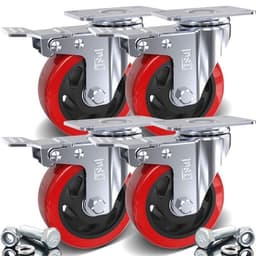
DSL’s 100 mm attribute says rubber. The bullets name no polymer, and a review says the red tyre sounds hard. Keep the attribute as rubber. Do not quietly change it to polyurethane. DSL 50 mm says polyurethane in the attribute and the bullets, and the title also says rubbered. That is two materials in one listing. DSL 75 mm is the line where the attribute and the bullets both say polyurethane. Agreement is not a soft feel: one reviewer found them harder to push than flight-case wheels. CHEUNGR says PVC and steel, and also soft rubber. Navoys says a rubber tread in the bullets and metal in the attribute. WEIBIDA names thermoplastic rubber. Do not merge those words.

Soft on a hard floor is a rule of thumb

A rule of thumb cited from EN 12528 and EN 12529 is a soft tread on a hard resilient floor and a harder wheel on carpet. It is not a test of these listings, and it is not a certificate that a pack will not mark. On the 75 mm DSL pack, a raised moulding marked wood laminate. A WEIBIDA reviewer reports no marking on a wooden floor. One household is not a floor certificate. A soft tread left under a static load can develop a flat, the QED point on a wheel that almost never moves. A harder wheel avoids that flat and can mark or make more noise. A locked hard wheel can still slide on laminate, which a DSL 50 mm review describes. The lock itself is on swivel castors with brakes.

Hard wheels and unnamed wheels

Flintronic’s bullets say high-hardness polypropylene. One reviewer calls them 2 inch nylon wheels. Report both. Do not merge polypropylene and nylon. If the bullet and the review disagree, you do not yet know which hard wheel will arrive. TXMXT names no polymer. An unnamed tread cannot sit on either side of the floor rule. Aeaocvo’s stainless-steel ball is a mini roller, not a cabinet tread. Which reviewed pack fits the cabinet, rather than the floor chemistry, is on best swivel castors. Load before tread is the swivel castors buying guide.

Common questions

Is polyurethane the same as rubber?
No. QED lists them as separate castor wheel materials, along with nylon, polypropylene, steel, and cast iron. Polyurethane is a different polymer from rubber, and TPR, thermoplastic rubber, is a third word, not a nickname for either. PVC and polypropylene sit towards the hard end. A listing that uses two of those words for one wheel has not told you which wheel you are buying.
Will these mark laminate or wood?
They might. A 75 mm DSL reviewer reported that a raised moulding marked wood laminate. A WEIBIDA reviewer reported no marking on a wooden floor. Both are single households, not a floor certificate, and this comparison did not run a stain test. Do not buy on will not mark. If the listing’s material words disagree with each other, you do not even know which tread the promise would have applied to.
What is TPR?
TPR means thermoplastic rubber. In this file, WEIBIDA’s bullets name thermoplastic rubber, and Biekezi’s 32 mm bullets name TPR rubber. It is a moulded rubber-like tread, not polyurethane, and not a reason to ignore a second material word if the attribute says something else. Treat it as its own label. Then apply the soft-on-a-hard-floor rule of thumb only if the rest of the listing does not contradict it.
Why does one listing say rubber and polyurethane?
Because the title, the attribute, and the bullets are not always written as one description. DSL 50 mm says polyurethane in the attribute and the bullets, and the title also says rubbered. DSL 100 mm’s attribute says rubber, the bullets name no polymer, and a review describes a hard red tyre. You do not average those into one material. You treat the listing as unresolved and shop a pack whose words agree, such as the 75 mm DSL line, which stays on polyurethane.
Are hard wheels better on carpet?
As a rule of thumb cited from EN 12528 and EN 12529, a harder wheel is the usual choice on carpet, and a soft tread is the usual choice on a hard resilient floor. It is not a test of these packs. Flintronic’s polypropylene is the hard end here, with a review that instead says nylon, so you confirm the material before you rely on it. A soft wheel under a static load can also flat-spot.

Related pages

Sources

Public UK and manufacturer sources on furniture castors, brakes, and the Consumer Rights Act 2015. Listing prices and star counts are from the amazon.co.uk extracts for this comparison, dated 15 October 2026. Prices move.

  1. BS EN 12528:1999, furniture castors (retrieved 15 October 2026)
  2. BS EN 12532:1999, industrial castors (retrieved 15 October 2026)
  3. BS EN 12529:1999, swivel-chair castors (retrieved 15 October 2026)
  4. HSE, roll cages and wheeled racks (retrieved 15 October 2026)
  5. HSE, pushing and pulling (retrieved 15 October 2026)
  6. Consumer Rights Act 2015, section 11 (retrieved 15 October 2026)
  7. QED Castors, castor types (retrieved 15 October 2026)
  8. Guy-Raymond Engineering, braking it down (retrieved 15 October 2026)