Independent comparisons. We may earn from shop links. More info

How to fill sandbags for a doorway

Updated: 23 October 2026

A bag filled to the top will not mould against a door frame, and UK pages do not agree on whether you tie it. This is how to fill sandbags for that job: half full, closed, laid like bricks, then stopped when the lift or the wall is too much. Prices stay on the [sandbag comparison](/hub/diy-supplies/sandbag). A qualifying purchase can earn us a commission at no extra cost to you. Products Compared used council pages and the saved amazon.co.uk listings, not a lab, and this note is dated 22 October 2026. Fabric, if you are still choosing, is on the [hessian or polypropylene sandbags](/hub/diy-supplies/sandbag/sub/sandbag-hessian-or-polypropylene) page.

A bag filled to the top will not mould against a door frame, and UK pages do not agree on whether you tie it.

Our top picks

On this page

Fill to half, with sharp sand

Kirklees Council says fill the sack no more than half full, with about 15 kg of sharp sand, not soft sand. The Environment Agency leaflet that councils still host says the same half-full line. A Flood Re paper records that the 2009 leaflet was withdrawn in 2020, so treat it as withdrawn advice that council pages still echo. The fire service says half to three-quarters and 20–30 kg. Broxtowe says a little over half. Derbyshire says about three-quarters and about 20 kg. Do not average those figures. Name the page you are following. Two people do the fill. One holds the sack open. The other shovels. Stop while the sack still flops. A full neck will not tuck into the frame. If it will not bend, empty a little before you close it.

The tie is not one rule

The withdrawn leaflet says you do not need to tie the neck if you tuck the open end under. Broxtowe says tie close to the neck so the sand can still spread. Derbyshire also says tie. Those pages do not match. Use the closure that is actually in the pack, then tuck the end anyway. The polypropylene listing includes a black tie. UK reviews call those ties not that strong, and they still closed the sack. The hessian bullets do not name a tie, though UK reviews say ties were in the box. Knot close to the sand, not at the end of a long empty throat. A studio double zip is not this method. Amazon Basics and EMART say their saddlebags cannot hold water.
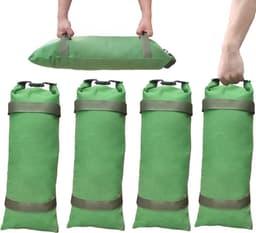
Ywkdnf Canvas flood 4-pack

Testsieger

Ywkdnf Canvas flood 4-pack
7.5/10about £8.40

Lay them like bricks, plastic on the wet face

Lay the first course lengthways, not upright. Broxtowe's picture is a paving slab: flat, then patted down with a shovel. Kirklees says the open end faces the water, tucked, and the next course overlaps like bricks. Stamp each course so it beds. A gap you can see is a gap the water will use. Put a plastic sheet on the wet face, or against the wall where the council page you are using says so. Kirklees mentions a sheet against the wall. The leaflet puts plastic on the wet face. The sheet slows the seep. It does not seal the house. At least six bags is the leaflet figure for about 20 cm at a standard door. A 4-pack cannot make that course. A 10-pack can, with bags left for a second layer. What six bags cannot cover, including air bricks, is on the sandbags for flood defence page.

Stop when the lift or the wall is too much

A filled sack in the fire-service range is 20–30 kg. The Health and Safety Executive's manual-handling guidance sets no statutory kilogram cap under the Manual Handling Operations Regulations 1992. The test is whether you can lift the sack close to your body. If you cannot, it is too full. Empty sand until you can. Stop stacking when the wall would be high enough to load the building. Kirklees says a high wall needs expert advice. Stop if water is already inside, if sewage is coming back through fittings, or if an employer is sending staff to fill bags. That last case is a manual-handling assessment. Sacks that have touched floodwater are contaminated. GOV.UK says take them to a household waste recycling centre and do not put them in the household bin.

Common questions

Sharp sand or soft sand?
Kirklees specifies sharp sand, not soft sand, at about 15 kg. Derbyshire allows sand or soil at about 20 kg. Keep those as two council figures. Soft sand and fine dry sand are a poor match for open hessian, which is a weave problem rather than a reason to invent a third weight.
Do I tie the neck?
The leaflet says you need not tie if you tuck the end. Broxtowe and Derbyshire say tie close to the sand so the sack can still spread. The polypropylene listing in this set includes a tie. The hessian bullets do not, though UK reviews found ties in the pack. Tuck the end either way.
Where does the plastic sheet go?
On the wet face, or against the wall, depending on the page you are using. Kirklees mentions the wall. The leaflet puts the sheet on the water side. The sheet slows seepage. It does not seal the house, and it does not replace a purpose-made barrier.
What if I cannot lift it?
Hereford and Worcester Fire and Rescue put a filled bag around 20–30 kg, and there is no legal kilogram cap. If you cannot lift it close to your body, tip sand out until you can. Half full on the Kirklees line is the lighter end of that range. Do not add people to a sack that is already too full to mould.
When do I stop and get advice?
Stop when the wall would be high, when water is already indoors, or when sewage is backing up through fittings. A high stack can load the building, and Kirklees points that case to expert advice. If an employer is sending staff to fill sacks, that is a manual-handling assessment.

Related pages

Sources

Public UK sources from the research digest, plus the amazon.co.uk listings compared on this page. Updated 23 October 2026.

  1. Environment Agency sandbag leaflet (retrieved 23 October 2026)
  2. Kirklees Council: use of sandbags (retrieved 23 October 2026)
  3. Hereford and Worcester Fire and Rescue: sandbags (retrieved 23 October 2026)
  4. GOV.UK: how to recover from flooding (retrieved 23 October 2026)
  5. GOV.UK: get flood warnings (retrieved 23 October 2026)
  6. City of Edinburgh Council: sandbags (retrieved 23 October 2026)
  7. HSE: manual handling (retrieved 23 October 2026)
  8. Blue Pages: standards and accreditations (retrieved 23 October 2026)
  9. Flood Re: temporary property flood resilience (retrieved 23 October 2026)