Independent comparisons. We may earn from shop links. More info

Disc magnet vs pot magnet

Updated: 23 October 2026

You are fitting a cupboard, a drawer, or a light panel, and the basket has both a plain silver disc and a steel cup with a screw in the middle. Disc magnet vs pot magnet is a choice about the magnetic circuit and about how you fix it, not about which title says extra strong. The [neodymium magnet comparison](/hub/diy-supplies/neodymium-magnet) includes one pot and several bare discs. A pot is stronger in direct contact and often weaker through a gap of about a millimetre. Prices and stars are the amazon.co.uk capture of 21 October 2026. Pull was not measured here.

You are fitting a cupboard, a drawer, or a light panel, and the basket has both a plain silver disc and a steel cup with a screw in the middle.

Our top picks

On this page

What the steel cup changes

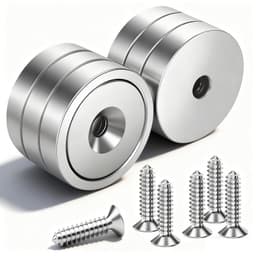
A pot magnet is a neodymium disc sitting in a steel cup. Eclipse Magnetics describes the cup as putting both poles on one face and raising the clamping force when that face is in direct contact with steel. The cup also takes knocks that would chip a bare disc. You get one working face. The sides and the back are largely shielded by the steel, which is why a pot is the usual screw-on catch and a poor choice when you need pull through a gap. The reach falls because the poles sit close together. A supplier calculation, not a test of the pot in this batch, is that a pot loses the contact advantage by about 1 mm of gap. Paint, a vinyl skin, a business card, or a wooden door that does not quite meet the plate are all gaps. A thicker bare disc still throws a field through that gap. A pot, stronger when it is flat on clean steel, often feels weaker once the door is proud by a millimetre. A pot is not always stronger. The only pot in this set is the VACUBXBY six-pack: 20 mm by 6 mm, countersunk, with six M4 screws, £4.99, 4.4 from 216 reviews. The bullet says a neodymium magnet in a steel sleeve. Grade is not stated. Use the cup when you can screw it flat onto steel. Use a thicker bare disc when the magnet has to work through a gap, or when you are glueing it into a recess.

Disc when you glue or recess

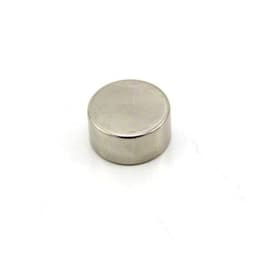
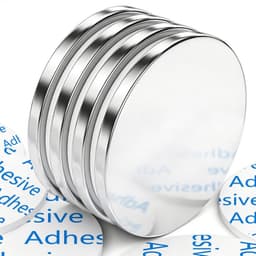
A plain disc has no hole. FIRST4MAGNETS F646-N52-1 is one 20 mm by 10 mm N52 at £9.99, with no adhesive and no screw. The amazon.co.uk listing says up to 14.8 kg vertically from the face, flush on mild steel. The maker's page for the same code says 14.6 kg vertical and 2.92 kg slide. Their fixing line for that disc is a glue such as Araldite or Loctite. You recess it or you stick it. You do not drill it. Drilling shatters sintered neodymium. Separating a stack, and why a drill is the wrong fix, is on the how to use page. Grtard is the other disc people buy when they want a catch: four 30 mm by 3 mm discs at £8.59, an 8 kg claim that does not name the surface, and adhesive pads. Reviews say the discs are very hard to separate, and that the pads held on some metal and failed on picture frames and in a hot car. A pad is not a pot. If the frame falls, the magnet may still be the strong part and the glue the weak part. A 30 mm disc will also reach through a thicker coat of paint than a shallow pot. It will not give you a flush screw, and the age line on the listing is 15+. Choose a bare disc when you are embedding it in wood, a model, or a printed part. If the plate is thin painted steel, a disc's extra reach can beat a pot's contact advantage. If the plate is thick and the faces meet, the pot is the tidier catch.

The six-pack pot in this set

VACUBXBY prints two pull lines, and neither is a grade. The spec field says 25 pounds. The bullet says over 25 lb, and also 20 lb on the metal plate in the pack. A review says 25 lb feels overstated. Twenty-five pounds is about 11.3 kg if you convert the unit, and that conversion is arithmetic, not a test. It is not the 13.2 kg figure on a different product. FIRST4MAGNETS lists a 20 mm by 7 mm N42 countersunk pot, with a 4 mm hole, at 13.2 kg vertical and 2.6 kg slide, flush on mild steel of equal thickness. That pot is 7 mm thick, graded N42, and it is not the £4.99 six-pack. Do not move 13.2 kg onto VACUBXBY. A door catch is mostly a shear load, people leaning on a door, not a straight pull. The vertical kilogram is the flattering number. Reviews of the VACUBXBY pots do name useful jobs: a shed door and a drawer. Those are contact catches with a screw. They are not a certificate that 25 lb survived on a rusty hinge. The comparison score for this pot is 69, because the pull lines disagree and no grade is printed. Score is not pull. Screws are in the pack: six M4. There is no adhesive pad. At £4.99 for six, the pack is cheap next to one specified N52 disc at £9.99. Cheap here means an ungraded cup with two pull sentences. It does not mean the catch is safe overhead.

Fit the screw without cracking it

Mark the hole, drill a pilot in the wood, and drive the M4 by hand until the pot sits flat. Stop when the head is home. A cordless driver set for a joist will crack the countersink or spin the magnet in the cup. If the head stands proud, the magnet no longer meets the plate and you have built in the 1 mm gap that throws the contact advantage away. Countersunk means flush. A pan-head screw from another job is the wrong screw. Face the pot at a steel strike, or face two magnets if you have planned the poles. One pot against a thin stainless door that failed the spoon test will do nothing, because the cup cannot invent steel. For a cupboard, screw the pot to the frame and fix a small steel plate to the door, or the other way round if the door is already steel. A catalogue pull is not a safe working load. Overhead hatches need a competent person. Use the VACUBXBY pot when you can screw it flat against steel and the gap is effectively zero. Use a thicker bare disc, the 20 mm N52 or the 30 mm Grtard, when you must glue, recess, or cross paint and air. Use neither as a photo magnet. A qualifying purchase can earn a commission at no extra cost to you.

Common questions

What is a pot magnet?
A neodymium magnet in a steel cup, with one working face. The cup puts both poles on that face, which raises the clamp when the face meets steel, and it gives you a countersink for a screw. Eclipse Magnetics describes that circuit. The sides are a poor second face. In this batch the pot is VACUBXBY's 20 mm by 6 mm six-pack, not a bare disc with a hole you drill yourself.
When is a plain disc enough?
When you are glueing it into wood or a print, or when the catch has to work through paint or a small gap. A 20 mm by 10 mm disc has no screw and is fixed with epoxy. A 30 mm by 3 mm disc with a pad is still a disc: the pad can fail while the magnet stays strong. If the two faces meet on thick steel and you want a flush screw, the pot is the better fit.
Do I get screws with the pot?
Yes on the VACUBXBY listing. The bullet says six 20 mm by 6 mm pots and six M4 screws. The head is meant to sit in the countersink. There is no adhesive pad in that pack. The FIRST4MAGNETS disc and the Grtard discs do not include screws. Do not add a hole to them with a drill.
Why is the pull lower through wood or paint?
Because the magnet is no longer flush on thick mild steel. A gap of about a millimetre is enough, on a supplier calculation, for a pot to lose the contact advantage of its steel cup. Paint, vinyl, and a door that sits proud are gaps. Catalogue kilograms assume clean, thick, bare steel. They are a ceiling, not the load through a kitchen-cabinet door.
Is 25 lb the same as a 13 kg specified pot?
No. VACUBXBY says 25 lb, over 25 lb, and 20 lb on the included plate, and it prints no grade. A FIRST4MAGNETS 20 mm by 7 mm N42 pot is listed at 13.2 kg vertical and 2.6 kg slide. That is a thicker, graded part, not this six-pack. Converting 25 lb to about 11.3 kg is arithmetic. It is not a lab result, and a review already calls 25 lb overstated.
Which of this batch is the pot?
Only VACUBXBY, six countersunk pots, 20 mm by 6 mm, £4.99, with M4 screws. Everything else in the eleven is a disc, a small block, or an adhesive bar of small discs. The 20 mm N52 from FIRST4MAGNETS is a bare disc with a stated mild-steel pull and no hole. Do not call that disc a pot because the diameter matches.

Related pages

Sources

Public UK sources and the amazon.co.uk listings compared on this page. Listings captured 21 October 2026. Updated 23 October 2026.

  1. OPSS PSA1, small high-powered magnets (retrieved 21 October 2026)
  2. OPSS guidance on the risk of small high-powered magnets (retrieved 21 October 2026)
  3. Toys (Safety) Regulations 2011, Great Britain (retrieved 21 October 2026)
  4. NHS Healthier Together: magnets (retrieved 21 October 2026)
  5. FIRST4MAGNETS F646-N52, pull and temperature note (retrieved 21 October 2026)
  6. Magnet Store pull chart (retrieved 21 October 2026)
  7. Eclipse Magnetics: what is a pot magnet (retrieved 21 October 2026)