Independent comparisons. We may earn from shop links. More info

MLCP or PEX pipe

Updated: 23 October 2026

You are choosing a coil for a floor, and the titles mention a barrier, a plastic, and a temperature near 95°C. MLCP or PEX pipe is not a choice between oxygen protection and none. Both families can stop oxygen. They do not bend, expand, or forgive a kink in the same way. Choose barrier PEX or PE-RT when you want a screeded loop you can warm out of a kink. Choose MLCP when you want the pipe to stay where you bent it, and cut a crease out rather than bury it. The seven multilayer listings are on the [MLCP pipe comparison](/hub/diy-supplies/mlcp-pipe). This page does not rank them. A purchase through our links can earn a commission at no extra cost to you.

You are choosing a coil for a floor, and the titles mention a barrier, a plastic, and a temperature near 95°C. MLCP or PEX pipe is not a choice between oxygen protection and none. Both families can stop oxygen.

Our top picks

On this page

Two barriers, not one pipe

BEAMA's underfloor-heating pipe guide puts an oxygen barrier on PE-X, on polybutylene, and on multilayer PE-X/Al/PE-X. The duty is the same: keep oxygen out of the system water so steel elsewhere does not corrode as fast. On multilayer pipe the barrier is the aluminium. On PE-X it is usually a chemical layer. Ambiente names EVOH as that usual barrier, and says EVOH loses performance when it is wet, which is why a five-layer pipe sandwiches it and a three-layer pipe can leave the coat open to scratches and moisture. A pipe with no barrier at all is the one Ambiente calls not compliant. A pipe with neither aluminium nor a protected EVOH layer is the one to refuse on a sealed heating system. Oxygen protection is the shared job. How the coil lies on the insulation is the split.

When barrier PEX is the screed pipe

BEAMA prints expansion for PE-X near 0.14 mm per metre per kelvin, and it says a kink in PE-X can be reformed with a little heat. The preference for that reformed pipe is a screed, where the pipe is held. The same expansion is why BEAMA is wary of PE-X on a dry or suspended floor. Uponor allows a PEX kink to be warmed with a hot-air gun, never a naked flame, up to a hand-warm maximum they print as 130°C. That is a PEX instruction, not an instruction for the aluminium coils in this set. This comparison does not include an EVOH coil, so there is no amazon.co.uk price to set against the multilayer reels. On barrier PEX, the sheet may let you warm a fold out before the screed goes in. On MLCP, warming a crease can leave cracked aluminium under a pipe that looks round again. Spacing and loop length sit on the underfloor heating page.

When MLCP is the pipe that stays bent

BEAMA prints multilayer expansion near 0.026 mm per metre per kelvin, several times lower than the PE-X figure, and it says a kinked multilayer pipe cannot be reformed. The same guide says multilayer suits screed and dry floors, because it does not spring back to the coil. You bend it and it stays. Floor Heating Warehouse treats PEX-AL-PEX and PERT-AL-PERT as one family for that bend memory. The aluminium is what they are describing. Use MLCP when the layout has to hold its shape, including a dry or suspended floor, and accept that a crease is scrap. Maincor says a buckled section is replaced or jointed. Uponor's squeeze-with-pliers line is Uponor's line for its own MLC. If your sheet does not say it, cut the damage out. The how to install page keeps those two repairs apart. The expansion numbers are BEAMA's printed comparisons, not a test of the Adept or Wärmer coils.

PE-RT or PEX inside the aluminium

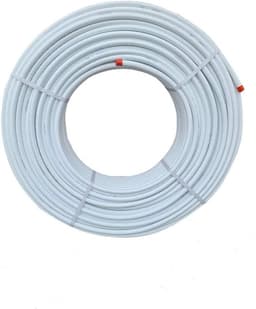
PE-RT is not cross-linked. PEX is. That is a difference in the plastic, and it is not the same difference as aluminium versus EVOH. Six bare coils in this set are sold as PERT-AL-PERT. The red pre-insulated coil says PEX-AL-PEX. Some suppliers call the PE-RT version more flexible. The Adept bullets do not report a flex test. Adept's bare coils print 40–95°C and 10 bar with no application class. Uponor's own sheet, for Uponor pipe, keeps continuous hot water at not above 70°C and continuous high-temperature heating at not above 80°C. PEX in the red coil's title does not make that jacket meet Approved Document L. If you have already decided the pipe is multilayer, the ranking inside these seven is the best MLCP pipe page. Screed plus a kink you hope to warm out points to barrier PEX or PE-RT. A layout that must hold its shape points to MLCP, and a cut-out if the aluminium creases.

Common questions

Is MLCP the same as PEX?
No. PEX is cross-linked polyethylene. MLCP is a multilayer pipe: plastic, adhesive, aluminium, adhesive, and plastic. The plastic layers might be PEX, which gives PEX-AL-PEX, or PE-RT, which gives PERT-AL-PERT. Barrier PEX without aluminium is a different pipe again, usually with an EVOH layer. Sharing the word barrier does not make them the same coil.
When is barrier PEX the better floor pipe?
When the floor is a screed and you want a pipe that BEAMA says can be reformed with a little heat after a kink. The expansion they print is near 0.14 mm per metre per kelvin, which is also why that guide is cautious about PE-X on a dry floor. There is no EVOH pipe in this Amazon set, so this is a materials choice rather than a row in the comparison table. Follow the kink repair on the sheet you bought.
When is aluminium multilayer the better floor pipe?
When you need the pipe to stay bent, including on a dry or suspended floor, or when you want the lower expansion BEAMA prints near 0.026 mm per metre per kelvin. It also goes in screed. The condition is the kink. BEAMA says multilayer cannot be reformed once it is creased. Cut that section out or joint it where a joint is allowed. Do not warm it just because a PEX guide mentioned a hot-air gun.
Is PERT-AL-PERT the same as PEX-AL-PEX?
Both are aluminium multilayer pipes, and Floor Heating Warehouse treats them as one family for bend memory. The plastics differ. PE-RT is not cross-linked. PEX is. Some suppliers call the PE-RT version more flexible. That is their description, not a flex test printed on the Adept listings. Six of the seven coils here say PERT-AL-PERT. The red pre-insulated coil says PEX-AL-PEX.
Can I warm a kink out of either?
You may warm a PEX kink only in the way that PEX sheet allows. Uponor prints a hot-air gun and a hand-warm maximum of 130°C, and never a naked flame. For MLCP, Uponor talks about soft pliers on its own MLC, and Maincor says replace or joint a buckled section. Do not mix those repairs. If the sheet for your multilayer coil does not describe a repair, cut the crease out.
Do both stop oxygen?
They can. BEAMA counts a chemical barrier on PE-X and the aluminium layer on multilayer pipe as oxygen barriers for underfloor heating. Ambiente describes EVOH as the usual chemical barrier and prefers it sandwiched in a five-layer pipe because moisture and scratches hurt a bare coat. Aluminium is the other route. A pipe with no barrier is the one to leave out of a sealed heating system. Neither route is a perfect score you can claim for these ASINs without a test.

Related pages

Sources

Public UK sources listed below, plus the seven amazon.co.uk listings compared on this page. Listings captured 19 October 2026. Updated 23 October 2026.

  1. Water Supply (Water Fittings) Regulations 1999 (retrieved 23 October 2026)
  2. WRAS appropriate standards (retrieved 23 October 2026)
  3. Water Regs UK, BS 6920 note (April 2025) (retrieved 23 October 2026)
  4. Approved Document G (retrieved 23 October 2026)
  5. Approved Document L Volume 1 (2021, 2023 amendments) (retrieved 23 October 2026)
  6. BEAMA underfloor heating pipe guide (retrieved 23 October 2026)
  7. Uponor UK multilayer specification (retrieved 23 October 2026)
  8. ISO 21003-2:2008 (retrieved 23 October 2026)