Independent comparisons. We may earn from shop links. More info

MLCP pipe buying guide

Updated: 23 October 2026

You have a coil in the basket that says multilayer, 16 mm, and a temperature high enough to look like a boiler setting. An MLCP pipe buying guide has to slow that title down. MLCP pipe is multilayer composite pipe: plastic, adhesive, aluminium, adhesive, and plastic, sold here as PERT-AL-PERT or PEX-AL-PEX. The fitting needs the outside diameter and the wall as one size, and you still decide whether anyone will drink the water. This page explains the columns and does not crown a reel. The seven coils stay on the [MLCP pipe comparison](/hub/diy-supplies/mlcp-pipe). Prices are the 19 October 2026 amazon.co.uk capture. A purchase through our links can earn a commission at no extra cost to you.

You have a coil in the basket that says multilayer, 16 mm, and a temperature high enough to look like a boiler setting. An MLCP pipe buying guide has to slow that title down.

Our top picks

On this page

Diameter and wall are one size

A multilayer pipe is sized as outside diameter times wall thickness, not as a copper nominal bore. In this set the printed sizes are 16 × 2 mm, 20 × 2 mm, 25 × 2.5 mm, and 32 × 3 mm. A 16 mm MLCP pipe is not a 15 mm copper tube, and a 15 mm olive will not take it. The insert is machined for that outside diameter and that wall. If either number is wrong, the joint closes on the wrong amount of plastic and aluminium. Maincor's range prints 20 × 2.25 mm. The Adept 20 mm coil in this set prints 20 × 2 mm. You match the fitting to the pipe you bought. A radiator tail that was 16 × 2 mm needs a coil that says the same pair. Loop length sits on the underfloor heating page.

Wholesome water and a WRAS line

In England and Wales, regulation 4 of the Water Supply (Water Fittings) Regulations 1999 requires a water fitting of an appropriate quality and standard, suitable for the circumstances in which it is used. Scotland and Northern Ireland have their own fittings rules. A heating-only loop is specified by diameter, an oxygen barrier, and a temperature class. A kitchen tap is wholesome water. The evidence you can check is a current approval, not a marketing word. WRAS approval is voluntary evidence with a number and an expiry. The appropriate-standards list names BS EN ISO 21003:2008, subject to BS 6920. None of the seven listings prints a number. Several Adept bullets say WRAS approved. The Wärmer 100 m coil does not say WRAS at all. The best MLCP pipe page says who should skip that reel for a tap.

The temperature printed on the coil

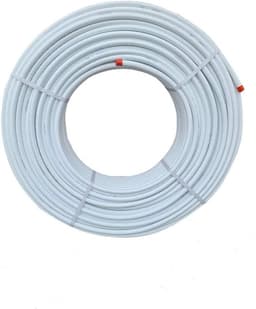
Adept's bare coils print service temperatures of 40°C to 95°C and a maximum working pressure of 10 bar. They do not name an ISO 21003 application class. Uponor's UK multilayer sheet, which is not these ASINs, cites BS EN ISO 21003-1 and keeps continuous domestic hot water at not above 70°C and continuous high-temperature heating at not above 80°C, both at 10 bar. You cannot paste that class table onto an Adept bullet. The British Plastics Federation's guidance, issue 5, notes that pipe made to the BS EN ISO series is not automatically BS 7291 Class S. None of these Amazon files prints 114°C or Class S. The red pre-insulated coil prints no degree figure and no pressure figure.

What this set of coils still hides

The Adept 25 m and 50 m coils of 16 × 2 mm share 4.5 from 7 reviews and the same best-sellers rank. That is one thin sample counted twice. The Wärmer material line says polyethylene while the title says PERT-AL-PERT. Origin is China, and the maker line is PSW TRADE SUPPLIERS LTD. The red coil's title says 20 mm × 50 m and the model field says IALPEX162/50B9. No jacket thickness is stated, so you cannot check it against Approved Document L, Table 4.4. For insulation at 0.025 W/(m·K) or better that table gives 10 mm up to 25 mm nominal internal diameter. Once size and the water are settled, the Wärmer 100 m coil is about £0.75 a metre and the Adept 25 m coil about £1.48. A cheaper coil with no WRAS line can be a heating bargain and a weak pick for a kitchen main.

Common questions

What does 16 × 2 mm mean for the fitting?
It means an outside diameter of 16 mm and a wall of 2 mm, so the bore is what is left after that wall. The fitting insert is made for both numbers. A 15 mm copper olive is the wrong part, and a 20 mm MLCP fitting is the wrong part as well. In this set the Adept and Wärmer 16 mm coils both print 16 mm with a 2 mm wall. Match the fitting to that pair before you look at the coil length.
Is a WRAS bullet enough for a kitchen tap?
Not by itself. Regulation 4 asks for a suitable fitting of an appropriate quality. A WRAS approval you can rely on has a number and an expiry, and the relevant standard family here is BS EN ISO 21003 with BS 6920. None of these seven pages prints a number. A bullet that says WRAS approved is a claim. For a tap, look the approval up, or choose a pipe whose current approval you can see.
Can I use a coil with no WRAS line on heating only?
You can consider it when the circuit is heating, the diameter and wall match the fitting, and an oxygen barrier is what the design asks for. The Wärmer 100 m coil is the listing in this set with no WRAS line. That does not make every heating pipe exempt. If the run connects to the wholesome supply, or you cannot find an approval the water company would accept, treat it as a drinking-water problem and go back to regulation 4.
Why do some 20 mm pipes say 2 mm and others 2.25 mm?
They are different walls, not two ways of writing the same pipe. Maincor's sheet prints 20 × 2.25 mm for that range. The Adept 20 mm coil here prints 20 × 2 mm. A fitting or a jaw cut for 2.25 mm is not automatically right for 2 mm. Read the wall on the coil you are holding, then buy the insert that names that wall.
Is 95°C the temperature I can run all winter?
No. On the Adept bullets, 40–95°C is a printed service range at 10 bar, with no application class beside it. Uponor's own sheet, for a different pipe, keeps continuous hot water at not above 70°C and continuous high-temperature heating at not above 80°C. The BPF notes that BS EN ISO pipe is not automatically BS 7291 Class S, where a short malfunction figure of 114°C is the sort of claim you would have to see in writing. Do not run the coil at the top of the bullet all winter.

Related pages

Sources

Public UK sources listed below, plus the seven amazon.co.uk listings compared on this page. Listings captured 19 October 2026. Updated 23 October 2026.

  1. Water Supply (Water Fittings) Regulations 1999 (retrieved 23 October 2026)
  2. WRAS appropriate standards (retrieved 23 October 2026)
  3. Water Regs UK, BS 6920 note (April 2025) (retrieved 23 October 2026)
  4. Approved Document G (retrieved 23 October 2026)
  5. Approved Document L Volume 1 (2021, 2023 amendments) (retrieved 23 October 2026)
  6. BEAMA underfloor heating pipe guide (retrieved 23 October 2026)
  7. Uponor UK multilayer specification (retrieved 23 October 2026)
  8. ISO 21003-2:2008 (retrieved 23 October 2026)