Independent comparisons. We may earn from shop links. More info

How to top up hydraulic jack oil

Updated: 23 October 2026

The trolley jack reaches the sill and then the handle goes light, or a bottle jack that lifted last year now stops short. You already have the oil the sheet allows. How to top up hydraulic jack oil is the ram fully down, the level your model prints, and air that feels like a bad bottle. These steps follow UK jack sheets and the amazon.co.uk notes captured on 21 October 2026. A qualifying purchase can earn us a commission at no extra cost to you. If you are still choosing the bottle, start with [which jack oil](/hub/diy-supplies/hydraulic-oil/sub/hydraulic-oil-for-trolley-jacks) and the [hydraulic oil comparison](/hub/diy-supplies/hydraulic-oil).

The trolley jack reaches the sill and then the handle goes light, or a bottle jack that lifted last year now stops short. You already have the oil the sheet allows.

Our top picks

On this page

Lower the jack before you look

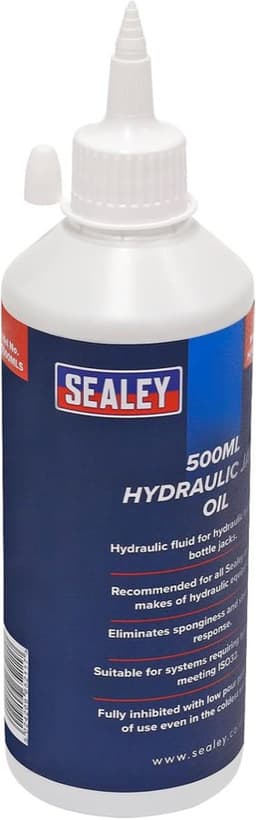
Oil level is only meaningful with the ram down. If you check it while the ram is still out, the reservoir looks empty because the oil is up in the cylinder, and you will overfill it. Open the release until the ram is home. Do not start with a car still on the saddle. Wipe the filler plug before you unscrew it. Carlube and Sealey HJO500MLS often arrive with a plain cap even when a photo suggested a spout. The filler can be a screw hole around 6 mm, so use a clean funnel.

The level is on your sheet, not in one rule

There is no single UK fill line. Professional Motor Mechanic describes the oil at about 5 mm below the filler neck on a Sealey-style service, and then says other jacks differ. Sealey’s 1150CX sheet puts the level at the bottom of the screw hole. A Clarke sheet uses about 5 mm below the plug with its own oil. SGS talks about ISO VG 32 or 46 on its own jacks. Pour to the mark on your model, with the ram down. Overfilling is a leak you created. Underfilling is a lift that stops early. If you are not sure you bought jack oil, the family choice is which family. Do not pause to compare ISO 32 with ISO 46.

Pour, then purge the air

Pour slowly through the clean funnel until you reach the mark on your sheet. Rock the jack gently if the sheet allows it, then fit the plug. Do not run the jack with the filler open and a car nearby. Air is the usual reason a fresh top-up still feels wrong. Open the release and pump the handle with no load. Close the release, raise the saddle unloaded, then lower it and recheck the level with the ram down, because purging can drop it. Top up to the mark if it has fallen. Repeat the open-release pumps before you buy a second bottle.

Stop when it is not an oil problem

Oil on the floor, with the jack creeping under a vehicle, is a seal or a pipe, not an empty reservoir. Fresh jack oil will not rebuild that seal. That is when a repairer, or Sealey’s instruction to use a local agent, replaces another bottle. Do not work under a car held only by the jack. The jack lifts, and axle stands support the vehicle. Brake fluid stays in the braking system. Engine oil, alcohol and glycerine are on the banned list of more than one UK jack sheet, including Faithfull’s. If you have already poured the wrong fluid, do not dilute it with a splash of jack oil. Empty it into a sealed container if you can, and do not put that mixture down a drain.

Common questions

Where should the oil sit?
At the mark in your jack’s own sheet, with the ram fully down. Sealey’s 2100TB note is about 5 mm below the filler and says jack oil, not brake fluid. The 1150CX sheet uses the bottom of the screw hole, and its one-year oil change belongs to that sheet, not to every Clarke or Halfords jack.
Does the ram have to be down?
Yes. Oil sitting in an extended ram makes the reservoir look low, so you add too much and then force it out of the breather on the next lift. Open the release, lower the saddle with no vehicle on it, and only then remove the filler plug. Wipe the plug first so grit does not fall in.
How do I get air out?
Open the release and pump with no load, about 15 times in SGS’s trolley-jack note or about 20 in the Professional Motor Mechanic Sealey-style note, unless your sheet prints its own count. Close the release, raise the saddle unloaded, lower it, and recheck the level with the ram down.
Why is it still spongy after new oil?
New oil often brings air, and a plain cap makes it easy to aerate the fill. If the ram rises and sinks on a dry floor, think air or a tired valve, not oil that was too thin. If the floor is wet and the saddle creeps under load, think seal, and stop topping up.
Can I use brake fluid if I have no jack oil?
No. Sealey’s 2500CX and 1150CX sheets, and Faithfull’s jack instructions, tell you not to top up with brake fluid. Other sheets also ban engine oil. Brake fluid attacks the seals these jacks were built around. Wait until you have jack oil the sheet allows, which in this set is a 500 ml bottle, not a substitute from the braking system.
Where does the old oil go?
Household waste oil goes to a recycling centre in a sealed container. GOV.UK classes hydraulic oil as hazardous waste. Keep it out of a drain and out of the same can as waste brake fluid. Oil forced under the skin is different: the Health and Safety Executive records serious injection injury above 100 bar, and that needs same-day medical help.

Related pages

Sources

Public UK sources and the amazon.co.uk listings compared on this page. Prices and stars are the 21 October 2026 capture. Updated 22 October 2026.

  1. GOV.UK: vehicle and oily wastes (retrieved 22.10.2026)
  2. HSE: hydraulic injection injury (retrieved 22.10.2026)
  3. MA Hydraulics: hydraulic oil cross reference (retrieved 22.10.2026)
  4. Sealey 2100TB instructions (retrieved 22.10.2026)
  5. Comma: MVCHF central hydraulic fluid (retrieved 22.10.2026)
  6. Fuchs UK: TITAN CHF 11S (retrieved 22.10.2026)
  7. Oil Care: waste oil (retrieved 22.10.2026)
  8. Bosch Rexroth: mixing limit (retrieved 22.10.2026)