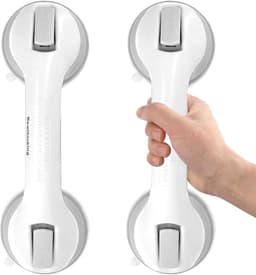
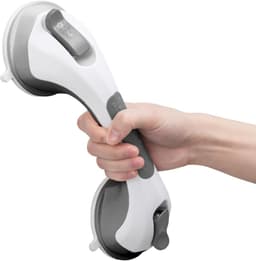
Independent comparisons. We may earn from shop links. More info

Suction or fixed grab rail: balance only, or screws

Updated: 23 October 2026

Choosing a suction or fixed grab rail usually starts because you rent the flat, or you are helping an older person, and you would rather not drill the tiles. A locking cup can feel solid on day one and still let go, and several listings in this set tell you the bar is for balance only. The rows are on the [handrail comparison](/hub/diy-supplies/handrail). The Products Compared editorial team used the amazon.co.uk listings captured on 19 October 2026. A qualifying purchase can earn us a commission at no extra cost to you.

Choosing a suction or fixed grab rail usually starts because you rent the flat, or you are helping an older person, and you would rather not drill the tiles.

Our top picks

On this page

What a cup can and cannot be

Suffolk County Council's adaptations page says secure rails by steps and in the bathroom, and then that it does not advise suction style grab rails. That is council advice. It does not name a tile size. Inside this capture the same limit is printed on the products. LEVERLOC says balance assistance only and tells you not to support body weight. Newthinking says balance assistance only, not body-weight leverage, with a specification maximum of 54.89 kg. TAILI black says up to 150 kg and also says not to put all your body weight on the rail, while the specification says minimum weight 10 kg. Those two figures conflict, so neither is a weight this project verified. Skip suction when a failure would hurt the person, when they need to pull themselves up, or when the wall is paint, plaster, or wallpaper. A high review count is not evidence that the cup equals a screw.

The wall has to match the cup

Each listing draws a different tile. LEVERLOC, 31 cm at £22.99, asks for airtight, smooth, non-porous tile larger than 10 × 10 cm. TAILI black, 38 cm at £39.99, limits itself to smooth airtight tile of at least 12.7 cm, and it names paint, wallpaper, and drywall as surfaces to avoid. Newthinking, about 30 cm as a two-pack at £22.09, wants flat non-porous tile larger than 4 × 4 inches, not across a grout line. A 15 cm grout module, or a textured slate, fails those sentences even when the plastic looks identical. Musbus, £28.71 for two, lists smooth non-porous tile, glass, marble, acrylic, or steel, and does not give a length. A rented wall that is painted plaster is outside every one of these surface lists. If you cannot put the cup fully on one smooth tile, clear of the grout, the listing has already opted you out.

How they fail in this capture

The UK-labelled reviews in the file show three ordinary failures, not a mystery defect. Rails drop off. LEVERLOC's UK texts include a firm hold and a rail that drops off. Newthinking's UK texts include a strong hold on large smooth tiles and a cup that fell after nearly two years. The listing tells you to check and reattach. Cups refuse to come off. One UK review of TAILI black could not release the cups and cut the rubber. A rail you cannot remove without a knife is a poor temporary fix in a rented bathroom, even when the hold felt strong. The surface was wrong. A UK review of TAILI black says ridged tile did not hold. That matches the listing's own limit to smooth non-porous tile. Non-UK reviews are not used here as British opinion.

When to screw instead

If you can drill a sound wall, the screwed short rail in this set is supregear, 50 cm of 304 stainless at £22.99, screws included, 4.6 from 2,673 reviews. That is the top pick for a fixed hold of about half a metre. It still will not run a flight, and the 136 kg line remains a listing claim. Named picks and the review cap are on best handrail. Choose the screw when the person must take weight, when the tile is ridged or cut by grout, or when Suffolk's advice matches the household. Choose a suction cup only as a checked balance aid on the surface that listing allows. If a failure would injure someone, ask the council adaptation service or an occupational therapist.

Common questions

Are suction rails safe for an older person?
Suffolk County Council does not advise suction-style grab rails. Listings here that say balance only, including Newthinking, LEVERLOC, and Musbus, are telling you not to haul body weight. A cup can be a checked balance aid on the exact smooth tile the page allows. It is a poor plan when the person would be hurt if it let go. That case wants a screwed rail and proper advice.
Which surfaces do these listings allow?
LEVERLOC wants smooth non-porous tile larger than 10 × 10 cm. TAILI black wants smooth tile of at least 12.7 cm and excludes paint, wallpaper, and drywall. Newthinking wants flat non-porous tile larger than 4 × 4 inches, not across grout. Musbus names tile, glass, marble, acrylic, or steel and does not state a length. Painted plaster in a rented flat is outside those lines.
Why do rails fall off in the reviews?
UK texts in this file include a LEVERLOC rail that drops off, a Newthinking cup that fell after nearly two years, and a TAILI black rail that did not hold on ridged tile. The listings already restrict the surface and tell you to re-check. Soap, a grout line, or a tile that is too small breaks the seal the bullet assumed. A large review count still contains those failures.
Can I use one to pull my weight out of the bath?
Not on the listings that say balance assistance only. LEVERLOC tells you not to support body weight. Newthinking's specification maximum is 54.89 kg and the bullets refuse body-weight leverage. TAILI black pairs a 150 kg bullet with a 10 kg specification line and a warning against full body weight. Pulling yourself up is the screwed-rail job, into a wall that can take it.
What should I buy instead if I can drill?
supregear's 50 cm 304 stainless rail at £22.99, with screws in the box and 4.6 from 2,673 reviews, is the fixed short rail in this set. It suits a bath or a doorway when the wall is sound. It is not a 3 m stair kit. If the person would be injured by a failure, get adaptation advice before you choose the position.

Related pages

Sources

Public UK sources and the amazon.co.uk listings compared on this page. Listings captured 19 October 2026. Updated 22 October 2026.

  1. Approved Document K (retrieved 22.10.2026)
  2. Scottish Domestic Technical Handbook, January 2025 (retrieved 22.10.2026)
  3. Northern Ireland Technical Booklet H (retrieved 22.10.2026)
  4. BS 6180:2011 extract (retrieved 22.10.2026)
  5. Workplace regulation 12 (retrieved 22.10.2026)
  6. Approved Document M FAQ (retrieved 22.10.2026)
  7. Suffolk County Council (retrieved 22.10.2026)
  8. Stiley handrail instructions (retrieved 22.10.2026)