Independent comparisons. We may earn from shop links. More info

How to fit concealed cabinet hinges

Updated: 23 October 2026

You have an 18 mm cupboard door on the bench, a 35 mm Forstner bit, and one chance at the face veneer. This is how to fit concealed cabinet hinges of the cup type on a frameless UK carcass: check the hinge in your hand, mark the cup, bore only as deep as that hinge, then hang the plate and adjust. It is not a router mortise for a hidden door. Prices and the packs in this set are on the [concealed hinges comparison](/hub/diy-supplies/concealed-hinges). A qualifying purchase can earn us a commission at no extra cost to you.

You have an 18 mm cupboard door on the bench, a 35 mm Forstner bit, and one chance at the face veneer.

Our top picks

On this page

Check the hinge before you drill

A 35 mm diameter is common. Depth is not. DIY Doctor’s fitting guide bores about 11–12 mm and then tests the cup. Eurofit Direct’s own pattern is 12 mm deep, so that jig setting is not a universal stop. The Furniware 4-pack states 11.5 mm cup depth and doors of 14–22 mm. The Furniware 10-pack states 13.5 mm and does not state the cup diameter. Do not average those figures into one correct depth. The stop is the hinge you are about to screw in. Offer the cup to any old hole first. Häfele’s note is that you can deepen a hole slightly, and you cannot put the face back. On an 18 mm door, 13.5 mm of cup leaves a thin skin. If the old hinge already matches, you do not need the bit.

Mark and bore the cup

Mark the hinge positions before you think about the carcass. DIY Doctor puts the cups about 85–100 mm from the top and bottom, then bores 11–12 mm and tests the fit. Furnica treats two hinges as a rule of thumb up to about 900 mm. Those figures are not a template on the Furniware or Kamtop listings, and Kamtop reviews say there is little or no paper pattern. Set the depth stop to the hinge in your hand. Drill slowly and test the cup before the next door. If you see a bulge on the front, that door is scrap for a clean face. Add a hinge as the door gets taller or heavier. Kamtop states 8 kg. Do not copy that load onto a pack that leaves load unstated.

Plates and adjustment

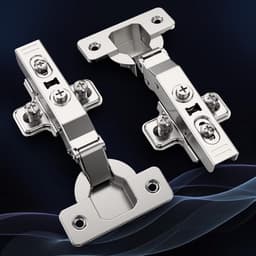
The mounting plate belongs to the same family as the hinge. Clip-on and slide-on do not share a plate because both cups are round. Fix the plate square on the side panel, in line with the cup. On a 3-way hinge such as the Furniware 4-pack, one screw moves the door up and down, one moves it in and out, and one sets the side gap. The 10-pack adds closing speed. Turn one screw a quarter turn and shut the door before you turn the next. On the Furniware 4-pack, one screw pattern did not match the previous holes. On Kamtop, one plate did not match the photograph. If the old holes are close but not identical, do not oval them until the panel is lace. A door that sits proud may need the depth screw, not a deeper cup.

When to stop

Stop if the face has broken through. You can ease a hole deeper, and you cannot replace the veneer. An 18 mm door with a 13.5 mm cup is already a small margin. Stop if the chipboard around the screws is stripped. Forcing a full-overlay hinge onto a half-overlay partition will not be solved by adjustment. Call a joiner when the door is veneered timber you cannot replace, or when several doors must share one gap line. A whole kitchen of mixed old holes is not. A surface hinge that claims no drilling is not a rescue for a ruined cup.

Common questions

What bit do I need for a standard concealed cabinet hinge?
A 35 mm Forstner bit or a hinge cutter, plus a depth stop. That diameter is the usual UK cupboard cup. It is not the depth. Set the stop to the figure on your hinge, such as 11.5 mm on the Furniware 4-pack or 13.5 mm on the 10-pack, and test the cup before the next door.
How deep can I bore an 18 mm door?
Only as deep as the cup you are fitting, and short of the face. DIY Doctor cites about 11–12 mm and then a test fit. A 13.5 mm cup on 18 mm chipboard leaves little timber. Häfele’s advice is that you may deepen slightly and you cannot restore the face. If the old hole is shallower than the new cup, decide before you drill.
How far from the door edge does the cup centre sit?
Guides disagree by a millimetre or two. DIY Doctor uses about 22 mm from the edge to the centre. Furnica describes a rim gap of typically 3–6 mm, so a centre about 20.5–23.5 mm in. Eurofit’s own hinges use 21.5 mm. Use the pattern in your pack if it has one. Kamtop reviews say a first-time fitter may not get a paper pattern.
How do I adjust a door that sits proud or low?
Use one screw at a time and shut the door between turns. In and out fixes a door that stands proud. Up and down fixes a handle that has dropped. Sideways fixes the gap to the next door. The Furniware 4-pack states 3-way adjustment. The 10-pack adds closing speed. Do not deepen the cup to cure a gap a screw can move.
What if the old holes do not match the new hinge?
Do not stretch the holes until the panel crumbles. In this set, a Furniware screw pattern failed to match, a Kamtop plate did not match its photograph, and a TASMIA set did not fit the Ikea unit one buyer expected. Keep the old plate if the new hinge is the same family, or fit a new plate in sound board. If the overlay is wrong, change family before you drill again.

Related pages

Sources

Public UK sources and the amazon.co.uk listings compared on this page. Prices captured 19 October 2026. Updated 22.10.2026.

  1. GOV.UK: General Product Safety Regulations 2005 (retrieved October 2026)
  2. Consumer Rights Act 2015, goods (retrieved October 2026)
  3. NBS: BS EN 15570:2008 (retrieved October 2026)
  4. GOV.UK: Fire door guidance (retrieved October 2026)
  5. Code of Practice: hardware for fire and escape doors (retrieved October 2026)
  6. Häfele UK: cabinet hinge FAQs (retrieved October 2026)
  7. DIY Doctor: fit a concealed hinge (retrieved October 2026)
  8. Blum UK: CLIP top BLUMOTION (retrieved October 2026)