Independent comparisons. We may earn from shop links. More info

Air admittance valve vs soil vent pipe

Updated: 23 October 2026

You want the soil pipe to stop under the tiles, because the flashing leaks. An air admittance valve vs a soil vent pipe is a ventilation choice. The valve can finish this stack indoors when the drain can still relieve positive pressure, normally an open vent on the run. If you take that vent off, the valve cannot do the outward job. Price does not settle it. The models are in the [air admittance valve comparison](/hub/diy-supplies/air-admittance-valve). We used Approved Document H and amazon.co.uk listings from 19 October 2026. A qualifying purchase can earn us a commission at no extra cost to you.

You want the soil pipe to stop under the tiles, because the flashing leaks. An air admittance valve vs a soil vent pipe is a ventilation choice.

Our top picks

On this page

What each one actually vents

Both keep water in the traps by different routes. When a WC flushes, pressure drops, and a trap loses its seal unless air can enter. An air admittance valve opens for that inward air and closes so sewer gas stays in the pipe. An open soil vent pipe does the inward job and also lets air out when drain pressure rises. A valve stays shut against that outward push, so it does not relieve a surcharge. An open stack does. Approved Document H allows a stack to finish indoors on a BS EN 12380 valve, and clause 1.33 says that must not remove the ventilation the underground drain still needs. If this roof pipe is the only route for positive pressure, the pipe stays.

When the open roof pipe stays

Approved Document H, clause 1.31, says an open vent should finish at least 900 mm above any opening into the building within 3 m of the pipe. That figure keeps foul air off a window, a door, or an intake. It is a rule for the open termination, not for an indoor valve. FloPlast’s 200 mm height on a 110 mm stack is on the soil-stack page. Leave the roof pipe if removing it would leave a septic tank or cesspool with no open vent, or if several homes share the drain and this is the vent at the head. Leave the pipe if you cannot get back to the valve. A lost cap is a lost rodding point. If the pipe is the system’s open vent, repair the flashing rather than swap it for a valve.

When an indoor valve is the right finish

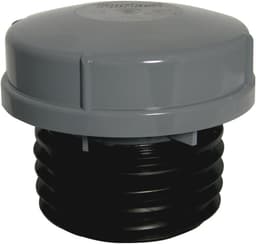
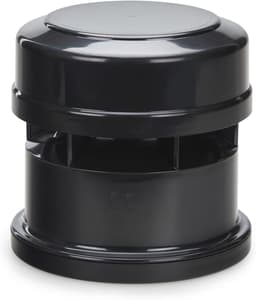
An indoor valve is the right finish on a single stack you can reach, where another open vent remains, and where the valve sits upright with air around it. Approved Document H allows that on a BS EN 12380 valve. You avoid a new hole in the roof, and you accept a part that dust can stick. The valve has to state the standard if you rely on clause 1.33. In this set that sentence is on the FloPlast AF110G, not on every listing that says 110 mm. Buying rules are on the buying guide. Price does not show whether an open vent remains. The LavaTap 110 mm page, ASIN B0F9G55VW1, at £23.49, says internal or external use and does not state BS EN 12380. England and Wales guidance keeps ordinary valves of this type indoors.

Outside, Scotland, and septic tanks

Approved Document H says these valves should not be used outside or in a dust-laden atmosphere in England and Wales. The 900 mm clearance is for an open pipe, not for a valve on an external wall. The BPF note says external use sits outside statutory guidance except in Scotland, where a notified body can certify an external valve. Northern Ireland’s booklet points to valves inside buildings. FloPlast’s screened external valve, the AX110, is a different product from the indoor AF110G. A related listing showed it from about £43.95. It is not in this set. A septic tank keeps its open vent. Finish this stack on an indoor BS EN 12380 valve when positive pressure still has an open route. Keep the soil vent pipe when that pipe is the route.

Common questions

Can an air admittance valve replace the soil pipe through the roof?
It can finish that stack indoors if the drainage system still has an open vent somewhere on the run. Approved Document H allows an indoor termination on a BS EN 12380 valve and says the valve must not remove underground ventilation. If the roof pipe is the only open vent, including the only vent to a septic tank or cesspool, the pipe stays. A cheaper cap does not change that test.
What is the 900 mm rule for?
Approved Document H, clause 1.31, says an open soil vent should end at least 900 mm above any opening into the building within 3 m of the pipe. The point is to keep foul air away from a window, a door, or an intake. The rule belongs to the open pipe. It is a separate measurement from the indoor valve height above the highest waste connection, and it is not a reason to hang a valve on an outside wall.
Why does an open vent still matter if the valve lets air in?
The valve lets air in when a flush pulls a vacuum, then closes. It does not let a pressure surge out. An open soil vent pipe does both, which is how the underground drain breathes when the system is under positive pressure. A stack may end on a valve, and the drain can still need an open vent further along the run.
Can I fit the valve outside, next to a window?
In England and Wales, keep it indoors. Approved Document H says not to use these valves outside. The 900 mm clearance is for an open pipe, not for an indoor valve mounted on an external wall. The BPF note describes an external route in Scotland where a notified body certifies the valve. A listing that says internal or external does not override the England and Wales guidance.
What about a septic tank or a shared drain?
Keep an open vent on a septic tank or a cesspool. An air admittance valve must not be the only vent to either. Where several houses share a drain, an open vent at the head of the run can still be required. A Scottish LABSS note states that for groups of dwellings. One householder capping the only pipe they can see from their loft is how that vent disappears.

Related pages

Sources

Public UK sources and the amazon.co.uk listings compared on this page. Listings captured 19 October 2026. Updated 22.10.2026.

  1. Approved Document H (2015), clauses 1.31–1.33 (retrieved 22.10.2026)
  2. BPF Pipes Group, Air admittance valves for domestic properties, January 2024 (retrieved 22.10.2026)
  3. BSI, BS EN 12380:2002 (retrieved 22.10.2026)
  4. FloPlast soil and waste FAQ (retrieved 22.10.2026)
  5. FloPlast Kitemark schedule KM 512474 (retrieved 22.10.2026)
  6. Sefton Council, smelly drains note (retrieved 22.10.2026)
  7. P&H Engineering, Air admittance valves: getting it right (retrieved 22.10.2026)