Independent comparisons. We may earn from shop links. More info

Acoustic foam vs felt panels

Updated: 23 October 2026

A black wedge pack and a grey polyester board are both labelled as if they soundproof a room. Acoustic foam vs felt panels is a narrow choice. Both are porous absorbers. They take energy out of a reflection inside the room. Neither is a barrier, a bass trap or a party-wall fix. Foam buys area and a quick trial. Felt buys a flatter finish and, on one listing only, a named fire class, at about 10 mm. Prices are on the [acoustic panel comparison](/hub/diy-supplies/acoustic-panel). Slat walls are a third product, on [best acoustic panels](/hub/diy-supplies/acoustic-panel/sub/acoustic-panel-best). Notes are from 19 October 2026, and we did not measure coefficients. A qualifying purchase can earn a commission at no extra cost to you.

A black wedge pack and a grey polyester board are both labelled as if they soundproof a room. Acoustic foam vs felt panels is a narrow choice. Both are porous absorbers.

Our top picks

On this page

They are both porous, and that is not enough

An open material lets some sound in and turns part of it into heat. That is absorption. Blocking is mass and a complete construction, which is what Approved Document E describes. Listings in both camps still say soundproof. The word does not change the mechanism. A bright vocal or a desk slap might ease with either material. Bass, or next door, will disappoint you in the same way with both. A stated inch of foam and a stated inch of felt are not automatically equal. GB Acoustics shows NRC on its own PetFelt rising with a cavity. That is not an AudioSilk test. In this set only AudioSilk writes EN 13501-1 Class B-s1,d0. Every other pack says flame-retardant or nothing. We have not seen the certificate.

What this set's foam actually is

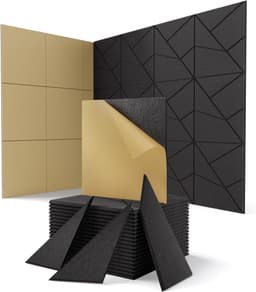
Sonic is £11.02 for 0.72 m² of 25 mm self-adhesive tiles, with no absorption number. Reviews mention a quieter utility door, and also glue that fails. AUSLET is £27.99 for wedges stated as 1 inch. Reviews put them nearer 15–20 mm and say the vacuum pack can need a night. There is no Euroclass. Focusound is the coverage pack: £61.99, stated 2 inch wedges at 25 kg/m³, about 4.65 m², 300 loose pads, 3.9 from 513. There is no NRC, and the fire line is only flame-retardant. Reviews split on pads and foam that stays flat. Measure after 48 hours before you decide the foam won.
AudioSilk AudioSilk 4-pack room kit

Testsieger

AudioSilk AudioSilk 4-pack room kit
8.4/10about £120.00

What this set's felt actually is

AudioSilk is four PET panels, 1160 × 580 × 10 mm, about 2.69 m², £120, a stated NRC up to 0.91, and Class B-s1,d0. Strips are extra. The line is 4.4 from 440. Reviews say highs and calls calm down, and that the board is too thin for bass. Topnaca is the cheap patterned felt: £27.99, 18 tiles at a stated 0.4 inch, about 1.67 m², 4.2 from 126, mostly United Kingdom reviews. Echo and door slap ease. Neighbours do not. Paint soaks in. Fluxynara is six 60 cm squares, about 9 mm, £139.99, a claimed NRC of 0.95, and 4.3 from 1,243 with no United Kingdom review in the file. The text describes a pinboard, and no fire class is stated. Do not promote every PET tile to Class B. Only AudioSilk states B-s1,d0.

Choose with a condition

Choose Focusound's stated 2 inch foam when you want area for echo, you will check that the tiles recover, and you accept weak pads and no Euroclass. Choose AudioSilk when the board must look finished, you can live with 10 mm, and you will buy strips or screws. Choose Topnaca for a cheap geometric tile and door slap, not for isolation. Choose Sonic when £11.02 is a trial of whether peel-and-stick stays on your paint. Choose neither for bass or the neighbour. An MCW slat is a timber face, not the winner of foam versus felt. If you want the strongest paperwork in this set, buy AudioSilk and treat bass separately. If you want the most stated thickness per pound, buy Focusound and budget time for the foam to open.

Common questions

Is 2 inch foam better than 10 mm PET?
It is the better depth on paper, when the 2 inches are real. Focusound states that depth and about 4.65 m² for £61.99, with no NRC, no Euroclass, and reviews that dispute pads and shape. AudioSilk states 10 mm, an NRC up to 0.91, and Class B-s1,d0, at £120, with reviews that praise highs and refuse bass. Buy foam for depth. Buy the PET for the finish and the named class. Recheck with a ruler after a night out of the bag.
Which is safer near a heater or in a workplace?
Keep both off heaters and alarms. For a workplace that asks for a Euroclass, AudioSilk is the only listing that names B-s1,d0, and you should still ask for the certificate. Flame-retardant on Focusound is not that class. A bedroom trial can use foam if you accept the missing class and the glue risk. The class on the listing is the seller's sentence until the report is in your hand.
Will either stop bass?
No. Ten millimetre PET, and even a genuine 2 inch wedge, are small beside a corner trap. AudioSilk reviews separate highs from bass. Foam bought for neighbour noise fails the same way. Expect these thicknesses to work above the low mids, not on the boom. Adding more of the same thin sheet does not invent the missing depth.
Which is kinder to a rented wall?
A few peel-and-stick tiles, tested overnight, are easier to reverse than spray or an 11 kg slat. That points at Sonic, AUSLET or Topnaca, with the glue warnings. AudioSilk needs strips you buy, and tape may not hold the large boards. The fixing decides, not the word felt. Written permission still matters, because deposit disputes cite strips as well as screws.
Why do listings say soundproof for both?
The word sells, and sellers mix absorption with insulation. The MCW walnut page is the rare sentence that refuses it. If the title says soundproof and the reviews say the neighbour is unchanged, believe the reviews. Read the thickness before you read the adjective. A slat from the floor toward the ceiling is a third product, not the winner of foam versus felt.

Related pages

Sources

Public UK sources and the amazon.co.uk listings compared on this page. Listings captured 19 October 2026. Updated 22.10.2026.

  1. Approved Document E (retrieved 22.10.2026)
  2. HSE: how to reduce noise (retrieved 22.10.2026)
  3. University of Salford: sound absorption (retrieved 22.10.2026)
  4. Ecophon UK: absorption classes (retrieved 22.10.2026)
  5. Furniture and Furnishings (Fire) (Safety) Regulations 1988 (retrieved 22.10.2026)
  6. Consumer Rights Act 2015 (retrieved 22.10.2026)
  7. Resonics: foam versus PET (retrieved 22.10.2026)
  8. Resonics: panels for homes (retrieved 22.10.2026)