Independent comparisons. We may earn from shop links. More info

How to use a square mouth shovel for sand and spoil

Updated: October 2026

You have a bulk bag of gravel beside the path, and the square mouth shovel is already in the shed. How to use a square mouth shovel comes down to sliding under what is loose, placing it close, and stopping when the ground or a buried service is no longer a Saturday job. A taper mouth cuts ground you have not broken. This note is from the Products Compared editorial team, using the amazon.co.uk listings in the [square mouth shovel comparison](/hub/digging-tools/square-mouth-shovel) and Health and Safety Executive guidance, with no lab test. Updated 15 October 2026. A qualifying purchase can earn us a commission at no extra cost to you. Length and shaft are in the [square mouth shovel buying guide](/hub/digging-tools/square-mouth-shovel/sub/square-mouth-shovel-buying-guide).

You have a bulk bag of gravel beside the path, and the square mouth shovel is already in the shed.

Our top picks

On this page

Scoop, level, and refill

A square mouth shovel is for material that is already loose. Wonkee Donkee's blade-shape guide lists scooping sand, gravel, and soil, levelling a heap, turning a small concrete mix, and refilling a trench. The blade skids when the ground still needs cutting. Start at the loose face. Slide the mouth under the spoil, lift a blade you can set down, and place it. A full blade of wet gravel is a different load from a skim of dry sand. When you level, knock the crest of the heap into the hollows. On unbroken clay the edge skids. The cutting edge is sorted on the square mouth shovel or taper mouth page.

The load, not a magic kilogram

No regulation sets a single safe kilogram for one blade load. The Manual Handling Operations Regulations 1992 require employers to avoid hazardous handling where that is reasonable, to assess what remains, and to reduce the risk. Keep each scoop close, and move your feet with the blade so you place the spoil. Wet sand is heavier than the same volume of dry gravel. If you are paid to move this spoil, the assessment belongs to the employer. A longer shaft does not take the place of a wheelbarrow.

A longer shaft is not a machine

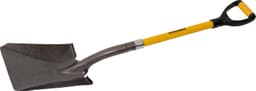
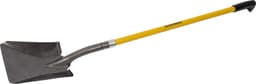
Extra length lets you stand straighter. You still lift the shovel, then the spoil. The long Roughneck in this set, ROU68144, is listed at 1,460 mm and 2.67 kg on amazon.co.uk before the blade is loaded. Tall reviewers on that page praise the straighter back. Short reviewers say the length is wrong for them. Foot treads are advertised only on the two Roughnecks, ROU68144 and the 1,070 mm ROU68146. A boot slips on the plain shoulder of any of the other seven. That length still cannot show you where a cable runs.

Ease the blade, and stop

Before the blade enters ground you have not opened, get the plans and locate the services. LSBUD is a free householder search, though not every asset owner is a member, so a clear result is not proof the bed is empty. HSG47 then tells you to dig beside a service and ease the blade in, and not to throw the shovel at the ground. Near a cable, use an insulated tool. None of these nine is sold as one. Ease means pressure you can stop. On a Roughneck with a foot tread, rest a boot on the shoulder and slide the blade in beside the service. BS 8020:2011 is not a mark on these listings and is not BS EN 60900. None of the nine states a pass against BS 3388:2004, and paint on the head does not insulate the steel. Stop and hand the job to a competent person, or to someone allowed to run a machine, in four cases. Stop for a dig in the road, for sides that can collapse, for a service you are not trained to expose, and for spoil that is an employer's handling assessment rather than your Saturday.

Common questions

What is a square shovel actually for once I own it?
Once you own it, scoop sand, gravel, and loose soil, knock a heap level, turn a small concrete mix, and put spoil back in a trench. On unbroken clay a taper mouth cuts, and this straight mouth skids.
How do I shift gravel without treating the shovel as a cutting tool?
Slide the straight mouth under gravel that is already loose, and lift only a blade you can place. The square edge spreads force across the whole mouth, so a chop at a packed crust mostly skids. Loosen a crust with a cutting edge, then scoop.
Is there a safe weight for one blade load?
No single safe kilogram is set for one blade of spoil. The Manual Handling Operations Regulations 1992 tell employers to avoid hazardous handling where they reasonably can, to assess what remains, and to reduce the risk. They do not print a shovel weight you may treat as allowed.
Does a longer handle replace a barrow?
A longer handle changes how straight you stand, and you still lift the shovel and the spoil. The long Roughneck in this set, ROU68144, is listed at 1,460 mm and 2.67 kg on amazon.co.uk before the blade is loaded. If 2.67 kg empty is already awkward, extra length leaves the loaded blade heavy.
Can I use one of these nine next to a live cable?
Near a cable, use an insulated tool. None of these nine is sold as insulated, so this square mouth shovel is the wrong tool beside a live cable. BS 8020:2011 is not a mark on the listings and is not BS EN 60900. BS 3388:2004 covers forks, shovels, and spades, and none of the nine states a pass. Paint on the head does not insulate the steel.
When do I stop and get a person or a machine?
Stop if the dig is in the road, if the trench can collapse, if a locator or the soil shows a service you are not trained to expose, or if the spoil is an employer's handling assessment rather than your own Saturday. Those are the four points where ordinary steel should leave your hands.

Related pages

Sources

Sources from the research digest. amazon.co.uk listings in this comparison were captured on 15 October 2026. We did not run a laboratory test.

  1. Wonkee Donkee Tools, blade shapes (retrieved 15 October 2026)
  2. Pavingexpert, hand tools (retrieved 15 October 2026)
  3. Spear & Jackson, square mouth micro shovel (retrieved 15 October 2026)
  4. HSE, construction manual handling (retrieved 15 October 2026)
  5. HSE, HSG47 Avoiding danger from underground services (retrieved 15 October 2026)
  6. LSBUD (retrieved 15 October 2026)
  7. GOV.UK, General Product Safety Regulations 2005 (retrieved 15 October 2026)
  8. Consumer Rights Act 2015 (retrieved 15 October 2026)