Independent comparisons. We may earn from shop links. More info

How to use a shovel

Updated: October 2026

You have a shovel in your hands and a pile, a trench or a border in front of you. This is how to use a shovel so the load stays close, your feet do the turn, and the blade does not become a pry bar or a spike over a buried cable. If you are still choosing a square, a taper or a micro, start with the [shovel buying guide](/hub/digging-tools/shovel/sub/shovel-buying-guide) and the main [shovel comparison](/hub/digging-tools/shovel). Peter F. set this out in October 2026. There was no lab test. A qualifying purchase can earn a commission at no extra cost to you.

You have a shovel in your hands and a pile, a trench or a border in front of you.

Our top picks

On this page

Set your feet before you lift

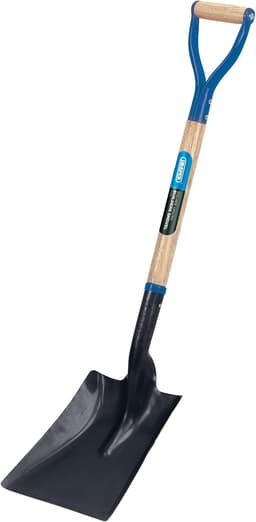
Put one hand down the shaft, near the blade, and the other at the grip. On a Y-dee or a D-grip that upper hand sits in the handle. On the long straight Roughneck, both hands are on the pole. Stand close enough that the blade is in front of your feet. If the shovel has foot treads, press with your boot. The industrial Roughneck square, the long serrated Roughneck and the Roughneck micro list those treads. The Draper hardwood shovel and the JCB do not state them. Slide the blade in. Do not jump onto the shaft. The RHS, reporting Coventry University work, found a poor digging posture raised lumbar load by about half as much again and more than doubled shoulder load, versus a large knee bend and little forward bend. Bend your knees and lift with the legs. If the bite is too heavy, take a smaller one.

Turn, do not twist

When the blade is loaded, turn your feet towards the barrow, the sheet or the heap. Then tip. Wonkee Donkee's notes follow that order: both hands, a low lift, the foot on the tread, the legs doing the lift, and the feet doing the turn. Twisting at the waist with the blade out in front of you is how a short session becomes a sore back. For gravel, set the barrow close and tip sideways off the square mouth. A taper with little lip sheds stones earlier, so take a smaller bite. A long shaft lets some taller people stoop less. It does not cancel a twist. Stop when pain changes the way you lift.

Roots, slabs and a buried cable

A shovel is not a pry bar. Levering a root or a slab loads the socket and the rivets, which is how hardwood shafts snap, and how a forged head can still break, as one JCB review records. A serrated edge on the long Roughneck cuts ordinary roots. Wrist-thick roots in those reviews still needed a saw. If a cable or a pipe might be there, check the plans before you guess a depth. HSG47 says the final exposure is by horizontal digging, with insulated tools near electric cables. Ease a curved edge in with the foot. Do not spike it. None of the nine shovels is described as insulated. Clay and a neat edge belong on the shovel vs spade page.

When the job is no longer a shovel job

Stop and hire someone when the hole is deeper than you can work without standing in an unsupported excavation, when the plans show services you cannot trace, or when you cannot lift a modest bite without twisting. Existing back pain is the same kind of stop. Also stop if the head is loose, the shaft is cracked, or a locking washer is bent. The Consumer Rights Act 2015 covers a tool that was not of satisfactory quality in ordinary use. It is not a reason to keep levering a cracked shaft. Loose gravel wants the square mouth on the square mouth shovel page.

Common questions

Do I stand on the blade?
Yes, if there is a tread and you can press with your boot rather than jump. The Roughneck industrial square, the long serrated Roughneck and the Roughneck micro list foot treads for that. Ease the blade in. HSG47 makes the same point near services: ease a curved edge in with the foot, and do not spike it. If your shovel has no tread, do not invent a foothold on a sharp shoulder.
Can I lever a root or a slab?
No. Use the blade to cut or to scoop, not as a crowbar. Levering is how riveted hardwood shafts snap in the Draper reviews, and a serrated edge still left wrist-thick roots for a saw in the long Roughneck reviews. If the root will not cut, fetch a saw or a mattock. If a slab will not lift, it is no longer a shovel job.
What if I have a bad back?
Use a large knee bend, keep the load close, and turn your feet instead of your waist. The RHS, citing Coventry University, linked a poor posture to about half as much lumbar load again and more than double the shoulder load. A longer shaft, such as the 1,460 mm Roughneck, lets some people stoop less. It does not make a heavy bite safe. Stop if pain changes how you stand.
How do I dig near a cable?
Assume you need the plans first. HSG47 says to expose a service by digging horizontally, to use insulated tools near electric cables, and to ease a spade or shovel with a curved edge in with the foot. Do not throw or spike the blade. None of the shovels compared here is described as insulated. If you cannot tell where the cable is, do not dig.
When do I stop and hire someone?
Hire help when services are unmarked or unclear, when the excavation is too deep to work safely by hand, or when your back already limits a small lift. Also stop if the shaft is loose, cracked or bent. A 2 kg shovel can still carry an awkward blade of wet soil. The HSE figure of about 25 kg is a low-risk filter for a close, easy grip, not permission to fill the blade.

Related pages

Sources

Public UK sources from the research digest. Listing prices, stars and review counts are the amazon.co.uk lines used for this comparison, retrieved 19 October 2026.

  1. HSE — HSG47 Avoiding danger from underground services (retrieved 19 October 2026)
  2. HSE — Agriculture manual handling (retrieved 19 October 2026)
  3. BSI — BS 3388:2004 Forks, shovels and spades (retrieved 19 October 2026)
  4. Wonkee Donkee — Shovel blade shapes (retrieved 19 October 2026)
  5. Ideal Home — Spade vs shovel (retrieved 19 October 2026)
  6. Pavingexpert — Tools for paving (retrieved 19 October 2026)
  7. RHS — Digging techniques (retrieved 19 October 2026)
  8. Spear & Jackson — Tubular contractors’ range data sheet (retrieved 19 October 2026)