Independent comparisons. We may earn from shop links. More info

Manual tile cutter vs wet saw

Updated: October 2026

You can buy a quiet rail cutter for the straight cuts and still be staring at a socket opening the bed cannot start. Manual tile cutter vs wet saw is a class choice, not an upgrade. Use the rail cutter for straight cuts it can snap. Use or hire a wet saw for notches, mitres and tile that will not snap. Do not treat a dry diamond disc in a small room as the easy third option. The [tile cutter comparison](/hub/cutting-tools/tile-cutter) lists the models. Porcelain limits sit on [cutting porcelain with a manual tile cutter](/hub/cutting-tools/tile-cutter/sub/tile-cutter-porcelain). The score-once sequence stays on [how to use a manual tile cutter](/hub/cutting-tools/tile-cutter/sub/tile-cutter-how-to-use). Prices and stars are the captured amazon.co.uk figures as of October 2026. Products Compared has not cut a tile in a lab. A purchase through our links can earn a commission at no extra cost to you.

You can buy a quiet rail cutter for the straight cuts and still be staring at a socket opening the bed cannot start. Manual tile cutter vs wet saw is a class choice, not an upgrade.

Our top picks

On this page

Straight cuts stay on the rail cutter

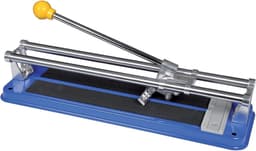
A manual rail cutter scores the glaze and snaps the tile. It is quiet, it does not throw a dust cloud, and on a 200 mm metro tile it is faster than filling a water tray. B&Q still sends many straight wall cuts there. Screwfix puts the usual thickness band for those tools at about 10–16 mm depending on the model; that range is their guide, not a test of these ASINs. In this folder the short beds are 330–432 mm and the long beds run 600 mm and 1200 mm. Those machines exist for the straight line. What they cannot do matters more than the star row. A rail cutter cannot start in the middle of a tile. It cannot cut a curve, an L around a shower valve, or a bevel. Homebuilding prefers a saw for small strips and delicate tiles because the edge is ground rather than fractured. If your bathroom is mostly full tiles and a few straight cuts at the end of the run, the rail cutter is the tool you should finish with. If the same room is a grid of sockets and a tray cut-out, you are already in saw territory before you compare prices. The Vitrex 330 mm listing’s technical table says AC. The product is still a hand-powered score-and-snap. Do not describe that cutter as electric. Every other manual listing in this set says hand powered. The only electric machine here is the Vitrex Torque Master. Buying a saw because it has 3,106 reviews, when the job is a straight ceramic splashback, is the false upgrade this page is for.

What the wet saw in this set actually lists

The Vitrex Torque Master at £59.95 is a 240 V, 450 W compact saw with a 110 × 22 mm continuous-rim diamond blade at 4600 rpm and a flip table for 22.5° and 45° mitres. It sat at 1 in Power Tile Cutters with 4.4 from 3,106 amazon.co.uk reviews. The listing describes water recirculation and a splash guard. A maximum tile length is not in the table. Depth of cut is not in the table either. A compact-saw manual for that model family states 230 V 50 Hz, 25 mm depth with a new blade and 17 mm at 45°. Those manual figures are manufacturer documentation. They are not extra amazon fields, and the 25 mm depth must not be printed as if it were on the product card. UK reviews of this saw describe metro tiles cut successfully, a black-on-black scale that is hard to read until slurry fills it, spray even with the guard down, noise at ear level, a blade that rusts if it is left wet, and plastic parts that break. One review title claims large-format tiles. A 110 mm blade on a compact table cannot swallow a 1200 mm tile in one rip the way a 1200 mm rail cutter can. Treat that review as a user report, not as a capacity. The smoother edge you get from abrasion is real. It is not a size claim. If you need a 1200 mm straight score, the long ROJOO rail cutters are the tools that print that length. If you need a notch in a 300 mm wall tile, the compact saw is the tool that can start the cut. Those are different purchases. A 4.4 from 3,106 does not merge them.

Water, ears, and the RCD

A wet saw is electricity next to water. The Vitrex compact manual recommends an RCD, an indoor bench, and a continuous-rim blade only. UK mains are nominally 230 V; the listing still says 240 V. This set does not print a plug type, so do not assume a BS 1363 plug from the card. Fit or check an RCD in the circuit before you fill the tray. Unplug the saw before a blade change. Do not treat every outdoor socket as already protected. The mess is slurry, not a light mist. Reviewers still report spray with the guard down. Keep a bucket that is not the bath waste. Slurry sets. Settle the solids and bin them; do not pour the tray down the drain. The blade rusts if you store it wet, which is a storage habit, not a defect you discover on day one. Ear-level noise is the other cost. A rail cutter does not ask for that. Dust is the reason the rail cutter stays the default for a straight cut. A score-and-snap does not create the cloud of a dry diamond disc. HSE’s workplace exposure limit for respirable crystalline silica is 0.1 mg/m³ as an 8-hour average. That limit binds employers, and COSHH still requires exposure to a carcinogen from a work process to be kept as low as reasonably practicable. HSE’s roof-tile page — water suppression plus RPE with an assigned protection factor of 20, such as FFP3 — is the control when a disc saw cuts silica-bearing tile. It is the wrong analogy for scoring glaze. It is the right reason not to use an angle grinder in a bathroom. PUWER 1998 applies to employers’ equipment, not to a private DIY kitchen.

Buy or hire

A one-off saw job does not have to be a £59.95 purchase plus a rusty blade in the shed. Tedbar’s published tile-saw hire lines are £32 and £30 for a day or a weekend on the two machines they show. Those hired tools are not the Vitrex ASIN. They are the comparison that matters if you have a weekend of notches and no wish to store a wet saw. A 17 kg 1200 mm rail cutter is the other hire-or-borrow case: useful for a handful of planks, awkward in a flat. Buy the Vitrex saw if you already know you will keep cutting notches and mitres, you have a bench and an RCD, and you will empty the tray into a bucket. Buy a rail cutter if the work is straight and the tile snaps. Hire if the job is short and messy, or if the alternative is a dry disc. Expert Reviews preferred the electric cutter it tried for finish. Finish is not a reason to fill a kitchen with slurry for six metro cuts a rail cutter would have finished before the tray was full. Keep the rail cutter for every straight cut it can snap. Add or hire the wet saw when the cut turns a corner, starts in the middle, or refuses to part. Do not dry-cut the leftovers. Then go back to the comparison for the listings that match that class.

Common questions

When is a manual cutter the better tool?
When the cuts are straight, the tile snaps, and you want speed without slurry. Ceramic metro work on a 330–432 mm bed is the usual case. A rail cutter is quieter and it does not need an RCD. It still cannot cut a socket opening.
When do I need the wet saw?
When you need a notch, a mitre, a small strip, or a tile that will not snap. B&Q and Screwfix both send harder tile, angles and cuts a manual cutter cannot start to an electric tool. The compact Vitrex is the only saw in this set, and it does not print a length.
Will the Vitrex Torque Master cut a 1200 mm tile?
The listing does not give a cutting length. A 110 mm blade on a compact table is not a 1200 mm rip. One review title claims large-format work; treat that as a user report. For a 1200 mm straight score, the long rail cutters are the listings that print 1200 mm.
Do I need an RCD?
The Vitrex compact manual recommends one. A wet saw is a 240 V listing next to a water tray. Check the circuit before you fill it. This set does not print the plug type, and not every outdoor socket is already protected.
Is a manual cutter dust-free enough to skip a mask?
A score-and-snap does not create the silica cloud of a dry disc, which is why it stays the default for a straight cut. It still throws chips, so eye protection stays on. A mask does not make a dry grinder the third tool in a small bathroom.
Should I hire instead of buying the £59.95 saw?
If the job is a weekend of notches and you will not use the saw again, hire is the cleaner arithmetic. Tedbar’s published day or weekend rates on the two tile-saw lines they show are £30 and £32. Those machines are not the Vitrex ASIN. If you tile often, buying can still make sense.
Can I pour the slurry down the bath waste?
No. It sets. Settle the solids and bin them. The tray is not a sink accessory. Reviewers already report spray with the guard down; the drain is the next place that slurry goes if you treat the bath as a bucket.
Does PUWER apply to my own kitchen?
PUWER 1998 is an employer duty on work equipment. A private DIY job is not that duty. If you employ someone to dry-cut silica-bearing tile, COSHH and PUWER are yours to meet. The dust is the same dust either way.

Related pages

Sources

Public UK sources used for this comparison. Listing prices, stars and review counts are the amazon.co.uk figures saved for this set on 19 October 2026.

  1. HSE EH40/2005 — workplace exposure limits (retrieved 19 October 2026)
  2. HSE — cutting roofing tiles (retrieved 19 October 2026)
  3. PUWER 1998 (retrieved 19 October 2026)
  4. Screwfix — tiling tool buying guide (retrieved 19 October 2026)
  5. Vitrex compact tile saw manual (retrieved 19 October 2026)
  6. Tedbar — tile saw hire (retrieved 19 October 2026)