Independent comparisons. We may earn from shop links. More info

Manual tile cutter vs wet saw

Updated: October 2026

You are tiling a UK bathroom in 600 mm tiles and both tools are in the search box: a score-and-snap bed and a wet diamond saw. Manual tile cutter vs wet saw is a two-tool choice, not a ranking of the six amazon.co.uk 600 mm listings. The snap cutter is faster and cleaner for straight scores it is rated to make. The wet saw is the one for notches, mitres, stone and cuts the breaker cannot finish. The [600 mm tile cutter comparison](/hub/cutting-tools/tile-cutter-600mm) is the product table. A qualifying purchase can earn us a commission at no extra cost to you.

You are tiling a UK bathroom in 600 mm tiles and both tools are in the search box: a score-and-snap bed and a wet diamond saw.

Our top picks

On this page

What each tool does

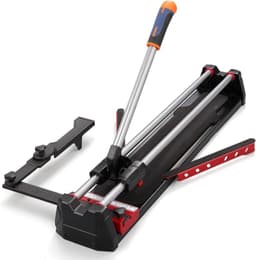
A 600 mm manual cutter scores a glaze line with a carbide wheel, then snaps the body. There is no water tank on these listings, and no honest mains lead. Faithfull's technical table says AC. The bullets describe a hand push-action cutter with no plug. TILER, ROJOO, HobbyLane and NIDAYE are hand powered. The mess is a sharp shard, not slurry. A wet saw is a water-cooled diamond blade. Homebuilding puts it on small cuts, L-shapes and thicker porcelain. Screwfix puts electric cutters on bevels and thick stone, and calls them noisier and messier. You need a UK 13 A socket and a place for the slurry. Homebuilding's budget line for a wet saw is from around £40–£50, which is that page's range, not a price scraped here. Speed favours the snap cutter on identical straight rips: mark, score once, snap, stone the edge. That sequence is on how to use a 600 mm manual tile cutter. A wet saw wins the awkward cut: a pipe notch, a mitre, a face the wheel will not track. A harder push does not turn the bed into a saw. The snap cutter does not throw the silica cloud a dry grinder makes. A wet saw suppresses visible dust with water. HSE still treats unseen silica as a risk on powered cutting, so RPE still applies. Do not call the wet saw dust-free.

When the manual 600 mm cutter is the one to use

Use the bed when every cut is a straight score inside the printed length and thickness, on ceramic or on smooth porcelain that has already snapped on a spare. A 600 × 300 mm wall run, or a 600 × 600 mm tile ripped down one side, is that job. Homebuilding says the manual cutter is quicker for simple straight lines. Faithfull at £46.48 states 600 mm, 425 mm diagonal and 12 mm. KATSU at £79.99 states up to 15 mm. TILER states 600 / 425 mm and is silent on thickness. The diagonal of a 600 mm square is about 849 mm, so a diamond layout leaves this bed. Homebuilding points a sliver of about 10 mm at nippers or a wet saw.
KATSU KATSU 347752 tile cutter

Testsieger

KATSU KATSU 347752 tile cutter
8.0/10about £79.99

When the wet saw takes over

The wet saw takes over when the cut is not a through-line. L-shapes, notches, curves, mitres and bevels from the middle of a tile are saw cuts. Homebuilding puts thicker porcelain and stone there. Topps Tiles send natural stone to an electric cutter. Walls and Floors put textured porcelain, and porcelain thicker than about 10 mm, on the wet saw. Ultimate Handyman's rippled 10 mm tile wandered on a manual cutter and cut on a wet saw. That exit is tile cutter for porcelain 600 mm. At work, once you leave the bed for a powered blade, HSE CIS36 applies: water or extraction, then RPE at APF 20, against a silica limit of 0.1 mg/m³ over 8 hours. A dry grinder is neither tool. If a spare snapped, use the manual cutter for straight work and hire a saw for the awkward cuts. If the tile is textured, stone, or over the rating, start with the wet saw.

Dust, water and a UK socket

Wear eye protection and stone the edge. TILER's bullets add gloves and a ban on rail oil. You do not need a mask in the CIS36 sense to snap a tile on a bench. You do once you pick up a powered blade on silica-bearing tile. A wet saw needs a UK mains socket and makes slurry. Unseen silica can remain, so RPE still applies. A Faithfull AC cell is not a plug. If the only remaining method is a dry grinder indoors, stop.

Common questions

Is a manual cutter better than a wet saw for straight cuts?
Yes, for speed and mess, if the score is inside the printed length and thickness and a spare has already snapped. Homebuilding says the manual cutter is quicker for simple straight lines. A wet saw is slower to set up and leaves slurry.
When is the wet saw the one to use?
Notches, L-shapes, curves, mitres, textured porcelain, natural stone, and tiles thicker than the bed's rating. Screwfix puts electric cutters on bevels and thick stone.
Which is dustier?
A dry grinder is the dusty tool. A snap cutter does not throw that cloud. A wet saw suppresses visible dust with water. HSE still treats unseen silica as a risk on powered cutting, so RPE still applies.
Do I need a mask to snap a tile?
Not in the CIS36 sense for a manual score-and-snap on a bench. You do need eye protection. You need RPE at APF 20 once you switch to a powered blade or a grinder on silica-bearing material.
Can I cut an L-shape on the 600 mm bed?
No. The breaker splits a through-score. An L is two saw cuts, or a saw plus nibblers. That is a wet-saw job.
Does a wet saw need a UK mains socket?
Yes. These 600 mm manual listings do not. Faithfull's AC cell is not a plug. A Schuko-only wet saw is a UK buying problem.

Related pages

Sources

Public UK sources from the research digest, last checked 20 October 2026. Listing prices, stars and review counts are the amazon.co.uk figures saved for this set.

  1. HSE — construction dust FAQ (retrieved 20 October 2026)
  2. HSE — CIS36 construction dust (retrieved 20 October 2026)
  3. HSE — PUWER overview (retrieved 20 October 2026)
  4. GOV.UK — General Product Safety Regulations 2005 (retrieved 20 October 2026)
  5. Consumer Rights Act 2015, section 9 (retrieved 20 October 2026)
  6. Topps Tiles — how to cut tiles (retrieved 20 October 2026)
  7. Walls and Floors — which tile cutter (retrieved 20 October 2026)
  8. Pro Tiler Tools — Battipav Super Pro 600 (retrieved 20 October 2026)