Independent comparisons. We may earn from shop links. More info

How to use a 600 mm manual tile cutter

Updated: October 2026

The first 600 mm floor tile is on the bed, the pencil line looks straight, and the last snap ran into the corner. How to use a manual tile cutter is one continuous score, then one decisive snap, on a spare of the same tile before you touch the box. The cutter is already chosen. This page is the procedure, not the shopping list. The [600 mm tile cutter comparison](/hub/cutting-tools/tile-cutter-600mm) is for the six listings. Curves and L-shapes leave this bed. A qualifying purchase can earn us a commission at no extra cost to you.

The first 600 mm floor tile is on the bed, the pencil line looks straight, and the last snap ran into the corner.

Our top picks

On this page

Set the tile before you score

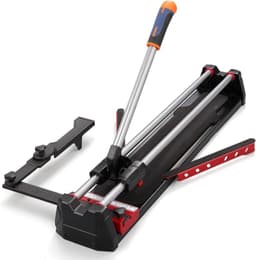
Mark the cut on the face you will see, then allow for grout. Homebuilding's order is measure, mark, then score. Sit the tile against the fence so the wheel meets both edges. Fold side arms out so a 600 × 600 mm tile does not hang off a narrow bed. Faithfull reviewers called that bed too narrow. TILER lists foldable arms. Rubber feet belong on a firm bench. A centre ridge, which Faithfull reviews mention, can crack a tile if you lean on it before the score exists. Park the breaker. TILER says fold it onto the magnet while you score. Wear eye protection. TILER also says gloves. Practise on a spare of the same body. One Faithfull review cut 600 × 600 × 10 mm porcelain cleanly. Others shattered 9–10 mm floor tiles. If the spare fails, stop. Which bed those millimetres belong to sits on the 600 mm manual tile cutter buying guide.

Score once

Topps Tiles and Homebuilding both say one pass, then snap. A second score wanders, and the snap follows the stray scratch. Faithfull reviews include tiles that would not snap after repeated scoring. TILER's bullets say one continuous pass from back to front. Other beds follow the handle. Do not stop mid-tile. A pause leaves a dull patch, and the snap leaves the line there. Pressure is enough to hear a continuous scratch. Porcelain wants more force than glazed ceramic, and it still wants one pass. If the wheel skates, the face may be textured or the wheel blunt. Faithfull reviews include a wheel that died after about a dozen porcelain cuts. KATSU reviews include a bar that flexes. More passes will not stiffen a rail. TILER says do not oil the rails. If a laser is fitted, check it on the spare. KATSU reviews put the line 3–4 mm off, or dead after a day. Mark with a pencil.
KATSU KATSU 347752 tile cutter

Testsieger

KATSU KATSU 347752 tile cutter
8.0/10about £79.99

Snap, then stone the edge

Lower the breaker onto the score, on the waste side, and push once. A hesitant press crushes the glaze. A snap that runs to a corner often means the score never reached that corner, the wheel was blunt, or the rails flexed. Faithfull and KATSU reviews describe that. KATSU reviews also mention a breaking foot that drops into the score. Park it until the wheel has finished. The fresh edge is sharp. DIYWiki says stone it with a rubbing stone or a diamond pad. You can dress a millimetre or two. You cannot dress a 15 mm wander. That tile is waste. Narrow strips are where this sequence dies. Homebuilding puts a sliver of about 10 mm with nippers or a wet saw. DIYWiki's range runs from about half an inch to two inches. Those figures are not one rule. A thin ribbon is not a breaker job.

When the cutter should not be used

This bed makes straight scores it is rated to make. It does not cut curves, L-shapes around a WC, mitres, or the diagonal of a 600 mm square, about 849 mm. Faithfull and TILER state 425 mm diagonal. Notches and stone sit on manual tile cutter or wet saw. A dry grinder is not a fallback. If you pick up an angle grinder indoors, you have left this procedure and entered HSE CIS36: water or extraction, then RPE at APF 20. Stop when the spare shatters, when the tile is natural stone, or when the cut is an L.

Common questions

Do I score once or several times?
Once. Topps Tiles and Homebuilding both say one pass, then snap. A second score wanders and the break follows the stray line. Faithfull reviews include tiles that would not snap after repeated scoring.
Which way do I push the handle?
The way that cutter is built. TILER's bullets say one continuous pass from back to front. Other beds follow the rail toward the operator. Do not stop mid-tile. A pause is a dull patch.
Where does the breaker sit while I score?
Out of the groove. TILER says fold it onto the magnet. A foot that sits on the score chips the glaze. Lower it only for the snap.
Why did the corner break off?
The score often never reached that corner, the wheel was blunt, or the rails flexed on the press. Faithfull reviews describe 9–10 mm floor tiles breaking at the corners. Check the wheel and the spare before you cut another paid tile.
How narrow a strip can I snap?
There is no single millimetre law in the sources. Homebuilding points a sliver of about 10 mm at nippers or a wet saw. DIYWiki's range runs from about half an inch to two inches. If the waste is a thin ribbon, do not force the breaker.
Should I oil the rails?
Not on a TILER: the bullets say no lubricant. Other machines may differ. Follow the cutter in your hands. Do not treat daily oil as universal. Stone the cut afterwards. DIYWiki and Topps Tiles both finish with a rubbing stone.

Related pages

Sources

Public UK sources from the research digest, last checked 20 October 2026. Listing prices, stars and review counts are the amazon.co.uk figures saved for this set.

  1. HSE — construction dust FAQ (retrieved 20 October 2026)
  2. HSE — CIS36 construction dust (retrieved 20 October 2026)
  3. HSE — PUWER overview (retrieved 20 October 2026)
  4. GOV.UK — General Product Safety Regulations 2005 (retrieved 20 October 2026)
  5. Consumer Rights Act 2015, section 9 (retrieved 20 October 2026)
  6. Topps Tiles — how to cut tiles (retrieved 20 October 2026)
  7. Walls and Floors — which tile cutter (retrieved 20 October 2026)
  8. Pro Tiler Tools — Battipav Super Pro 600 (retrieved 20 October 2026)