Independent comparisons. We may earn from shop links. More info

How to remove threadlocker when the bolt will not turn

Updated: October 2026

The spanner has stopped and the nut has not moved. How to remove threadlocker on a high-strength joint starts with hand tools, then localised heat, and you turn the fastener while it is still hot. A wet bag, a half-empty bottle and a bead that stays liquid are different faults. The first assembly is [how to apply threadlocker](/hub/cutting-tools/threadlocker-high-strength/sub/threadlocker-high-strength-how-to-apply). If the next bolt has to come apart with hand tools, the strength choice is [high strength versus medium threadlocker](/hub/cutting-tools/threadlocker-high-strength/sub/threadlocker-high-strength-vs-medium). Fill and service temperature are the [buying guide](/hub/cutting-tools/threadlocker-high-strength/sub/threadlocker-high-strength-buying-guide). The listings are on the [high-strength threadlocker comparison](/hub/cutting-tools/threadlocker-high-strength). There was no lab test.

The spanner has stopped and the nut has not moved. How to remove threadlocker on a high-strength joint starts with hand tools, then localised heat, and you turn the fastener while it is still hot.

Our top picks

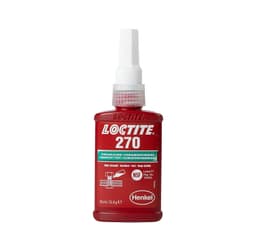
Loctite Loctite 270 50 ml

Best overall

Loctite Loctite 270 50 ml
8.4/10about £11.50
On this page

Hand tools first, then heat, and turn it while it is hot

For Loctite 270, the green 50 ml grade, Henkel’s November 2024 data sheet gives an order. Try standard hand tools first. If they fail because the engagement is long, use localised heat to about 250 °C and undo the fastener while it is hot. That sentence is for 270. The 33 N·m figure on the same sheet is a locking figure on M10 steel, not a removal torque. Do not copy 250 °C onto an unbranded red bottle. Loctite 270 in this set is green. Henkel’s anaerobic FAQ says the cured material softens with heat and firms again as it cools, so the fastener has to turn while it is still hot. Solvent on the outside of a closed joint is not a substitute. Clean residue after the bolt is out, with a solvent soak and a wire brush, or a tap in a female thread.

The published heats do not match

Three figures are in the sources, and this page will not pick one. Loctite’s UK consumer guide says about 230 °C for about five minutes on red high-strength grades. The 270 sheet says about 250 °C if hand tools have already failed. A Henkel sales line says 300 °C. Service temperature is not a removal heat: the UK page quotes −55 °C to 180 °C for 270 in service. Keep the flame or the heat gun off fuel, hoses, wiring and plastic. If you cannot heat the fastener without heating those parts, stop.
Loctite Loctite 270 50 ml

Testsieger

Loctite Loctite 270 50 ml
8.4/10about £11.50

Half full, leaked, or still wet

A bottle that arrives half full is normal headspace when the maker leaves air in it. Anaerobic liquid cures once air is shut out, so air in the bottle keeps it liquid on the shelf. Henkel’s anaerobic FAQ describes a fill of about half. A designed half-fill is not a short measure and not a reason to heat anything. Do not pour liquid that has sat in a bag back into the bottle. A cap that has leaked into the bag is a fault. This page does not assign those leak reports to one ASIN. Consumer Rights Act 2015 sections 9 and 11 are the frame: satisfactory quality, and a match to the description. A joint that is still wet after a day has not cured. Liquid in the open air does not dry. Stainless, aluminium and plated steel can be slow. Plastic will not cure. For Loctite 270, Henkel names activators SF 7649 or SF 7240 if the bead stays wet or the workshop is below 5 °C. That note is not a licence for every unbranded bottle.

When the head rounds, stop

One Flintronic review describes screw heads stripped while a high-strength joint was undone. If the flats start to round, stop. This page does not describe drilling, an extractor or an impact gun. Brakes, steering, suspension and fuel are a mechanic’s job if you are not already competent. NSF P1 123006 is Loctite 270 only. If this bolt has to be serviceable next time, buy medium strength, which Henkel puts on hand tools.

Common questions

How do you remove high-strength threadlocker when the bolt will not turn?
On Loctite 270, Henkel’s data sheet says hand tools first, then localised heat to about 250 °C if they fail, and undo while the part is hot. The film softens with heat and firms again as it cools. That 250 °C line is for 270, which is green in this set. It is not a figure to copy onto every red bottle.
What temperature should you use, and why do the pages disagree?
The pages describe different things. The UK consumer guide says about 230 °C on red high-strength grades. The Loctite 270 sheet says about 250 °C after hand tools fail. A Henkel sales line says 300 °C. This comparison will not collapse those into one torch setting. Keep heat off fuel, hoses, wiring and plastic.
Why is the bottle only half full?
Air in the bottle stops the anaerobic liquid curing on the shelf. Henkel’s FAQ describes a fill of about half. It is not, by itself, a short measure. A bottle that has leaked into the bag is a separate fault. Do not tip that liquid back in. Sections 9 and 11 of the Consumer Rights Act 2015 are the frame when the goods do not match the description.
Why is the joint still wet after a day?
A bead in the open air does not cure, because the reaction needs close metal threads and no air. Oil, paint or a plastic thread will also leave it wet. Stainless, aluminium and plated steel can be slow. For Loctite 270 only, Henkel names activators SF 7649 or SF 7240 if the bead stays wet or the workshop is below 5 °C. That is not an instruction for every unbranded bottle.
What should you do if the screw head starts to round?
Stop. One Flintronic review describes heads stripped while a high-strength joint was undone. More leverage on a rounding head makes the next step harder, and this page does not give an extraction method. If the fastener is on brakes, steering, suspension or fuel, or the flame would sit beside a line or a tank, that is a mechanic’s job when you are not already competent.

Related pages

Sources

Sources from the research digest. amazon.co.uk listings in this comparison were read on 15 October 2026. We did not run a laboratory test.

  1. Henkel UK, LOCTITE 270 (retrieved 15 October 2026)
  2. Henkel TDS, LOCTITE 270, November 2024 (retrieved 15 October 2026)
  3. Henkel UK, choosing a threadlocker (retrieved 15 October 2026)
  4. Henkel UK, blue, green and purple threadlockers (retrieved 15 October 2026)
  5. Loctite consumer UK, how threadlocker works (retrieved 15 October 2026)
  6. HSE, COSHH basics (retrieved 15 October 2026)
  7. HSE, GB CLP (retrieved 15 October 2026)
  8. Consumer Rights Act 2015, section 9 (retrieved 15 October 2026)