Independent comparisons. We may earn from shop links. More info

How to use an evaporative air cooler

Updated: 21 October 2026

You have unboxed a fan with a water tank, and the temptation is to shut the room, leave the water in, and expect ice packs to store cold. That setup makes evaporation look broken. Put it where air can change, fill it as the manual allows, judge the breeze on your skin, then empty it when you stop. The product table is the [fan with water cooling comparison](/hub/cooling/fan-with-water-cooling). Peter F. used public guides and these amazon.co.uk notes, not a home lab, on 20 October 2026. A purchase through our links can earn a commission at no extra cost to you.

You have unboxed a fan with a water tank, and the temptation is to shut the room, leave the water in, and expect ice packs to store cold. That setup makes evaporation look broken.

Our top picks

On this page

Put it where the air can change

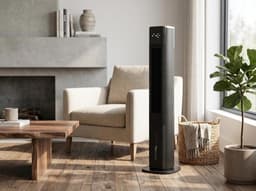
Start with the room, not the buttons. An evaporative cooler cools air that passes a wet pad by turning water into vapour. That air has to leave, or the room gets damper and the breeze stops feeling cooler. Honeywell’s guide says not to run one in a closed room, and to place it near an open window. You are not opening every window. Other internal doors can stay shut so you treat one room. Put a floor unit about a metre out from the wall, crack the window, and stand in the stream before you decide the pump has failed. The hose setup is the versus air conditioner page.

Fill the tank and use ice honestly

Use cold tap water unless your manual says otherwise. The HandFan listing is the exception in this set: tap or mineral water, not purified or distilled. Do not copy that line onto a tower. Fill to the mark once the lid is on. On the Mr.Pufferfish, the max line overflowed when the lid went down. The Air Pro’s guide left people unsure where to pour. Ice makes the first part of the session feel colder, then it melts. Listing runtimes, not a test here: about 3–5 hours from the ViaForest’s 300 ml, about 6–8 hours from the LENGDENG’s 500 ml, about 6 hours from the Mr.Pufferfish’s 700 ml, and about 22–50 minutes of spray from the HandFan’s 34 ml. Switch on at low speed and judge the air on your skin. Night noise is on the bedroom page.

Empty, dry and break the damp habit

Standing water is how these units start to smell. When you stop, empty the tank, wipe what you can reach, and leave the unit open to dry. An app timer does not empty the tank for you. A leak is different: water at a leg of the BLACK+DECKER in one review, or on a bedside table under the Lazenry. Stop using it. Follow the cleaning steps in your own manual. This page does not give a bleach recipe. The Health and Safety Executive discusses legionella risk for some workplace humidifier systems. A home tower is not a cooling tower. Do not store warm, dirty water.

When it is a fault, not the setup

Some failures survive an open window and a fresh fill. Mist that never starts, or a mist button that dies while the tank is full, showed up in Mr.Pufferfish and ZUSKYZU reviews. Air only slightly cooler than a dry fan, after ventilation and cold water, can be the limit of evaporation on a humid afternoon. Reviewers on the Air Pro and the BLACK+DECKER say that often. A unit that will not run, runs for a few seconds, or stops within a week is a fault, as is a low-water warning on a full Lazenry tank. Missing ice packs or a missing remote are delivery problems. Unplug anything that smells of burning. One Mr.Pufferfish review described a near-fire. That is a single report, and it is a reason to stop, not to open the housing.

Common questions

Do you keep the window open or shut?
Keep an air path open. A sealed room is the wrong setup, because the air cannot take more moisture and the breeze stops feeling cooler. You do not have to open every window in the flat. One cracked window, or a door, matches the Honeywell guide and UK evaporative advice. Other internal doors can stay shut so you are only treating one room. The exhaust hose belongs to a portable air conditioner, not to this fan.
Where does the water go, and how long does a tank last?
Water evaporates into the airstream and, on a mist fan, leaves as fine droplets. What remains in the tank should be emptied, not stored overnight. Listed times vary: about 22–50 minutes of spray from the HandFan’s 34 ml, and multi-hour claims on the 300 ml to 700 ml desk units. Those are listing claims. The speed you choose changes them, and none of these pages measures your room overnight.
What water can you put in a mist fan?
Cold tap water is the normal fill unless your manual says otherwise. The HandFan listing is narrower: tap or mineral water, not purified or distilled. Follow that for the HandFan only. Do not add anything the manual does not allow, and do not fill past the mark once the lid is fitted. On at least one personal unit, the printed max line overflowed when the lid went on.
The fan runs but the air is not cold. Is that a fault?
Not always. Stand in the stream with a window cracked and cold water in the tank before you decide. In humid weather, or in a shut room, evaporation has little work left, and several reviewers describe air only slightly cooler than a fan. A mist function that never starts, or a unit that will not run at all, is the fault. A modest breeze is the design.
When should you stop and not just clean it?
Stop if it leaks onto furniture, will not run, smells of burning, or the mist or pump stays dead after a fresh fill. A low-water alarm with a full tank is the same kind of stop. Cleaning deals with stagnant water. It does not repair a dead pump, and it does not make a water fan cool a sealed room the way an air conditioner can.

Related pages

Sources

Public UK sources from the research digest, used for this page on 20 October 2026. Prices, stars and review counts are the amazon.co.uk figures in this comparison. Listing slogans about a temperature drop were not treated as measurements.

  1. Energy Saving Trust: tips to keep your home cool (retrieved 20 October 2026)
  2. NHS: heatwave, how to cope in hot weather (retrieved 20 October 2026)
  3. GOV.UK: beat the heat, keep cool at home (retrieved 20 October 2026)
  4. Electrical Equipment (Safety) Regulations 2016, Great Britain (retrieved 20 October 2026)
  5. Electrical Equipment (Safety) Regulations 2016, regulation 35 (retrieved 20 October 2026)
  6. HSE: other legionella risk systems (retrieved 20 October 2026)
  7. Honeywell: portable evaporative air cooler guide (retrieved 20 October 2026)
  8. The Guardian, 13 August 2025: evaporative air coolers (retrieved 20 October 2026)