Independent comparisons. We may earn from shop links. More info

Cordless or 12 V tyre inflator

Updated: 21.10.2026

You can buy a pump on its own battery, or one that only runs from the car’s accessory socket, and both are sold as portable. A cordless or 12 V tyre inflator is that choice, made with the listings in our [portable air compressor comparison](/hub/compressors/portable-air-compressor), read on amazon.co.uk on 19 October 2026. If the only job is car tyres beside that car, start with the 12 V AstroAI. If the pump has to work away from the socket, start with a battery listing you will charge on a schedule. A title that says both is not enough until the included line agrees. Adapters are on the [car and bike](/hub/compressors/portable-air-compressor/sub/portable-air-compressor-car-and-bike) page.

You can buy a pump on its own battery, or one that only runs from the car’s accessory socket, and both are sold as portable.

Our top picks

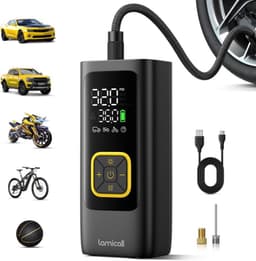
Lamicall Lamicall VHEP02

Best overall

Lamicall Lamicall VHEP02
9.4/10about £42.99
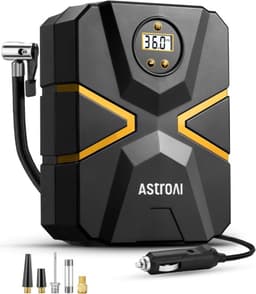
AstroAI AstroAI S1

Rank 2

AstroAI AstroAI S1
9.0/10about £17.99
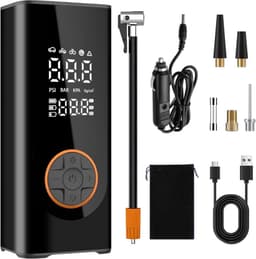
Semflagree Semflagree CLB-6010

Best value

Semflagree Semflagree CLB-6010
9.0/10about £21.99
On this page

What you are choosing

A cordless inflator carries a small pack. You can take it to a bike in the hall. It is useless when that pack is flat. A 12 V inflator borrows the car’s socket, so several tyres do not depend on a battery you forgot in January. The clean 12 V row is the AstroAI S1: 12 V DC, 100 W, no battery, 22 L/min, a 48 cm hose, £17.99, 4.5 from 11,896 reviews. The Bimson 8 L is neither. It is 230 V, and it leaves this page after that sentence. Hose lengths and the placard check are on the buying guide.

When the socket is the better bet

Choose the socket when you may do more than a light top-up and the car is where you will do it. Auto Express still tests 12 V inflators on their own. Their 2026 winner was a Ring, not the AstroAI, so their times stay on their page. On the AstroAI, United Kingdom reviews describe a cut-off they call accurate in the cold, and a long run that gets loud and hot. There is no power-lead length in the specification. Parkers’ guide says a 12 V socket is usually live only with the engine running. That is their advice, not a statute. What the listing makes certain is that there is no battery. Skip it for a bike in the hallway. The Semflagree is not a second clean 12 V answer. Its bullets describe the socket and a 13 ft lead, and its title also claims a 6000 mAh pack.
Lamicall Lamicall VHEP02

Testsieger

Lamicall Lamicall VHEP02
9.4/10about £42.99

When cordless is the better bet

Choose a battery pump when the inflator has to leave the car. We do not have a shared timing, so the Lamicall’s 28 L/min is not a claim that it beats the AstroAI’s 22 L/min on your wheel. None of these cells say free air delivery. The failure mode is the boot. Tarden 8023 reviews say the battery needs a charge out of the car. A NOCO review describes drain over about five weeks. Lamicall reviews split because the jobs differ: four car wheels in one report, two or three tyres and a recharge in another. A WOLFBOX review needed a power-bank pause before a flat rear tyre reached 40 PSI. Charge the pump on a reminder. Cordless is also the right side for a bicycle in the hall, provided the box names the adapter. The HOVVIDA does not name Presta. A charged pack with the wrong chuck still does not inflate the bike.

Dual claims in this set

Two listings try to be both. Neither earns a blanket claim that the cord runs the pump if the pack is flat. The Semflagree at £21.99 is 4.5 from 505 reviews, the best-value badge under the price rule. The title says dual supply and 6000 mAh. The bullets say plug into the 12 V socket and quote a 13 ft cord and 30 L/min. The specification says one lithium-ion battery is included and does not state airflow. One UK review reports six tyres on one charge. That is not a wiring diagram. The 13 ft figure is the electrical lead, not the air hose. The Woowind kit bullet includes a 12 V cord. One UK review says that input does not inflate when the battery is flat, and that USB-C charging worked instead. Other reviews saw a low-battery warning after three or four tyres. Beside the car, the AstroAI’s socket is the clearer start. Away from the car, pick a battery model you will charge.

Common questions

Do I need the engine running for a 12 V pump?
Parkers’ guide says the socket is usually live only with the engine running. Treat that as their advice, not as a statute. The AstroAI listing prints 12 V DC and no battery, so you need a live socket, and the manual is the instruction to follow.
Will a cordless pump be flat when I need it?
It will if you leave it in the boot and never charge it. The Tarden 8023 sample says charge it out of the car. Tyres-per-charge bullets are manufacturer claims, and a top-up is not the same job as an empty tyre.
Which listing is only 12 V?
The AstroAI S1, at 100 W, part ACAC3676YE-UK, with no battery. The Semflagree and the Woowind add a 12 V claim you should read carefully. The Bimson is mains, not 12 V.
Which listings claim both?
The Semflagree title says corded and cordless, while the bullets centre on the 12 V socket. The Woowind kit bullet includes a 12 V cord, and one UK review says that cord did not run a flat pack. The NOCO voltage cell says 12 V and the box list has no vehicle lead.
Is cordless faster?
We cannot say. There is no shared timing of the AstroAI against these cordless models. Stated airflow runs from 17 L/min on the NOCO to 28 L/min on the Lamicall. None of those cells say free air delivery.
Is the 8 litre tank a third option here?
No. The Bimson is an 8 litre 230 V tank, 16 kg, with a manual in the box. It is not a third glovebox option.

Related pages

Sources

Public UK sources and the twelve amazon.co.uk listings for this comparison. Prices, stars and review counts were taken on 19 October 2026.

  1. Highway Code Annex 6: vehicle maintenance, safety and security (retrieved 19 October 2026)
  2. TyreSafe: tyre pressures explained (retrieved 19 October 2026)
  3. The Motor Ombudsman: what tyre pressure should my car have? (retrieved 19 October 2026)
  4. HSE: PUWER overview (retrieved 19 October 2026)
  5. HSE INDG178: written schemes of examination (retrieved 19 October 2026)
  6. Control of Noise at Work Regulations 2005 (retrieved 19 October 2026)
  7. Cycling UK: tyre pressure (retrieved 19 October 2026)
  8. amazon.co.uk listings for the twelve models in this comparison (retrieved 19 October 2026)