Independent comparisons. We may earn from shop links. More info

How to use a recoil air hose

Updated: 21.10.2026

The coil is out of the packet, the compressor is still showing pressure, and the plug in your hand only looks as if it matches. That is how a recoil hose gets damaged, or a coupling leaves the nose. This how to use a recoil air hose page is the sequence for the ten spirals in the [compressed air spiral hose comparison](/hub/compressors/compressed-air-spiral-hose). Prices stay on that table. On 19 October 2026 those listings ran from £8.99 to £19.99. This is not a lab test, and a qualifying purchase can earn us a commission at no extra cost to you. Empty the line first. Then match the nose. Then pull, and expect less reach than the title.

The coil is out of the packet, the compressor is still showing pressure, and the plug in your hand only looks as if it matches. That is how a recoil hose gets damaged, or a coupling leaves the nose.

Our top picks

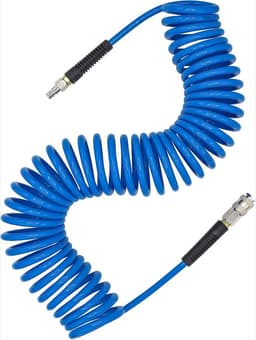
YOTOO YOTOO 10 m, 6 mm

Best overall

YOTOO YOTOO 10 m, 6 mm
8.7/10about £19.99
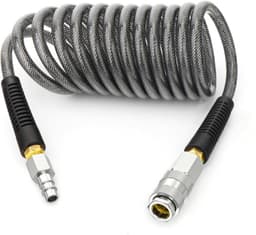
WISCRAFTER WISCRAFTER 7.5 m, 6 mm

Best value

WISCRAFTER WISCRAFTER 7.5 m, 6 mm
6.7/10about £14.98
On this page

Empty the line before you touch a coupling

Close the regulator or switch the compressor off, then bleed the outlet before you pull a plug. If the nose is wrong, the hose can whip. HSG39 describes rupture and whip. At work, the Pressure Systems Safety Regulations 2000 apply above 0.5 bar. The written-scheme rules drop away under 250 bar litres in the vessel, and the hose is not the vessel. A home user with no employees is outside that duty. You still bleed the line. If you cannot tell a UK-standard plug from a Euro plug, use the Euro coupling vs PCL page. Forcing the click is the next failure.

Tape the tapered thread, not the quick-release nose

PTFE tape belongs on a male tapered thread, the sort The Hosemaster describes as BSPT, where the seal is the thread. A parallel BSPP thread is meant to seal on a washer. Tape on that male thread can stop the washer seating. Several hoses, including the TAILONZ, say 1/4 inch BSP, which does not tell you taper or parallel. If it is tapered, a few turns on the male thread is the usual practice. If it is parallel, fit the washer and leave the tape off. Air Compressor Engineering notes that a quick-release coupler seals on an O-ring, so tape does not belong on the plug that pushes in. A hiss after a click is often the wrong profile or a damaged ring. An XF-Euro adaptor will not properly fit a UK-standard coupling, and a UK-standard adaptor can sit loosely in an XF body. Do not wrap the nose. Return a hose that is not as described under the Consumer Rights Act 2015. Bore and profile are chosen on the recoil air hose buying guide.
YOTOO YOTOO 10 m, 6 mm

Testsieger

YOTOO YOTOO 10 m, 6 mm
8.7/10about £19.99

Pull it once and listen

Bring the pressure up with no tool on the far end and listen at both joints. A soapy-water film shows a thread leak as bubbles. YOTOO reviews mention a leak at the thread on first use. Remake that joint with the compressor empty. Pull along the bench, not across a doorway. A Sealey review describes a coil that came only halfway back after one stretch. Store it off the floor, away from a hot exhaust, and inside the temperature the listing prints. Do not guess a range the file leaves blank. Seat the plug until it locks. If the nailer lags, the likely causes on this shelf are a 4 mm bore or a mixed coupling, not a regulator wound past the working sentence.

What you do not do with the airline

Where air is still used to clean components, the Health and Safety Executive’s FAQ says to cut the exit pressure towards 30 psi (2.1 bar). That is a cleaning limit, not a hose rating. If a hose has split, or a coupling has blown off, isolate the compressor and do not patch a charged line. If the receiver may be at or above 250 bar litres, ask someone who can do that sum.

Common questions

Do I empty the compressor before I connect the hose?
Yes. Switch off or close the feed, and bleed the outlet until the gauge has fallen and the coupling is quiet. Connecting a new nose to a charged line is how a mismatched plug gets tested by whip. Fit the hose only after that bleed, then bring the pressure up with no tool on the far end.
Where does PTFE tape go, and where must it not go?
Tape a male tapered BSPT thread, where the seal is the thread. On a parallel BSPP thread, the seal is the washer, and tape can stop that washer seating. Do not tape the quick-release nose. That joint seals on an O-ring. A hiss there is usually the wrong profile or a damaged ring, which tape will not cure.
The plug clicks but hisses. What next?
Stop and drop the pressure. A click with a hiss is not a successful fit. Check that you have not mixed a UK-standard plug with a Euro body, and check the O-ring. Do not add tape to the nose and do not hold the sleeve down by hand. If the shapes do not match, change the plug rather than forcing this one.
Why will a 10 m coil not reach 10 m?
Because a recoil hose is a spring, not a straight tube. YOTOO reviewers say their 10 m coil will not pull out to the printed length. Atlas Copco treats a spiral as a long path, with hose and coupling losses kept around 0.6–1.0 bar as guidance. Buy the coil for a short pull beside the compressor, or change to a straight hose if you need to walk.
Can I blow dust off my clothes with the hose?
No. HSE’s FAQ says not to dust clothing with compressed air. The 30 psi (2.1 bar) figure is a guide for cleaning components, not a hose rating, and it is not permission to blow down overalls. Air can also enter the skin through a small break, and a loose hose can whip.
When do I stop and get someone else?
Stop if the hose has burst, a coupling has blown off, or you are about to repair a line that is still under pressure. At work, ask a competent person if the receiver may be at or above 250 bar litres, or if the job needs anti-static hose. None of these listings claims a fire-resistant anti-static rating.

Related pages

Sources

Public UK sources below. amazon.co.uk listings for these ten spiral hoses, shelf date 19 October 2026.

  1. HSE: compressed air blow-down FAQ (retrieved 19 October 2026)
  2. HSE: HSG39, compressed air safety (retrieved 19 October 2026)
  3. legislation.gov.uk: Pressure Systems Safety Regulations 2000 (retrieved 19 October 2026)
  4. legislation.gov.uk: PUWER 1998 (retrieved 19 October 2026)
  5. legislation.gov.uk: Consumer Rights Act 2015 (retrieved 19 October 2026)
  6. PCL: couplings and adaptors sheet (retrieved 19 October 2026)
  7. CEJN UK: compressed air hose kits (retrieved 19 October 2026)
  8. Sealey: SA305 polyethylene coiled air hose (retrieved 19 October 2026)
  9. SGS Engineering: choosing a compressor air hose (retrieved 19 October 2026)
  10. Atlas Copco: air-line accessories white paper (retrieved 19 October 2026)