Independent comparisons. We may earn from shop links. More info

Recoil air hose buying guide

Updated: 21.10.2026

You already own a small garage compressor, and the next listing is a coil. On 19 October 2026 the ten hoses in the [compressed air spiral hose comparison](/hub/compressors/compressed-air-spiral-hose) ran from £8.99 to £19.99, with stated bores of 4 mm, 5 mm, or 6 mm, and one coil that never states a bore. This recoil air hose buying guide puts the decisions in order: the hole the air travels through, the plug profile, the working-pressure sentence, then the length you can actually pull. A qualifying purchase can earn us a commission at no extra cost to you. Stars come last, because a high rating on a 4 mm hose does not make that hose into a 6 mm hose.

You already own a small garage compressor, and the next listing is a coil.

Our top picks

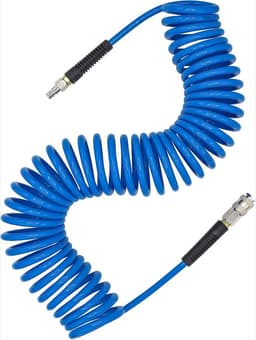
YOTOO YOTOO 10 m, 6 mm

Best overall

YOTOO YOTOO 10 m, 6 mm
8.7/10about £19.99
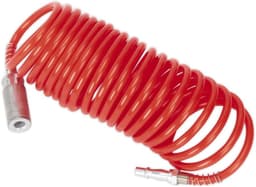
Sealey Sealey SA305 5 m

Alternative

Sealey Sealey SA305 5 m
5.4/10about £14.97
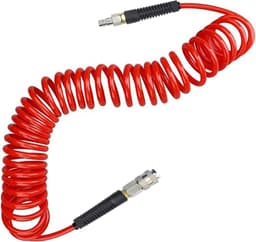
WISCRAFTER WISCRAFTER 7.5 m, 6 mm

Best value

WISCRAFTER WISCRAFTER 7.5 m, 6 mm
6.7/10about £14.98
On this page

Start with the hole the air travels through

Inside diameter is the first cut. A 4 mm bore with a 6 mm outside diameter is still a 4 mm hose. The 4 mm rows are both 9 m SRJQXH coils and the TIANLIN. The 5 mm rows are the LNSYSNS, the 6 m SRJQXH, and the Sealey SA305. The stated 6 mm rows are the WISCRAFTER, the FANOVO, and the YOTOO. The TAILONZ at £15.99 gives 6.35 mm outside and a 2.5 mm wall, and no inside diameter. Do not invent a bore from those two numbers. SGS Engineering treats about 6 mm as light-garage work and 8–10 mm for a hungrier impact tool. This shelf has no 8 mm spiral. Who should skip a row is on the best coiled air hose page.

Then match the plug, not the thread size

1/4 inch on these listings is usually the thread, not the nose. Euro, often XF, CEJN 320, or Rectus 25, and UK standard, PCL Airflow or Vertex or Rectus 19, do not interchange. PCL’s sheet gives UK standard a 4.8 mm nominal bore and 14 bar, and XF-Euro a 7.4 mm bore and 35 bar. Those are coupling bores, not the hose bore. Euro language appears on the YOTOO, the WISCRAFTER, the FANOVO, the TIANLIN, and all three SRJQXH coils. The LNSYSNS says 1/4 inch and names no profile. The Sealey listing names none, though a UK review describes UK-style ends. The TAILONZ says 1/4 inch BSP, and a UK review describes euro-style ends. Tape will not turn one profile into the other. The shapes are on the Euro coupling vs PCL page.
YOTOO YOTOO 10 m, 6 mm

Testsieger

YOTOO YOTOO 10 m, 6 mm
8.7/10about £19.99

Read the working figure, not the biggest number

CEJN’s UK hose-kit page puts non-braided spiral polyurethane at 10 bar. That is not a test of these coils. The YOTOO and the FANOVO state 150 PSI, about 10.3 bar, in the bullet and the cell. The LNSYSNS, TIANLIN, and SRJQXH rows say 10 bar. The TAILONZ working sentence is 0.8 MPa, about 8 bar, and the table’s 116.03 PSI matches it. A 1.5 MPa maximum sits beside that sentence. Use 0.8 MPa. Run the WISCRAFTER on the 300 PSI working sentence, not the 1,200 PSI cell. The Sealey UK file, and Sealey’s own SA305 page, state no working pressure. Do not paste CEJN’s 10 bar onto SA305.

Length, material, and temperature are the listing in front of you

A printed length is the tube, not the walk. If you need to walk around a car, the coiled air hose vs hose reel page is that choice. On the Sealey, Amazon’s material field says polyurethane and the bullets, a UK review, and sealey.co.uk say polyethylene. The LNSYSNS and the TIANLIN print −20 °C to 60 °C, the TAILONZ −20 °C to 120 °C, and the YOTOO and the FANOVO −40 °F to 150 °F. If the cell is empty, it is empty. Three SRJQXH ASINs share one 4.4-from-233 line.

Common questions

What should I check first on a recoil hose?
Check the inside diameter, then the coupling profile, then the sentence that says working pressure. Length and star rating come after those three. On this shelf the bores that are actually stated are 4 mm, 5 mm, or 6 mm. A title that mentions an impact wrench does not change a 4 mm bore into an 8 mm hose.
Is 4 mm enough if the title says impact wrench?
Not for a tool that sellers place on 8–10 mm. The 4 mm rows here are the two 9 m SRJQXH coils and the TIANLIN, all near £10. A 4 mm bore can suit a light blow gun. It is the wrong tube if the gun is a hungry 1/2 inch impact wrench, or if a nailer already feels starved on a 6 mm hose.
Is 6 mm the usual garage bore?
For a brad nailer, a blow gun, and tyres on a small compressor, 6 mm is the bore sellers usually name, and it is the largest bore stated in this set. SGS treats 8–10 mm as the step up for hungrier impact tools. That larger spiral is not on this Amazon shelf. PCL’s 8 mm HA5218, at about £27.50, sits outside the comparison.
How do I tell working pressure from burst?
Use the sentence that says working or maximum working. On the WISCRAFTER, 300 PSI is the working bullet and 1,200 PSI is the burst figure that the specification cell repeats. On the TAILONZ, 0.8 MPa matches the table, and 1.5 MPa is the higher maximum. The Sealey file states neither. CEJN’s non-braided spiral polyurethane figure is 10 bar, and it is not a test of these hoses.
Why do two listings disagree on polyurethane and polyethylene?
They are two materials, and the Sealey SA305 page disagrees with itself. Amazon’s material field says polyurethane. The bullets and sealey.co.uk say polyethylene, and a verified UK review agrees with polyethylene. Keep both statements. Do not pick the word that sounds tougher and delete the other.
Does a 10 m coil give 10 m of reach?
Not on the evidence in the YOTOO reviews. Owners say the coil will not pull out to the printed 10 m. Atlas Copco treats that shape as a long path and asks that hose and coupling losses stay around 0.6–1.0 bar. If you need to walk around a vehicle, use a straight hose or a reel. If a listing prints no temperature, leave it unknown rather than copying a neighbour’s range.

Related pages

Sources

Public UK sources below. amazon.co.uk listings for these ten spiral hoses, shelf date 19 October 2026.

  1. HSE: compressed air blow-down FAQ (retrieved 19 October 2026)
  2. HSE: HSG39, compressed air safety (retrieved 19 October 2026)
  3. legislation.gov.uk: Pressure Systems Safety Regulations 2000 (retrieved 19 October 2026)
  4. legislation.gov.uk: PUWER 1998 (retrieved 19 October 2026)
  5. legislation.gov.uk: Consumer Rights Act 2015 (retrieved 19 October 2026)
  6. PCL: couplings and adaptors sheet (retrieved 19 October 2026)
  7. CEJN UK: compressed air hose kits (retrieved 19 October 2026)
  8. Sealey: SA305 polyethylene coiled air hose (retrieved 19 October 2026)
  9. SGS Engineering: choosing a compressor air hose (retrieved 19 October 2026)
  10. Atlas Copco: air-line accessories white paper (retrieved 19 October 2026)