Independent comparisons. We may earn from shop links. More info

How to use an air bag jack

Updated: 21.10.2026

The bag looks low enough to slide under the sill, and it is tempting to treat the air valve as a lift you can trust on its own. This is how to use an air bag jack so the bag only raises one corner, and rated stands take the weight before any part of you is under the vehicle. It follows the HSE page on working under vehicles, the catalogue summary of BS EN 1494, and the listings in our [compressed air jack comparison](/hub/compressors/compressed-air-jack). It is not a lab procedure. A qualifying purchase can earn a commission at no extra cost to you.

The bag looks low enough to slide under the sill, and it is tempting to treat the air valve as a lift you can trust on its own.

Our top picks

On this page

Before you connect the hose

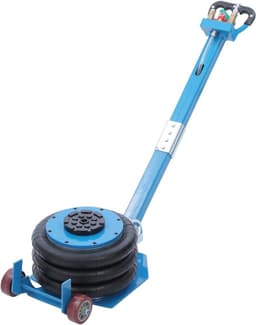
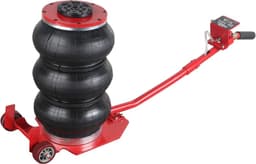
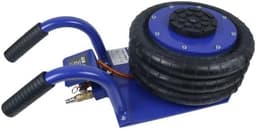
Park on firm, level ground, with chocks on the wheels that stay down. Mud, a slope or a half-on-the-driveway stance are reasons to stop. Put the handbrake on, leave the car in gear or in Park, and keep people clear of the corner you are about to raise. Find the jacking point in the vehicle handbook. A plastic sill cover, a bumper or a floor pan is the wrong place. Slide the jack in while it is still flat. These bags start at 140–150 mm. If it will not go under the point without forcing it, it does not fit this car. If the hose already shows a split, a kink or a cracked fitting, do not connect the compressor. Have the stands within reach now. Which pressure to aim for is on the compressor size for a compressed air jack page.

Raise only as far as you need

Connect the hose to the inlet your own jack uses. AIM Tools 161207 and the KATSU state G1/4. US PRO 8820 states a 1/4 inch inlet. AIM Tools 161202 and the 20 ton bottle do not state an inlet size. If the coupler does not seat, stop and fit the correct adaptor. Open the inlet only when the bag is under the jacking point and the exhaust is closed, and raise the corner only until you can set the stands. US PRO 8820 states 6–8 bar. The other four listings do not state a working pressure. Do not add air to chase 10 bar, and do not adjust a safety valve. Stop at 400 mm on three of these bags and at 450 mm on US PRO 8820. The ranges are on the air bag jack buying guide.

Stands, then work

Put rated axle stands under the vehicle’s support points and lower the corner until the stands carry the weight. HSE’s rule is not to work under a vehicle held only by a jack. The catalogue summary of BS EN 1494 says work under the raised load is not permitted unless the load is secured another way. That applies to a wheel change and to a quick look at a brake. Shake the car gently at the wing before you trust the stands. If a stand rocks, reset it without crawling under the bag. When you are clear, raise slightly, remove the stands, and lower in short bursts.

When to stop

Stop if the airline splits, if the inlet snaps, or if the jack will not come down. Support the vehicle before you touch the fault. Do not lie under the bag to inspect the valve. The Consumer Rights Act 2015 is the route with the seller once the vehicle is safe. Call a recovery fitter when you cannot place stands, including air suspension that can drop and a 20 ton bottle whose height and pressure are not stated. If a 12 V inflator is all you have and the bag is rising unevenly, shut the air off and lower the car.

Common questions

Where do I put the jack?
Use the jacking point in the vehicle handbook, on firm level ground, with the wheels that stay down chocked. Do not use a plastic bumper, a sill cover or a floor pan because the bag happens to reach them. If the flat jack will not slide under that point, the start height does not fit this car.
Which valve lets air in?
The one marked on your jack. Another seller’s 3.5 ton sheet uses a green inlet and a red exhaust. AIM Tools and KATSU do not print that colour code. Close the exhaust, seat the adaptor, and open the inlet only when the bag is under the jacking point. If you are guessing which lever is which, you are not ready to add air.
Do I need axle stands if I only change a wheel?
Yes. Taking a wheel off puts your hands in the space the car would fall into. HSE says not to rely on a jack alone, and the BS EN 1494 summary says the load needs another support before you work under it. Set the stands, then lower the jack so the stands carry the car.
What if it will not go down?
Stop adding air. If you are not yet under the car, keep clear and let it settle only if it will settle on its own. If it has stalled in the air, support it another way before you touch the valve. Do not crawl underneath to free a stuck exhaust. A jack that will not descend is a fault to take up with the seller once the vehicle is safe.
When is this a job for a recovery fitter?
Call a fitter for air suspension that can drop, for a low-floor bus or similar recovery, and for any lift where you cannot place rated stands. Also stop if the tool in front of you is the 20 ton bottle and you still do not know its height or working pressure.
Does LOLER apply at home?
Home DIY is not an employer’s duty under that regime. HSG261 treats garage bottle and trolley jacks as lifting equipment, with thorough examination about every 12 months. A jack that came with the car is not normally included. The reason for stands does not change on a private drive.

Related pages

Sources

Public UK sources below. amazon.co.uk listings for these five jacks, shelf date 19 October 2026.

  1. HSE: Working under vehicles (retrieved 19 October 2026)
  2. HSE: HSG261 (retrieved 19 October 2026)
  3. HSE: OC 803/69 (retrieved 19 October 2026)
  4. BSI: BS EN 1494:2000+A1:2008 mobile or movable jacks (retrieved 19 October 2026)
  5. BSI: BS EN 13731:2007 lifting bag systems for fire and rescue (retrieved 19 October 2026)
  6. GOV.UK: Supply of Machinery (Safety) Regulations 2008 (retrieved 19 October 2026)
  7. legislation.gov.uk: Consumer Rights Act 2015 section 22 (retrieved 19 October 2026)
  8. amazon.co.uk listings for the five jacks in this comparison (retrieved 19 October 2026)