Independent comparisons. We may earn from shop links. More info

Blasting media grit size

Updated: 21.10.2026

You are looking at pouches that say 80, 100, 120, 180 or 220, and a tub that says 180–300 microns, and none of those strings is a guarantee. Blasting media grit size is a set of scales that do not add together. A higher number usually means a smaller particle, and a seller’s number is not a certificate. The listings are the [blasting media comparison](/hub/compressors/blasting-media). The Products Compared editorial team used Key Abrasives, EP Power Grit and the amazon.co.uk pages captured on 19 October 2026. We did not sieve these bags. A qualifying purchase can earn a commission at no extra cost to you.

You are looking at pouches that say 80, 100, 120, 180 or 220, and a tub that says 180–300 microns, and none of those strings is a guarantee. Blasting media grit size is a set of scales that do not add together.

Our top picks

On this page

Four ways the size gets written

A FEPA F grade is a spread of grain across sieves, not one diameter. Key Abrasives publish bands you can picture. F70 is about 0.180–0.250 mm. F100 is about 0.106–0.150 mm. F120 is about 0.090–0.125 mm. F180 is about 0.053–0.090 mm. F220 is about 0.045–0.075 mm. EP Power Grit’s windows are close: F70 at 170–250 microns, F120 at 88–125 microns, F220 at 44–74 microns. 180–300 microns is 0.18–0.30 mm. A crushed-glass claim of 0.5–1.5 mm is several times coarser than F120. On these labels a higher number is a smaller grain: 80 is coarser than 220. That does not make a Wakects 80 grit title into FEPA F80.

What fine and coarse change on the metal

Coarse angular grain cuts thick rust and paint. Fine grain mattes and can fail to strip. The Garosa 120 grit pouch, £19.99, which the listing calls fine, has a UK review that says it would not strip paint off a wheel. The 220 grit Garosa pouch, £17.37, was used in a vapour blaster on aluminium. That is a fine wet clean, not a dry rust strip. Key Abrasives sit coarser for structural work: F70 for motorbike frames, F54 for alloy wheels, or F100 if the paint is already off. Oxide or bead is the other decision, on aluminium oxide or glass bead.

How the bags in this comparison are labelled

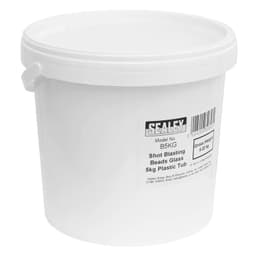
Spacnana at £18.06 prints 100 grit and 120 grit in the title, while the grit-number field says 120. The rating is 5.0 from one review, with no review text. Wakects says 80 grit only in the title, at £16.59, with no customer-reviews line. The Garosa 100, 120, 180 and 220 pages keep one number. The Sealey B5KG states 180–300 microns, 0.18–0.30 mm, near an F70, except the particle is a round bead. Laeto’s title says 0.5–1.5 mm. The only review says the grit looked like 1.0–2.0 mm and would not feed the machine.

A practical size pick

Buy a stated micron band or an F grade when the job matters. Treat an amazon grit word as a hint, then confirm it on scrap. For heavy rust on steel you will paint, look toward F36 to F70, not the 180–220 pouches. For a satin on aluminium, the Sealey 180–300 micron bead is a size you can name, and it is not an F70 oxide. If two numbers appear on one title, do not average them. Size is the second decision, after the blasting media buying guide has picked the mineral.

Common questions

Is 120 grit the same as FEPA F120?
Not on these amazon pouches. FEPA F120 is a sieve distribution. Key Abrasives put it at about 0.090–0.125 mm, and EP Power Grit put a similar window at 88–125 microns. A title that says 120 grit, especially one that also says 100 grit, has not shown you that distribution. Use the F band when the sack prints F120. Use the marketplace word only as a hint that the seller means a fine powder.
What size strips paint, and what size only mattes?
Coarser angular oxide, in the band trade suppliers mark around F36 to F70, is what cabinet notes point at for rust and frames. Fine labels, 120 and finer, are the matte and light-clean end. One review of a 120 grit pouch says it would not strip paint off a wheel. A 220 grit review describes a vapour blaster on aluminium, not a dry strip. Those are two UK reviews, not a profile chart. Test on scrap if the coating is thick.
How big is 180–300 microns next to F100?
180–300 microns is 0.18–0.30 mm. Key Abrasives put F100 at about 0.106–0.150 mm and F70 at about 0.180–0.250 mm, so the Sealey band overlaps the coarse end of those grades and runs a little larger. The Sealey product is round glass bead, not angular oxide. Similar length does not mean the same finish. A reviewer who said 300 grit was guessing, not converting the micron line.
Will 1–2 mm glass go through a small nozzle?
Often it will not. The Laeto review says grit that looked like 1.0–2.0 mm would not feed the machine, against a bag print near 0.5–1.0 mm and a title of 0.5–1.5 mm. That is many times coarser than F120, which is around a tenth of a millimetre. Match the largest chip to the nozzle before you buy a millimetre sack for a hobby gun. More pressure packs the blockage.
Why do two grit numbers appear on one title?
Because the listing was assembled from more than one template. Spacnana prints 100 grit and 120 grit, and the grit-number field says 120, at £18.06 with one review and no review text. Those lines cannot all be the grade. Do not average them and call the result an F grade. Skip the pouch, or sieve it and accept that you no longer know the seller’s number.

Related pages

Sources

Public UK sources from the research digest. Listing prices, stars and review counts are the amazon.co.uk figures captured on 19 October 2026.

  1. COSHH 2002, Schedule 2 (retrieved 19 October 2026)
  2. HSE CN7: Abrasive blasting (retrieved 19 October 2026)
  3. HSE: Silicosis and the silica WEL (retrieved 19 October 2026)
  4. HSE HSG201: Abrasive blasting (retrieved 19 October 2026)
  5. Key Abrasives: Aluminium oxide (retrieved 19 October 2026)
  6. Airblast Products: Blast media (retrieved 19 October 2026)
  7. Ribble Technology: Blasting media (retrieved 19 October 2026)
  8. sandblasters.co.uk: Media for a blast cabinet (retrieved 19 October 2026)