Independent comparisons. We may earn from shop links. More info

Aluminium oxide or glass bead blasting

Updated: 21.10.2026

You have one cabinet and two bags in the results, and it is tempting to treat aluminium oxide as the strong grit and glass bead as the weak grit. They are not two grades of the same thing. Oxide is angular and cuts a matte profile. Bead is round and peens a satin. Aluminium oxide or glass bead blasting is decided by the next process, not by the price. The pounds are on the [blasting media comparison](/hub/compressors/blasting-media). The Products Compared editorial team compared amazon.co.uk listings on 19 October 2026 and did not blast a test panel. A qualifying purchase can earn a commission at no extra cost to you.

You have one cabinet and two bags in the results, and it is tempting to treat aluminium oxide as the strong grit and glass bead as the weak grit. They are not two grades of the same thing.

Our top picks

On this page

They are not two grits of the same thing

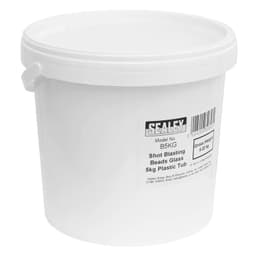
KUE Group describe grit blasting as angular particles that cut, and shot blasting as spherical particles that peen. Brown aluminium oxide is grit. Glass bead is shot. Airblast Products put brown oxide near 9 Mohs, angular and hard on nozzles. They put bead as less aggressive, reusable, and suited to aluminium and brass. Oxide leaves a toothed surface that paint can grip. Bead leaves a brighter satin and is slower when corrosion is heavy. Oxide pouches here are about £16.59 to £19.99 per kilogram. The only bead is a 5 kg tub at £26.20.

Choose oxide when the next step is a coating

If you will paint or powder steel, oxide is the cabinet media. sandblasters.co.uk say aluminium oxide if you will paint. Size is a separate choice, on blasting media grit size. The pouches here are labelled from 80 grit to 220 grit. One review of the Garosa 120 grit pouch, at £19.99, says it would not strip paint off a wheel. Key Abrasives suggest F70 for motorbike frame restoration and F54, or F100 if the paint is already off, for alloy wheels. A 120 grit title is not FEPA F120. Oxide on aluminium is reasonable when you will coat it. It is a poor choice when the aluminium should stay bright.

Choose bead when the part should stay smooth

Choose bead when the part is aluminium, brass or a similar metal, the corrosion is light, and you want a satin you will leave bare or clear. Reviewers of the Sealey B5KG, 180–300 micron beads at £26.20, mention aluminium and motorcycle parts. The listing is 4.4 from 84 reviews. If the bracket is still crusted, oxide first is the honest route. Bead is the wrong last step if paint needs a tooth. A fine bead held in one place will still frost a thin panel. Move the gun, and use the lowest pressure that cleans the scrap. That pressure step is how to use blasting media.

When you might use both, and what not to substitute

Some finishers use both, in that order. A Products Finishing answer describes a coarser oxide to hide machine marks, then glass bead to brighten the surface. Empty the cabinet between the two so sharp grit does not stay in the bead. Mixing them in one hopper scratches the satin. Crushed recycled glass is not a stand-in for bead. It is angular, so it cuts more like oxide, and it usually breaks down in one pass. Soda leaves no profile, so it will not key paint and it will not peen a metal satin. If you cannot recover the media, you are no longer choosing between oxide and bead. If you will coat steel, check you have not ordered 220 grit for heavy rust. If you want bare aluminium satin, check the tub when it arrives.

Common questions

Which one leaves a key for paint?
Aluminium oxide. The grains are angular, so they cut a matte profile a coating can grip. Glass bead is round and leaves a smoother satin, which is the wrong last step before paint on steel. The oxide pouches here run from 80 to 220 grit, and a 120 grit review says that pouch would not strip wheel paint. Coarser oxide still belongs to this answer. Bead does not.
Which one keeps aluminium bright?
Glass bead, when the corrosion is light enough for a peening clean. The Sealey tub of 180–300 micron beads is the only bead in this set, at £26.20 with 84 reviews, and reviewers mention aluminium and motorcycle parts. Oxide leaves a duller matte. Use oxide on aluminium if you will coat it. Use bead if the bright satin is the finish. Neither one repairs deep pitting on its own.
Can I use oxide on aluminium at all?
Yes, if you want a matte surface or you will paint or powder the aluminium afterwards. Oxide cuts faster than bead, so it is the wrong bag if the part should stay bright. On a thin panel, keep the gun moving and test on scrap. A vapour-blast review of 220 grit oxide on aluminium is a fine, wet job, not permission to dwell on a dry cabinet panel.
Is crushed glass a stand-in for bead?
No. Crushed glass is angular. It behaves more like oxide, and suppliers usually treat it as single-use because it fractures. Bead is round and is the media you recover for a satin. If the particles are millimetre chips, they will also struggle in a small nozzle. Do not buy crushed glass because the word glass appears in both names.
Which one ruins a thin panel?
Both can, if you dwell. Oxide ruins it faster because it cuts. Bead can frost and dish a thin cover if you hold the nozzle in one place. Use scrap of the same thickness, the lowest pressure that works, and a moving gun. If the panel is a vehicle structure or the coating may contain lead, the media choice is not the safety control. That job belongs with a blaster.

Related pages

Sources

Public UK sources from the research digest. Listing prices, stars and review counts are the amazon.co.uk figures captured on 19 October 2026.

  1. COSHH 2002, Schedule 2 (retrieved 19 October 2026)
  2. HSE CN7: Abrasive blasting (retrieved 19 October 2026)
  3. HSE: Silicosis and the silica WEL (retrieved 19 October 2026)
  4. HSE HSG201: Abrasive blasting (retrieved 19 October 2026)
  5. Key Abrasives: Aluminium oxide (retrieved 19 October 2026)
  6. Airblast Products: Blast media (retrieved 19 October 2026)
  7. Ribble Technology: Blasting media (retrieved 19 October 2026)
  8. sandblasters.co.uk: Media for a blast cabinet (retrieved 19 October 2026)