Independent comparisons. We may earn from shop links. More info

Airbrush for miniatures UK

Updated: 21.10.2026

You have a squad of plastic figures, a rattle can you are tired of overspraying, and an airbrush listing that mentions Warhammer in the title. An airbrush for miniatures in the UK is a narrow tool: primer, a base coat, and a simple zenithal, on a gravity gun whose nozzle you can keep clear. It is not a cake gun or a panel gun that happens to share an amazon.co.uk search. The [airbrush gun comparison](/hub/compressors/airbrush-gun) holds the full table and the prices from 19 October 2026. This page follows one figure from a dark primer to a lighter coat from above. Paint Picker, FauxHammer and Warhammer Guild disagree on size, and the overlap is a 0.3 mm gravity gun and a pressure you can set. We did not paint a competition entry.

You have a squad of plastic figures, a rattle can you are tired of overspraying, and an airbrush listing that mentions Warhammer in the title.

Our top picks

Fengda Fengda FE-130

Preis-Tipp

Fengda Fengda FE-130
8.4/10about £15.99
On this page

What an airbrush changes on a miniature

A brush still does the face and the last highlight. The airbrush changes the slow coats: a primer under a backpack, a base colour without brush ridges, and a zenithal that leaves a lighter value on the upper surfaces. Army Painter’s note is dark primer first, then a light colour from above, in thin layers. Their article also sells their own paints. This page does not claim that a spray-can paint is an airbrush paint. If the goal is ten figures with a consistent base, a 0.3 mm gun and a regulated compressor are the setup hobby pages describe. Milk-thin paint and air before fluid sit on how to use a dual-action airbrush. Here those steps are assumed.

Nozzle, with the disagreement left visible

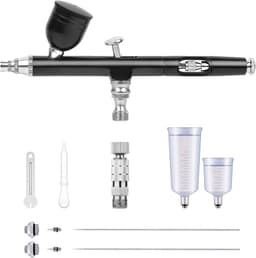
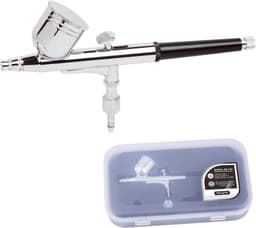
Use 0.3 mm as the size that appears in every serious UK description of a first miniature gun. It sits in Paint Picker’s primer-to-zenithal range, in Warhammer Guild’s preference, and in Army Painter’s 0.3–0.4 mm band. Paint Picker talks about 0.3–0.5 mm for primer, base coat and zenithal. FauxHammer leans toward 0.4–0.5 mm for primer and zenithal, and 0.2 mm for recess work, with a warning that smaller nozzles clog on model acrylics. Warhammer Guild prefers 0.3 mm at about 20–25 psi and tells readers to avoid sub-£30 guns. Those pages disagree. A 0.5 mm nozzle lays primer faster and punishes you less when the primer is slightly thick. It is also easier to flood a small detail. A 0.2 mm nozzle is the recess size, and it clogs when a model acrylic still has a speck of pigment. Buy it after you can thin paint, not before. Fengda at £15.99 and Anmas Power at £16.14 are the cheap single 0.3 mm gravity guns. Magicrose at £16.99 and Rosemary & Co at £22.65 add 0.2 mm and 0.5 mm sets, so you can prime a little faster and return to 0.3 mm if you swap needle and nozzle together. Timbertech includes those three sizes and a hose, and it does not state gravity or dual action. Ykall’s only stated size is 0.4 mm. Magicrose’s title names Warhammer miniatures. That is a listing claim, not a test. The kit still needs a compressor. Fengda’s UK reviews split. Some buyers find it fine for larger pieces and railway buildings. One said it was not for miniatures. One Rosemary & Co review called finescale hopeless. Keep that as one review, not a verdict on every 0.3 mm pass.

Pressure, primer coats and zenithal

The Mighty Brush starts miniature work near 20 psi and tells you to raise it if a pale paint spatters. Warhammer Guild’s primer note is about 20–25 psi. Iwata’s band for the Revolution BR, which is not in this ASIN list and costs £149.00 at Everything Airbrush, is 20–30 psi. Treat these as guides for thinned model acrylics and for primers made to be sprayed. They are not a reason to open the trigger at a 50 psi maximum. Ordinary acrylic usually needs thinning until it behaves like milk. Spray a plastic card first. If the primer peppers, it is too thick or the air is too low. If it spiders, you are too close or too wet. A simple zenithal is three decisions. Put down a dark primer all round, in passes that stay moving. Let it dry. Load a light grey or the light version of the base colour, and spray from above and slightly in front, so shoulders and helmets catch the light and the underside stays dark. If the light coat covers the dark completely, you pulled the trigger too far or you stood too still. You are leaving a map for the brush, not painting the final highlight. You need a gauge to do this twice the same way. A cordless headline of 48 PSI, with no regulator listed, does not tell you whether you are near 20 psi.

Which listings in this comparison fit

If a compressor with a regulator and a moisture trap is already in the room, the guns that match are the gravity dual-action sets with a 0.3 mm nozzle. Rosemary & Co states that trigger, that feed, the three sizes and a 1/8 inch BSP thread, at 4.4 from 119 reviews, without a hose. Magicrose states the three sizes and the down-for-air trigger, at 4.2 from 58 reviews, and the file is too small to lean on. Fengda and Anmas Power are the single 0.3 mm options near £16, with clogs, needles that do not fit, heavy thinning, and a seal that blew paint from the cup already in the reviews. The airbrush buying guide is where you check the thread before you order the hose. Cordless kits are a poor default. Aloxina, Fantspati and Ykall do not list a gauge. Aloxina’s 48 PSI is a bullet, and one of three reviews says it blocks after about two minutes. Fantspati’s steps are 28, 38 and 48 PSI in the bullets, already at or above the top of the guide band, and one review found no useful power. Ykall prints 34 PSI and 34 Pascal on the same product. The cordless airbrush versus compressor page is where you decide you still want a battery for a coarse base. Warhammer Guild’s warning to avoid sub-£30 guns is one site’s advice. A £15.99 Fengda has primed figures for some buyers and disappointed others. The tank, the regulator and the moisture trap are the parts those pages are right to insist on.

Common questions

What nozzle for Warhammer miniatures?
Start at 0.3 mm. UK pages that otherwise disagree still include it. Use 0.4–0.5 mm when you want primer down faster and you can keep the coat thin. Leave 0.2 mm until your mix stops clogging the 0.3 mm nozzle. Swap needle and nozzle together when you change size.
What is zenithal priming?
It is a dark primer all over the figure, then a lighter colour sprayed from above so the upper surfaces are pale and the shadows stay dark. Army Painter describes it as thin layers. The point is a map for the brush, not a finished highlight. If the light coat erases the dark, the pass was too wet.
What pressure should I start at?
For thinned miniature acrylics, hobby pages cluster around 20 psi, with Warhammer Guild near 20–25 psi for primer and Iwata’s Revolution BR band at 20–30 psi. Those are guides. Raise the air a little if a pale paint spatters, and do not start at a 48 or 50 psi headline because it is the largest number on the box.
Will a £16 gun do base coats?
Sometimes. Fengda at £15.99 and Anmas Power at £16.14 are 0.3 mm gravity guns, and UK reviews describe both a fine spray and clogs, plus needles or seals that fight you. They can lay a base coat when the compressor and the mix are in order. They are a weak bet for a hairline, and they do not include air.
Do I need a tank compressor?
For a primer and a zenithal you want to repeat, you need a regulator, a gauge and a moisture trap, and a tank if you want the pulse taken out of a small piston compressor. The gun listings here do not include that compressor. A hose in the Timbertech box does not create one.
Is a cordless 48 PSI kit a miniatures tool?
Not as the default. The guide band sits near 20–30 psi, and the cordless kits here either print 28–48 PSI without a gauge or print two units for one pressure. Aloxina’s three reviews include a block after about two minutes. Use one for a coarse experiment you can abandon, not for a zenithal you want to copy onto the next unit.

Related pages

Sources

Public UK sources and amazon.co.uk listings from the research digest, checked on 19 October 2026.

  1. HSE MR2: isocyanate booth controls (retrieved 19 October 2026)
  2. HSE: isocyanates in motor vehicle repair (retrieved 19 October 2026)
  3. HSE MR5: SMART limits for an airbrush (retrieved 19 October 2026)
  4. Food Standards Agency: approved additives and E numbers (retrieved 19 October 2026)
  5. Electrical Equipment (Safety) Regulations 2016, regulation 35 (retrieved 19 October 2026)
  6. Consumer Rights Act 2015, section 22 (retrieved 19 October 2026)
  7. Iwata: airbrush basics (retrieved 19 October 2026)
  8. Airbrushes.com: airbrush guide (retrieved 19 October 2026)