Independent comparisons. We may earn from shop links. More info

How to mount an air hose reel

Updated: 21.10.2026

The usual failure is a bracket fixed with the plugs from the box into plasterboard, or a hose that flies back because the latch never clicked home. You are hanging a reel of roughly 6–10 kg and then pulling against it, so the fixing sees an outward load. This is how to mount an air hose reel on a UK garage wall or ceiling without opening the case. The latch steps follow Sealey’s UK instructions. The whip warning follows HSG39. Your own leaflet governs if it differs. Which reel to buy stays on the [15 m comparison](/hub/compressors/air-hose-reel-15m). Where it should sit relative to the car is the [garage layout](/hub/compressors/air-hose-reel-15m/sub/air-hose-reel-15m-garage).

The usual failure is a bracket fixed with the plugs from the box into plasterboard, or a hose that flies back because the latch never clicked home.

Our top picks

On this page

Isolate the compressor first

Switch the compressor off and drain the tank until the gauge reads zero before you offer the reel to the wall. A charged line turns a loose coupling into a whip. HSG39 says a burst flexible hose can thrash, and you do not use compressed air to blow down clothing. Connect nothing until you have pulled the bracket by hand. If the threads do not start cleanly, stop and read the buying guide.

Studs, masonry, or move the reel

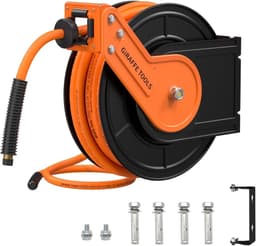
Plasterboard alone will not hold this pull. Güde reviews call the expandable bolts unspecified. Goodyear reviews say the plugs do not grip. Giraffe reviews include bolts that sheared. Fix into a timber stud or into masonry. If the only flat wall is hollow board, move the reel. A ceiling mount uses the same rule: the joist has to be there. Sealey’s note is the one to keep: the fixing must hold the working strain. If cables or pipes may lie in the drill line, stop and get someone who can confirm the wall.
Goodyear Goodyear 15 m 3/8 inch BSP

Testsieger

Goodyear Goodyear 15 m 3/8 inch BSP
8.0/10about £110.99

Test the bracket, then learn the latch

With the airline still dead, pull the hose along the path you will use, including the car door and the garage door. If the bracket moves, the fixing is wrong. Add no air in the hope that it will settle. Run the garage door with the hose stowed and half out. Then learn the latch before a tool is attached. Sealey’s SA88 sheet says pull until you hear a click, then let the hose retract slowly so the pawl can seat. Walk the hose back. Do not let go, and do not keep pulling once the hose has stopped. The case stays shut. Sealey sends spring and pawl work to an authorised agent.

When to stop

Stop when the hose retracts without a deliberate pull. That is the injury case, even in a home garage that is not a PUWER workplace. Stop if the case is cracked, if the swivel still weeps after you have reseated the joint, or if a coupling has blown off once. More tape is not a repair. Stop if you cannot find structure. At work, a receiver can fall under the Pressure Systems Safety Regulations 2000. A domestic garage compressor usually does not. The whip is the same. The order is dead line, structure, tug test, latch, then air.

Common questions

Can I use the plugs in the box on plasterboard?
Do not rely on them. Güde and Goodyear reviews in this set say the supplied fixings were vague or did not grip. Plasterboard will not take the outward pull when the hose reaches its stop. Fix into a stud or into masonry. If you only have hollow board, move the reel, or screw a batten into the studs and mount the bracket on the batten.
How high should the reel go?
High enough that the hose clears bonnets and mirrors, and low enough that you can walk it back without climbing. There is no single height in the listings. Offer the reel up, pull the dead hose along the real path, and run the garage door. A reel above the compressor is common in the reviews. It is only right if that wall is solid and the hose does not then cross the bay.
How do I make the hose stay out?
Pull until you hear a click, then let the hose retract slowly so the pawl seats. Sealey’s sheet says the latch may take the first, second or third click. A short extra pull releases it. Holding the hose at a random length, without a click, is why it seems not to lock. Follow your own leaflet if the pattern differs.
Why does it rewind on its own?
Either the pawl never seated, or the latch has failed. Try the click method with the line depressurised. If a proper click still will not hold, stop using the reel. Giraffe reviews include a latch that failed after about five months. Do not open the case to bend the pawl. That is an authorised repair.
Can I open the case and tighten the spring?
No. The spring is tensioned in a housing that is not a user service. Sealey says not to dismantle the case, and sends spring and pawl faults to an authorised agent. An opened case can release the spring. If the rewind is weak or violent, isolate the compressor and take the reel back to the seller. A Consumer Rights Act 2015 claim, if the reel is not of satisfactory quality, sits with the retailer.
Do I connect the compressor before the bracket is tested?
After the tug test, not before. Drain the tank, hang the reel, and pull the hose by hand. Only then fit the lead-in and charge the line. The first pressurised check is for leaks at the swivel and the coupler, with eye protection on, and with nobody in line with a coupling. If it weeps, drain the tank again before you loosen anything.
Is a ceiling mount different from a wall mount?
The load is the same problem in a different plane. The bracket still has to land on a joist, not on plasterboard between joists. Check headroom and the garage-door gear, which often runs on the ceiling. A 180° swivel, where the listing states one, lets the hose leave at an angle. It does not reduce the pull on the screws.

Related pages

Sources

Public UK sources and the trade pages below. amazon.co.uk listings in this set. This is not a lab test.

  1. HSE: compressed air (retrieved 20 October 2026)
  2. HSE: HSG39 compressed air safety (retrieved 20 October 2026)
  3. legislation.gov.uk: Pressure Equipment (Safety) Regulations 2016 (retrieved 20 October 2026)
  4. HSE: Pressure Equipment (Safety) Regulations (retrieved 20 October 2026)
  5. British Compressed Air Society: compressed air safety fact sheet (retrieved 20 October 2026)
  6. The Hosemaster: air hose fittings, connectors and couplings (retrieved 20 October 2026)
  7. ISO 5774:2023 thermoplastic hoses for compressed air (retrieved 20 October 2026)
  8. Sealey: SA88 hose reel instructions (retrieved 20 October 2026)
  9. Screwfix: PCL HRA3L02/SFX 10 mm x 15 m air hose reel (retrieved 20 October 2026)