Independent comparisons. We may earn from shop links. More info

Where to put a weather station in a UK garden

Updated: October 2026

Where to put a weather station is a choice between two published heights that one all-in-one head cannot meet at once. Standard wind height is 10 m. An amateur rain rim is about 30 cm. You pick a clear, safe place, you say how sheltered it is, and you stop before a mast, lightning, or a coastal install. The [professional weather station comparison](/hub/climate-measuring/professional-weather-station) is the ten amazon.co.uk listings, about £95 to £309. The Products Compared editorial team used Met Office and Royal Meteorological Society guidance, plus those listings on 15 October 2026. A purchase through our links can earn a commission at no extra cost to you.

Where to put a weather station is a choice between two published heights that one all-in-one head cannot meet at once. Standard wind height is 10 m. An amateur rain rim is about 30 cm.

Our top picks

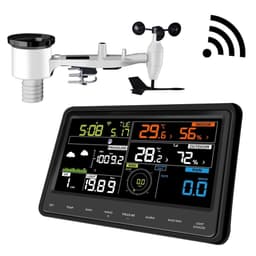
Ecowitt Ecowitt WS2910

Best overall

Ecowitt Ecowitt WS2910
8.6/10about £134.99
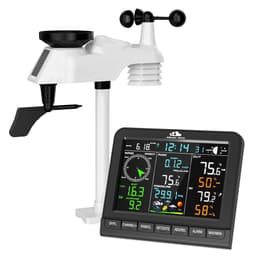
AIRAIN TECH AIRAIN TECH AIR6

Best value

AIRAIN TECH AIRAIN TECH AIR6
7.3/10about £99.99
SQECH SQECH SWS-01

Alternative

SQECH SQECH SWS-01
7.1/10about £99.99
On this page

One head, two heights

The Met Office wind rating that observers treat as the open standard wants the sensors at 10 m. The Royal Meteorological Society’s amateur guide uses the same 10 m figure and says most gardens will miss it. That guide puts the gauge rim ideally 30 cm above the ground. WOW’s site-rating page splits the jobs: temperature and rainfall want a low, open site, and wind is scored apart. None of the ten stations can do both. Each outdoor unit is one piece, so the rain rim sits wherever the wind sensors sit. If the numbers must be split, that is a Davis, which the buying guide already separates from this shelf. Keep the head lower for a garden rain total and call the wind sheltered, or raise it for the gust and treat the rain as the compromise.

Clear of the fence, and only as high as you can work safely

Shelter under-reads wind, and rain blows past a gauge against a wall. The gauge has to be level. A fence post will spin cups in turbulence and still miss the open-field gust. MN6 reviews are the example: cups spun in Storm Éowyn while the displayed gust stayed at 18 mph in one report. That is a review, not a lab. A shed ridge often swirls. Prefer the south-west side, clear of the wall, on a pole you can lower. Several of these boxes omit that pole, so buy the pipe before you promise a height.
Ecowitt Ecowitt WS2910

Testsieger

Ecowitt Ecowitt WS2910
8.6/10about £134.99

North on the array

Wind direction is only as good as the mark you set on a calm afternoon. The HP2564 bullets include a north alignment indicator. Use a compass away from the metal pole, and fix the outdoor unit so the marked arm points north before you tighten the last bolt. An all-in-one cannot be twisted later to correct the vane without moving the rain gauge with it. Level the rim, then set north, then leave it. A separate vane on its own mast is what the amateur guide assumes, and it is not what these ten products are. If that separation is the point of the install, the best station page is where this shelf stops and a Davis starts.

Say the exposure out loud

WOW exposure class 3 means nothing significant within twice the obstacle height. Their example, a gauge at 30 cm beside a 5 m building, wants about 9 m of clearance. Class 5 is open country. These classes score temperature and rain, and a garden is not an official Met Office site. Write the limit where you will see it: fence, house, and head height. A haptic head can still miss drizzle there, and cups can still clog. The ultrasonic or cups page is the sensor choice. It does not cancel a sheltered pole.

When a professional takes the mast

Stop for a ladder you would not trust, a guyed mast, or lightning bonding. A chimney mount wants the wind sensors 2 m or more above the roof, and someone who installs masts. Coastal work belongs there too: the HP2564 listing says seawater corrodes the temperature module. A 915 MHz radio or a US two-pin plug is a return, not a siting task. Above a safe working height, call someone who installs masts. The figure you upload is a garden reading.

Common questions

How high should the wind sensors be if you cannot reach 10 m?
Put the head as high as you can lower again without a risky ladder, keep it off the ridge if the air there swirls, and record the height. A 3 m pole in the open is a clearer wind site than a 6 m pole in a courtyard.
How high should the rain gauge rim be?
The amateur guide uses about 30 cm above the ground, and the gauge must be level. On these all-in-one heads you will not get 30 cm and 10 m together. Choose which reading you are willing to compromise, and say which one.
What is WOW exposure class 3 in plain language?
Nothing significant within twice the obstacle height of the sensor. Class 3 is a realistic garden aim for temperature and rain. It is not an official-station badge, and the console icon is not a Met Office record.
Which of these sets include a pole?
The AIR6 lists a mounting pole, and the SQECH includes a rod and bracket. The HP2564 bolts to a 1 inch pole you supply. WS2910 and Ambient reviews say you still buy the mast. Check the WS3901 diameter before you order pipe, and do not assume the MN6 or Temtop manual line includes a full pole.
Is a shed roof or a fence post good enough?
Use a fence or a shed roof only if you will label the site as sheltered. A pole clear of the building, on the south-west side, is the better ordinary garden.
When do you stop and call someone?
When the mast is above a ladder you trust, when it needs lightning bonding, or when the site is coastal or on an island. You can set north, level the rim, and log the exposure yourself. A wrong radio or a US plug is a return, not a siting problem.

Related pages

Sources

Public UK sources used for this comparison. Listing prices are from amazon.co.uk on 15 October 2026.

  1. Ofcom — short-range devices (retrieved 15 October 2026)
  2. Wireless Telegraphy (Exemption) Regulations 2021 (retrieved 15 October 2026)
  3. GOV.UK — Radio Equipment Regulations 2017, Great Britain (retrieved 15 October 2026)
  4. Electrical Equipment (Safety) Regulations 2016, regulation 35 (retrieved 15 October 2026)
  5. Consumer Rights Act 2015 (retrieved 15 October 2026)
  6. NPL — MSF radio time signal (retrieved 15 October 2026)
  7. Met Office — Weather Observations Website retirement (retrieved 15 October 2026)
  8. Royal Meteorological Society — amateur AWS guide (retrieved 15 October 2026)
  9. Met Office WOW — site exposure ratings (retrieved 15 October 2026)
  10. Weather Spares (retrieved 15 October 2026)