Independent comparisons. We may earn from shop links. More info

Indoor humidity, weather stations, and mould

Updated: October 2026

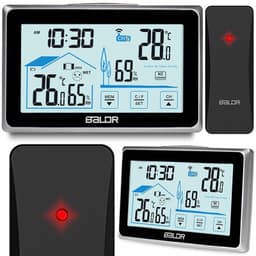
The bedroom window is wet again, and the console is showing a humidity number you are not sure you should trust. An indoor humidity weather station is useful here as a hygrometer: it tells you which room is damp and whether airing moved the number. It does not stop mould. This page uses the indoor line against the 40–60% relative humidity band that UK energy advice treats as a household target. A qualifying purchase can earn us a commission at no extra cost to you. The models that show humidity are on the [Baldr weather station comparison](/hub/climate-measuring/baldr-weather-station).

The bedroom window is wet again, and the console is showing a humidity number you are not sure you should trust.

Our top picks

U UNNI U UNNI weather station

Best overall

U UNNI U UNNI weather station
9.2/10about £32.99
Baldr Baldr BD-910 weather station

Alternative

Baldr Baldr BD-910 weather station
6.4/10about £22.22
On this page

The number that matters indoors

Read the indoor humidity, not the outdoor sensor, when the question is condensation on your glass. The Centre for Sustainable Energy advises households to aim for about 40–60% relative humidity and about 18–21 °C. Their damp and mould leaflet treats mould risk as higher when relative humidity stays above 60%. A reading that sits at 70% all afternoon is the clue, even if the room only feels close. Almost every console in this set can show that indoor line, including both Baldr models. The U UNNI claims humidity accuracy of about ±5%. The LIORQUE BJ8201-1 claims ±3% relative humidity. A station that disagrees with a second hygrometer by three or four points can still tell 45% from 70%. Put the console where you live or sleep, away from a kettle. Water on the inside of the glass comes from moist indoor air on a cold pane.

Comfort icons versus that target

Several listings add a comfort face beside the humidity digits. The Youshiko sets and the Baldr BD-910 describe a comfort indicator. The U UNNI listing mentions comfort or mould indexes. Those icons are the maker’s band. They are not the Centre for Sustainable Energy’s 40–60% target, and they are not a mould test. A smiling face at 65% would still sit in the range CSE flags if it stays there. Read the percentage. A mould index on the screen is a prompt, not a survey. The buying guide separates a thermo-hygrometer from a wind array and from the Temtop. The Temtop W100 lists air-quality figures at about £189.24 with two UK reviews. Those pollutants are a different question from condensation.
U UNNI U UNNI weather station

Testsieger

U UNNI U UNNI weather station
9.2/10about £32.99

Why the reading jumps

Humidity in a UK home moves because you add water vapour faster than the room can lose it. CSE notes that the figure rises when you cook, shower, or dry clothes. A hall console can climb during a shower if the bathroom door is open and the extractor is off. That swing means the measurement is working. A station that never moves is the one to suspect. NICE guideline NG149 points at the same levers: use trickle vents, use extractor fans, and avoid drying clothes indoors when you have another option. If the reading returns toward 40–60% and the window dries, ventilation is doing the job the meter can show you. If it climbs back above 60% as soon as you seal the room, the room is holding moisture. Cold surfaces condense moisture that warmer air, about 18–21 °C, would have held.

When a meter is not enough

A hygrometer shows you which rooms to ventilate. Lasting mould, a tide mark, or damp that returns in the same corner in dry weather is a building question. GOV.UK guidance separates condensation, which households can influence, from defects such as leaks and penetrating damp. If you rent, tell the landlord what the rooms are doing and for how long. A note of indoor humidity staying above 60% is a clearer report than a comfort icon. Manchester University NHS Foundation Trust’s leaflet says babies, children, and pregnant women face a higher risk from damp and mould, and it treats a humidity meter as one check, not a treatment. If someone is unwell and you are worried the housing is involved, speak to a clinician and, where you rent, to the landlord. None of these listings can claim to prevent mould.

Common questions

Is the comfort smiley the same as 40–60%?
No. A comfort icon is the maker’s own band. Youshiko and the Baldr BD-910 list one, and the listings do not show that the face switches at 40% and 60%. Read the percentage beside the icon. A cheerful symbol can sit next to a figure CSE would still flag. The digits are the part you can compare with the advice.
Can a weather station stop mould?
It cannot. It can show you that indoor relative humidity is staying above 60%, which is the CSE risk marker, and whether ventilation brought the room back down. Mould on cold walls, in rented homes, or after a leak is a housing problem. GOV.UK guidance treats defects and condensation differently. Buy the station as a meter.
How close are two humidity readings on one station?
Expect a few percentage points, not a match to the decimal. Raddy reviewers saw that kind of gap between console and sensor. The U UNNI claims about ±5%, and the cheaper LIORQUE claims ±3%, which remains a listing claim. A gap of three points does not hide a room at 70%. A quarrel about 48% versus 52% sits inside the uncertainty, and both figures are still in the 40–60% band.
Do I need the Temtop for window condensation?
You do not. The simpler consoles already show indoor humidity. The Temtop W100 adds particulates, CO2, TVOC, and an air-quality index, with Wi-Fi, at about £189.24 and with two UK reviews. Those sensors answer a different question. Two reviews are a thin reason to spend that money for condensation alone.
When should I talk to a landlord or a surveyor?
Talk to the landlord when you rent and mould or damp persists after ventilation and reasonable heating, and write down how long indoor humidity stayed above 60%. Talk to a surveyor when you suspect a leak or a fault in the building fabric. A weather station can support that conversation with a number. It is not the repair.

Related pages

Sources

Public UK sources and the amazon.co.uk listings for the twelve models in this comparison, last checked on 19 October 2026.

  1. NPL, MSF radio time signal (retrieved 19 October 2026)
  2. NPL, radio-controlled clock incorrect time (retrieved 19 October 2026)
  3. Ofcom IR 2030 (retrieved 19 October 2026)
  4. Consumer Rights Act 2015, section 22 (retrieved 19 October 2026)
  5. Centre for Sustainable Energy, humidity at home (retrieved 19 October 2026)
  6. Centre for Sustainable Energy, damp and mould leaflet (retrieved 19 October 2026)
  7. NICE NG149, indoor air quality recommendations (retrieved 19 October 2026)
  8. Hama, setting up a weather station (retrieved 19 October 2026)