Vibration window alarm vs magnetic contact
You are about to buy a window alarm because the title says glass-break, and you either fear a sash that opens or a pane that gets hit. A vibration window alarm vs magnetic contact choice is that decision. A contact reports that two parts moved apart. A puck reports a shock on the pane it is stuck to. A room listener is a third product, and it is not in this set. The rows are on the [window alarm comparison](/hub/burglar-protection/window-alarm). This page is from the Products Compared editorial team. We did not lab-test the alarms or measure decibels. A qualifying purchase can earn a commission at no extra cost to you.
You are about to buy a window alarm because the title says glass-break, and you either fear a sash that opens or a pane that gets hit. A vibration window alarm vs magnetic contact choice is that decision.
You are about to buy a window alarm because the title says glass-break, and you either fear a sash that opens or a pane that gets hit. A vibration window alarm vs magnetic contact choice is that decision. A contact reports that two parts moved apart. A puck reports a shock on the pane it is stuck to. A room listener is a third product, and it is not in this set. The rows are on the window alarm comparison. This page is from the Products Compared editorial team. We did not lab-test the alarms or measure decibels. A qualifying purchase can earn a commission at no extra cost to you.
Our top picks
| Badge | Product | Sensor | Trigger | Modes | Note | Price | Offer |
|---|---|---|---|---|---|---|---|
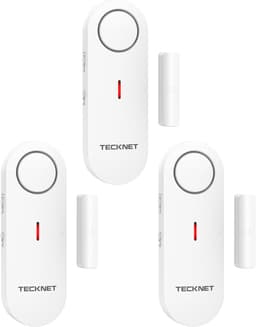
| Best overall |  TECKNET TECKNET window and door alarm, 3-pack | Magnetic contact | Parts more than 2 cm apart | Off, chime, alarm; 3 volumes | 8.6 | about £13.99 | View offer |
| Preis-Tipp |  VOXON VOXON magnetic window alarm, 4-pack | Magnetic contact | More than 20 mm apart | Off, chime, alarm; no volume slider | 8.6 | about £12.74 | View offer |
| Alternative |  Defender Defender ultra-slim window alarm, 2-pack | Vibration | Shock or glass impact | On/off | 6.4 | about £14.95 | View offer |


On this page
Vibration window alarm vs magnetic contact
What each type in this set can and cannot hear
Why a glass-break listener is a third device
When to buy which
Common questions
Will a contact alarm sound if the glass is smashed but the window stays closed?
Will a vibration puck sound if someone opens the window gently?
Is a glass-break sensor the same as a vibration alarm?
Can one vibration alarm cover two panes?
Which one fits a door I need to hear opening?
Can I use both on the same window?
Related pages
Sources
Public UK sources and the amazon.co.uk listings in this comparison. Listings checked 15 October 2026.
- Police.uk: keep burglars out of your property (retrieved 15 October 2026)
- ProtectUK: alarms and CCTV (retrieved 15 October 2026)
- nidirect: securing doors and windows (retrieved 15 October 2026)
- GOV.UK: how councils deal with noise complaints (retrieved 15 October 2026)
- Clean Neighbourhoods and Environment Act 2005, alarm powers (retrieved 15 October 2026)
- NSI: intruder alarm systems (retrieved 15 October 2026)
- NPSA: intrusion detection (retrieved 15 October 2026)
- Avon and Somerset Police: burglar alarms (retrieved 15 October 2026)