Independent comparisons. We may earn from shop links. More info

How to organise screws and fixings

Updated: 21 October 2026

A 4 mm screw and a 5 mm screw now share a bay because you were in a hurry. This is how to organise screws and fixings so you can see the size in six months without tipping the box out. It assumes you already have a lidded case, or you are about to fill one. It does not rank products. Prices are on the [parts organiser comparison](/hub/workshop/parts-organiser). Dividers, cups or drawers are the [parts organiser buying guide](/hub/workshop/parts-organiser/sub/parts-organiser-buying-guide). Peter F. used those listings and the UK notes below. This is not a lab method. If the case is already a junk box, empty it onto a tray before you relabel.

A 4 mm screw and a 5 mm screw now share a bay because you were in a hurry. This is how to organise screws and fixings so you can see the size in six months without tipping the box out.

Our top picks

On this page

Group the fixings

Group everyday wood screws by size. Group by job only when that bay always leaves for one task. A bay labelled kitchen cupboard screws fails the week a longer screw from it goes into a hinge. A bay of 4 × 40 mm countersunk screws survives. Keep wall plugs in the next bay. A similar colour makes them easy to mix at a skirting board. You do not need a bay for every length you have owned. Keep what you used in the last year and bag the rest. Fewer, fuller bays are easier to trust. A long coach screw goes in a divided case, not a small cup. One size in quantity goes in a cup the lid locks. If you are still choosing the hardware, stop filling. Leave one bay empty for today's mixed handful. That spare is a rule of thumb, not a maker instruction.

Label what you can see

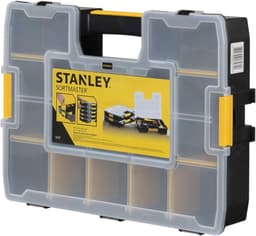
Write the size where you can read it without opening every bay. On a cup, note the rim, because the cup leaves the case. On a clear lid, label the edge so the screws stay visible. Use 4 × 40 CSK rather than wood screws various. The Amazon Basics bullets do not promise printed labels, so bring tape, and do not stick it across a joint that slides. A label on the outside of a SortMaster is useless once three cases are clipped and only the top lid shows. A wrong label is worse than none.

Close it and turn it

Close the lid and turn the case over a tray before you trust it in the car. On the FatMax 1-97-518, reviews say the lid locks the cups when the case is shaken. A Screwfix community post says those cups get very heavy when full. That is a user report, not a weight measured here. On the SortMaster, small items can still slip under the dividers even when larger screws stay put. Tip a comfortably full case on its side, then upside down for a few seconds, then open it. Mixed bays mean less fill, different dividers, or a cup for that size. Flat in the boot is not a fix if the next person stands the case on end. A leak you cannot close is cups versus dividers. Another colour of the same divider case leaks the same way. The best parts organiser note matches the case to that leak.

When one case is not enough

Stop when the case is heavy in one hand, or when two sizes share a bay. FatMax reviewers buy a second case rather than overfill the first. When the cases are the pile, the parts drawer cabinet page is the next step. The £3.59 pocket Stanley is for fuses and a few screws in a tote, not the overflow. Do not use these boxes for fuels or solvents, or when staff storage needs a risk assessment. A qualifying purchase can earn us a commission at no extra cost to you.

Common questions

Do I sort by length, by gauge, or by job?
Sort everyday wood screws by diameter and length, for example 4 × 40 mm in one bay and 5 × 50 mm in the next. Sort by job only for a kit that always travels together, such as the fixings for one piece of flat-pack furniture you have not built yet. A job bay goes stale. A size bay does not.
How do I label a clear lid without hiding the contents?
Put a short size at the edge of the bay, on tape, so the screws stay visible through the middle of the lid. On a removable cup, label the cup itself, because the cup is what you carry to the bench. Peel off any sticker that covers the plastic, which is what pocket-case reviewers do with the brand label.
What stops screws jumping bays in the car?
A lid that meets the dividers, or a lid that locks the cups, stops the jump. The check is to close the case and turn it over a tray before you rely on it. Dividers with a gap underneath will still let small washers through, which SortMaster reviews mention, even when larger screws stay put.
Should wall plugs live with the screws that use them?
Keep them in the next bay, not in the same one. A brown plug and a brass screw are easy to separate on a bench and easy to mix in a pocket. Label the plug bay with the drill size as well as the plug colour, so you are not guessing a 6 mm plug against a 7 mm one.
When is the case full enough to buy another?
Buy another when one hand no longer wants to carry it, or when you start sharing a bay between two sizes. Reviewers of deep cup boxes describe that weight and then buy a second case. There is no correct compartment count that means full.
What belongs in a pocket organiser instead?
The sizes you need with the tools, in small numbers: fuses, crimps, a few self-tappers, a couple of small screwdrivers. The pocket Stanley is listed at £3.59 and reviewers use it that way. It is not the overflow bin for the main case.

Related pages

Sources

Public UK sources and the amazon.co.uk listings compared on this page. Updated October 2026.

  1. Stanley Tools UK, FatMax 1-97-518 (retrieved October 2026)
  2. Sealants and Tools Direct, SortMaster 1-94-745 (retrieved October 2026)
  3. Screwfix tool storage buying guide (retrieved October 2026)
  4. Consumer Rights Act 2015, section 9 (retrieved October 2026)
  5. GOV.UK, General Product Safety Regulations 2005 (retrieved October 2026)
  6. HSE INDG412 (retrieved October 2026)
  7. SGS UK on IP testing (retrieved October 2026)
  8. Wickes, raaco 136242 (retrieved October 2026)