Independent comparisons. We may earn from shop links. More info

Pillar drill for metal: slow speed, peck and clamp

Updated: 2026-10-21

You want a clean hole in mild steel, and the listing still says metal next to a number that may be the chuck. A pillar drill for metal is the machine whose slowest step can run the bit, whose column does not flex, and whose work is clamped. The [Bernardo pillar drill comparison](/hub/workshop/bernardo-pillar-drill) is the model table. This page is speed, pecking and rigidity. A listed metal capacity is not a promise that the slowest belt step can run that bit. A qualifying purchase can earn us a commission at no extra cost to you.

You want a clean hole in mild steel, and the listing still says metal next to a number that may be the chuck.

Our top picks

SIP SIP Pro B20 bench drill

Best overall

SIP SIP Pro B20 bench drill
8.0/10about £434.75
KATSU Tools KATSU 100221 bench drill

Alternative

KATSU Tools KATSU 100221 bench drill
7.8/10about £149.99
On this page

A starting speed, not a guarantee

Metaldrilling.co.uk starts high-speed steel in mild steel near 25 metres per minute: about 800 rpm for a 10 mm bit and about 500 rpm for a 16 mm bit, on the nearest lower step. Rubbing with too little feed work-hardens the surface. Another rule of thumb is rpm roughly equal to 10,000 divided by the diameter in millimetres. A college example sits near 955 rpm for 10 mm at 30 metres per minute. These are starting points, not a test of any drill here. If your nearest lower speed is still faster, you are crowding the bit. Leaning on the handle does not correct that.

Which drills in this set can go slow enough

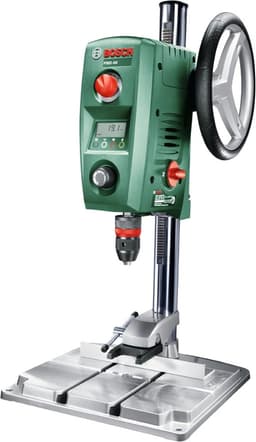
The closer matches have a slow belt step. The KATSU 100221 lists 12 speeds from 250 rpm, a 16 mm chuck and 20.1 kg, with no reviews. The SIP Pro B20 lists 16 speeds from 200 rpm, 80 mm of travel and 48.5 kg, with one 5.0 review that is not a sample. The SIP floor drill starts at 220 rpm. The Draper 95092 lists 16 speeds up to 3,000 rpm, but the slowest step is not printed, so do not invent it. Five-speed drills are the weaker match: Draper 38255 from 580 rpm, and KATSU models from 600 and 620 rpm. A 16 mm bit, nearer 500 rpm on the rule of thumb, does not fit. Draper reviews include stalling and a chuck that comes off. The Bosch has two gears up to 2,500 rpm, no printed slow floor, and 11.2 kg. Owners doubt it for serious metal. Ignore the 650 Nm cell. The Einhell 50 mm metal cell is a depth conflict, not a steel hole.
SIP SIP Pro B20 bench drill

Testsieger

SIP SIP Pro B20 bench drill
8.0/10about £434.75

Clamp, peck and a sharp bit

Clamp or vice the steel. A bit grabs at breakthrough, and thin sheet will climb the drill if nothing holds it. Use a sharp high-speed steel bit and a pilot for a larger hole. Peck: drill a short depth, lift so the flutes unload, and go again. A continuous shove on a 350 W head is how reviews describe a stall. A drop of cutting fluid stops the squeal that means the edge is rubbing. Keep it off the belt. Ease the feed as the point exits. A KATSU review that calls a 50 mm stroke short is a real limit. SIP’s stated 80 mm of travel is more room, and it is still a listing figure.

When the pillar drill is the wrong tool

Stop when the job is thicker or harder than a shed hole in mild steel. Thick plate, stainless and structural steel want a machine this set is not promising. Stainless work-hardens if you rub. A bent column, which a KATSU review reports, will not drill round however carefully you peck. A 3 kg mini or a 100 W head is the wrong tool before you switch it on. If the bit still squeals on the slowest step, change the bit or the machine. If the drill is work equipment, or the hole holds a building up, a fabrication shop is the next step. For a 6 to 10 mm hole in a mild-steel bracket, a slow step, a clamp and a peck are the whole method.

Common questions

Can a hobby bench drill drill steel?
A light hole, sometimes. Five-speed drills in this set that start near 580 to 620 rpm can manage a small bit in mild steel if you clamp, peck and ease off at breakthrough. Reviews on the Draper 38255 include stalling and a chuck that comes off. A large hole saw is already the wrong ask.
What rpm for a 10 mm bit in mild steel?
As a rule of thumb, about 800 rpm at 25 metres per minute, or about 1,000 rpm if you use 10,000 divided by the diameter. Use the nearest lower step your drill actually has. These drills were not measured at those speeds. The figures are a start, not a guarantee.
Do I need cutting fluid?
On mild steel, yes, a little. It keeps the edge from rubbing and squealing. It does not fix a drill whose slowest speed is still too fast, and it does not replace a clamp. Keep fluid away from the belt and do not defeat a guard to apply it.
Is the Bosch good for metal?
It gives you electronic control up to 2,500 rpm and two gears, which is easier than a single fast belt. It is 11.2 kg, and owners doubt it for serious metal. Run-out matters when the hole must be precise. Ignore the 650 Nm cell. It is not credible for 710 W.
What is peck drilling?
You drill a short way, lift the bit so swarf leaves the flutes, and continue. On steel that keeps the edge cooler than one long shove. It still needs a clamp and a depth that fits the spindle travel. Some KATSU bullets limit that travel to 50 mm.
When should I use a different machine?
When the steel is thick, stainless or structural, when the column is bent, or when the slowest speed is still too fast and the bit only rubs. A mini drill is already the wrong machine. A fabrication shop is the next step, not a heavier feed on the same head.

Related pages

Sources

Public UK and manufacturer sources from the research digest, last checked on 21 October 2026.

  1. HSE: PUWER overview (retrieved 21 October 2026)
  2. HSE: Work equipment and machinery introduction (retrieved 21 October 2026)
  3. HSE: UK law on the design and supply of machinery (retrieved 21 October 2026)
  4. BSI: BS EN 12717:2001+A1:2009, safety of drilling machines (retrieved 21 October 2026)
  5. Bernardo: bench drilling machine TB 16 T, 230 V (retrieved 21 October 2026)
  6. ManoMano UK: pillar drill buying guide (retrieved 21 October 2026)
  7. DIY Doctor: using a pillar drill (retrieved 21 October 2026)
  8. Metaldrilling.co.uk: drilling mild steel (retrieved 21 October 2026)