Independent comparisons. We may earn from shop links. More info

Glyphosate or contact weed killer

Updated: October 2026

You have a dock in a path crack that went brown after one spray and then greened up from the crown. That return is the decision. A glyphosate or contact weed killer is two different claims: a root treatment, or a fast scorch of the leaf the droplet hits. This page sorts seven amazon.co.uk listings by the chemistry they print, so you know which claim you are paying for. Pack size and a wider shortlist sit on the [weed killer comparison](/hub/weed-control/weed-killer). The Products Compared editorial team checked these listings in October 2026 against Health and Safety Executive guidance and Royal Horticultural Society notes. We did not run a garden trial. Links to amazon.co.uk are affiliate links.

You have a dock in a path crack that went brown after one spray and then greened up from the crown. That return is the decision.

Our top picks

On this page

What a root claim does, and what a scorch does

Glyphosate is systemic. On a listing that names it, you spray growing green leaf and the active is meant to move into the root. Health and Safety Executive advice is to avoid drift, and not to use glyphosate on a lawn. HSE guidance G212 describes contact herbicides as a scorch only: the effect is rapid, large or perennial weeds may regrow, and moss is held for up to about four weeks. Contact products are not for lawns either. The Royal Horticultural Society draws the same line in the plant. Glyphosate moves into the root. Pelargonic acid or acetic acid scorches what the droplet hits, and woody growth often recovers. A young annual in a patio joint can blacken in a day or two and look finished. A dock, nettle or bindweed still has a crown or a runner under that brown leaf. Compared with a glyphosate product that claims the roots, a contact spray shows sooner and leaves the perennial behind. If the bottle never claims a root kill, plan on a repeat.

Where these seven listings sit

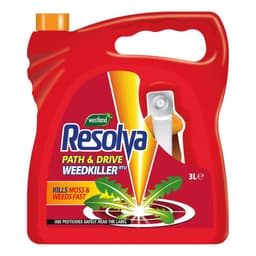
Three listings name glyphosate. Roundup Total Fast Action, two ready-to-use 1 litre bottles (B0HGBK3T8H, £12.98), claims the roots and a visible effect in one to two days. It is the only listing that says children and pets need not be excluded once the spray is dry. Roundup Pump 'N Go 5 litre refill (B01CNEM3EG, £25.99) is systemic, claims the roots, and needs a pump you already own. Gallup 1 litre (B0F2GVG8BD, £21.75) is 360 g/L glyphosate to dilute. The bullets do not say systemic. The title says both home and garden and industrial, and amateur use is not confirmed, so do not treat it as a home product until the label says so. Resolva Path & Drive 3 litre (B0GJTQJD4Q, £18.00) names pelargonic acid, includes moss, and has no root sentence. It is the only bottle here that names that acid, so glyphosate-free is not one formula. Topline Xpress 24H 5 litre refill (B0C4Z2TJBW, £23.99) says glyphosate-free, describes desiccation, and allows a repeat on large perennial weeds, with coverage of about 125–250 m². The acid is not named. A lawn bullet conflicts with reviews that say it killed grass, and with G212. Resolva 24H 1 litre (B001DYSARM, £9.70) claims the roots and about 35 m² without naming an active. Resolva Path & Drive 5 litre pump (B0GJTGTCCB, £25.99) is sold for weeds and moss. Reviewers call it contact and glyphosate-free. The listing does not, and it does not name pelargonic acid, so those reviews are not the label. Pack and coverage sit in the weed killer buying guide.

When to take the root claim, and when to take the scorch

Take a listing that claims the root and names glyphosate when the weed will come back from underground. An established dock, nettle or bindweed is that case. Roundup Total Fast Action 2 × 1 litre is the conditional pick when you want a ready-to-use bottle and the once-dry line for children and pets. The Pump 'N Go refill fits only if you already have that sprayer. Gallup stays off the pick while a systemic claim is missing and amateur use is unchecked. None of the three belongs on a lawn. Take Resolva Path & Drive 3 litre for a quick scorch of small weeds and moss on a named path or drive, if you will spray again. Pelargonic acid is printed, a root kill is not, and G212 says contact products do not give long-term control. About four weeks is the moss horizon. It is the wrong bottle for a dock crown. The 5 litre Path & Drive pump looks similar, but the active is not stated, so it is not this pick. Pumps, stains and drain run-off are on the patio and driveway weed killer page.

December 2026 and the open extension

Glyphosate's approval in Great Britain runs to 15 December 2026. The Health and Safety Executive extended that date so the renewal assessment can finish. A granted renewal could last up to 15 years. On 5 October 2026, Stephen Timms said in a written parliamentary answer that HSE is considering a further extension on the same basis. That further extension has not been agreed. The December date is the end of the current approval window. The date does not pick the bottle. A pelargonic acid spray is still a scorch if glyphosate stays approved, and a root claim still needs the active named and green leaf to spray. Northern Ireland has its own authorisation, so a Great Britain-only product is not valid there. Read the amazon.co.uk listing for a root claim, a contact scorch, or a missing active before you buy.

Common questions

Does a brown leaf mean the root is dead?
A brown leaf means the spray reached the foliage, not that the root is dead. Glyphosate, where the listing names it and claims the roots, is meant to move down from green leaf. A contact spray such as pelargonic acid scorches only the tissue the droplet hits. HSE guidance G212 says large or perennial weeds may regrow, and the Royal Horticultural Society notes that woody plants often recover. A green crown a fortnight later was never finished by the scorch.
Which listings name glyphosate?
Three of the seven name it. Roundup Total Fast Action 2 × 1 litre (B0HGBK3T8H, £12.98) claims the roots, a result in one to two days, and the once-dry line for children and pets. Roundup Pump 'N Go 5 litre refill (B01CNEM3EG, £25.99) is systemic and claims the roots. Gallup 1 litre (B0F2GVG8BD, £21.75) states 360 g/L glyphosate to dilute, without a systemic line, and amateur use is not confirmed. The other four do not name glyphosate.
Which listings are contact, and which only look like it?
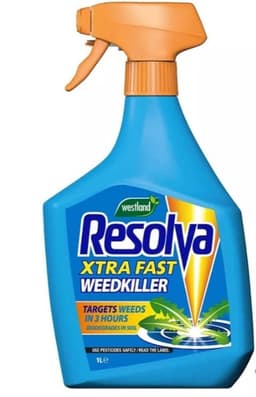
Resolva Path & Drive 3 litre (B0GJTQJD4Q, £18.00) names pelargonic acid, includes moss, and makes no root claim. Topline Xpress 24H 5 litre (B0C4Z2TJBW, £23.99) says glyphosate-free and describes desiccation, with a repeat on large perennial weeds, but it does not name the acid. Resolva Path & Drive 5 litre (B0GJTGTCCB) looks like the 3 litre bottle. Reviewers call it contact. The listing does not, so pelargonic acid stays on the 3 litre bottle only.
Is glyphosate banned in December 2026?
HSE extended Great Britain approval to 15 December 2026 so the renewal assessment can finish. A granted renewal could last up to 15 years. On 5 October 2026 a written answer from Stephen Timms said HSE is considering a further extension. That extension has not been agreed. There is no December 2026 ban to buy around. Choose the claim printed on the listing, not a date that is still open.
Will a contact spray kill a dock?
A contact spray will not finish an established dock. The plant regrows from the crown, and G212 expects a repeat on large perennial weeds because contact products do not give long-term control. Pelargonic acid on the Resolva 3 litre scorches the leaf and does not claim the root. For a dock, nettle or bindweed that has returned, use a listing that names glyphosate and claims the root.
Why does Topline mention a lawn?
Topline Xpress 24H says glyphosate-free, and one bullet mentions lawn weeds. Reviews on that amazon.co.uk listing say the spray killed grass. HSE guidance G212 says contact herbicides should not be used on lawns. The bullet conflicts with those reviews and with that guidance, so it is not a selective lawn weed killer. Keep Topline off the turf.
What if the listing does not name an active?
You cannot tell a root kill from a scorch. Resolva 24H 1 litre (B001DYSARM, £9.70) claims the roots and names no active. Resolva Path & Drive 5 litre (B0GJTGTCCB, £25.99) names none either, although reviewers say it is a contact spray. Only the 3 litre Resolva prints pelargonic acid. If the active is missing, leave that bottle out and buy a listing that states the chemistry.

Related pages

Sources

Public UK sources from the research digest, last checked on 16 October 2026. Shelf prices and star lines are the amazon.co.uk figures in the display file. This page did not run a laboratory test and does not confirm a MAPP number.

  1. HSE: garden and allotment use (retrieved 16 October 2026)
  2. HSE: glyphosate renewal (retrieved 16 October 2026)
  3. HSE: garden pesticide search (retrieved 16 October 2026)
  4. HSE: G212 contact and glyphosate (retrieved 16 October 2026)
  5. HSE: P501 amateur disposal (retrieved 16 October 2026)
  6. RHS: weeds on hard surfaces (retrieved 16 October 2026)
  7. RHS: storing and disposing of chemicals (retrieved 16 October 2026)
  8. DAERA: operator responsibilities for pesticides (retrieved 16 October 2026)