Independent comparisons. We may earn from shop links. More info

Roundup weed killer for patio and driveway weeds

Updated: October 2026

The weeds are in the joints of a patio or along the edge of a drive, and you want a Roundup weed killer patio treatment that does not paint the slabs. A path spray can kill the plant that is growing in the crack. It can leave a white mark, and it does not stop the next seed. The bottles and the prices are on the [Roundup weed killer comparison](/hub/weed-control/roundup-weed-killer). Rain, pets and the full waiting rules are on [how to use Roundup weed killer](/hub/weed-control/roundup-weed-killer/sub/roundup-weed-killer-how-to-use). The Products Compared editorial team wrote this on 16 October 2026 from the Path and Drive label PDF, these amazon.co.uk listings, a block-paving note from Thomas Armstrong, and a GardeningUK report of white marks. We did not stain a slab in a lab. A qualifying purchase can earn a commission at no extra cost to you.

The weeds are in the joints of a patio or along the edge of a drive, and you want a Roundup weed killer patio treatment that does not paint the slabs. A path spray can kill the plant that is growing in the crack.

Our top picks

Roundup Roundup Total Optima

Best overall

Roundup Roundup Total Optima
7.9/10about £16.98
Roundup Roundup Path

Preis-Tipp

Roundup Roundup Path
8.2/10about £8.84
On this page

Paths, patios, tarmac and gravel are on the path label

The Roundup Fast Action Path and Drive label, pack model 120036, lists paths, drives, patios, tarmac, paving and gravel. It says the product is not for lawns, and it says do not treat near drains, wells or watercourses. It also says do not walk wet product onto the lawn. The stated cover on that label is up to 30 m², the rain line is within six hours, and the active line on that label is 7.2 g/L glyphosate. Model 120036 is not an ASIN in this set. Treat the label as the brand's description of a path spray, then check the listing you are about to buy, rather than assuming the PDF is the bottle in the basket. Joints in block paving, a gravel strip and a tarmac edge are the places a path product is written for. A lawn, a stump and a plant in a drain are not. Thomas Armstrong says weeds grow in the joints, not through the blocks, and that a weedkiller used sparingly should not damage the blocks. If you pull the weed and drag the sand out, replace the sand.

The bottles in this set that name hard surfaces

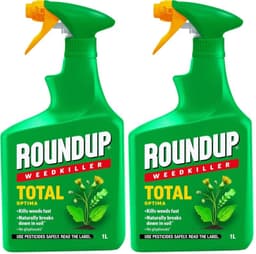
Three listings are the ones people actually use on this job. B01MSANUPH is the path bottle at £8.84, listed at up to 30 m², and the listing names paths, patios and drives. It shows 4.4 from 5,808 ratings. In this comparison it is the best value. The Amazon active cell says green, so the formula still has to be read on the label, not taken from that cell. Reviews mention white marks and a stiff trigger. A stiff trigger is awkward on a narrow joint. B0HGBK3T8H, the Fast Action twin at £12.98, is the top pick for a few weeds you can see. Reviews mention patio edges, regrowth within weeks and a slight leak. Our capture has no square-metre figure, so two triggers are not a stated 60 m² of drive. Put it on the weed, not on bare concrete. B0G4XVZBV6 is the Total Optima twin at £16.98, glyphosate-free pelargonic acid, 4.5 from 395 ratings. The bullets talk about beds, while reviews describe block paving and doubt the root. That is a contact scorch, not the root-kill tick on path and Fast Action lines. Skip it if you wanted a systemic claim. Who each pick is for, beyond the patio, is on the best Roundup weed killer in this set.
Roundup Roundup Total Optima

Testsieger

Roundup Roundup Total Optima
7.9/10about £16.98

White marks are a reported residue

Path reviews in this set mention white marks on the patio. Reviews on the Tough twin mention them too. A GardeningUK thread describes the residue as salts that rain washes off. That is a reported experience, not a measured stain test, and it does not promise that every mark leaves with the next shower. A covered porch may never see the rain that thread relies on, and you still accept a mark until weather shifts it. More liquid on a pale slab is more residue, and a leak on B0HGBK3T8H can leave a drip you did not intend. We cannot say the marks always vanish. Buyers of the path bottle already report them, so test one joint before you treat a whole terrace.

The joint still has soil

Killing today's weed does not empty the crack. Thomas Armstrong's point is that the joint is where the plant is living, in the sand and soil between blocks, not in the concrete. The GardeningUK account says the same thing from the other end: once the weed is dead, the soil is still there, so a new seed can use it. Reviews on the path bottle describe weeds back in weeks. Reviews on the Fast Action twin describe regrowth in a similar span. Neither chemistry seals the joint. A scorched Optima top still leaves the gap. If you pull the dead stem and the sand comes with it, replace the jointing sand once the surface is dry, not in the same hour. A weedkiller is not a seal. Knotweed between slabs is outside this page: do not point the stump bottle at it.

One litre is about 30 m², and not beside a drain

The path listing's claim is up to 30 m². A drive 30 metres long and about 3 metres wide is about 90 m², three times that claim. One litre is a run of joints or a small patio, not the whole drive. The Fast Action twin states no square-metre figure here, so do not double the path claim. The Optima pump's 165 m² claim is a bed listing, not 165 m² of tarmac. Do not treat near drains, wells or watercourses. A weed in the gully is that case. Rain within six hours on that glyphosate path label ruins the spray. Gravel is on the surface list, with the same bans: treat the weeds among the stones, not a soakaway. If the area is bigger than these bottles, start from the Roundup weed killer buying guide.

Common questions

Can you use these listings on a patio or drive?
Yes, where the listing or the path label names those surfaces: paths, drives, patios, tarmac, paving and gravel. B01MSANUPH names paths, patios and drives and claims up to 30 m². B0HGBK3T8H is used on patio edges in reviews and has no square-metre figure in our capture. They are not for lawns. Model 120036 on the brand PDF is not one of our ASINs, so match the words on the bottle you buy.
Will block paving be stained?
Buyers of the path bottle, and of the Tough twin, report white marks. A GardeningUK thread calls the residue salts that rain washes off. That is a report, not a lab test, and it does not mean every mark goes. Thomas Armstrong says a weedkiller used sparingly should not damage the blocks, because the weed is in the joint. Flooding the face of a pale slab is the pattern that leaves a stripe. Test one joint if the patio colour matters.
Will the weeds come back in the same cracks?
They can. Path reviews describe weeds back in weeks, and Fast Action reviews describe regrowth on a similar timescale. The joint still holds soil, which is where Thomas Armstrong says the plants grow, so a new seed can use it. Killing the stem is not a seal. If you pull the root and drag the sand out, replace the jointing sand after the surface is dry. Neither glyphosate nor pelargonic acid empties the crack.
Is 1 litre enough for a drive?
At the path claim, 1 litre is up to 30 m². A drive about 3 metres wide and 30 metres long is about 90 m², so one bottle at that rate does not cover it. A 3 by 15 metre drive is already about 45 m². Use the litre on the joints you can see, not on the whole rectangle. The twin pack does not state a square-metre figure here, so it is not automatically twice the path claim.
Glyphosate path spray or Optima on slabs?
The path bottle is the listing that names paths, patios and drives, at £8.84, with the best-value role in this set. Total Optima, B0G4XVZBV6, is glyphosate-free and shows up in block-paving reviews, but its bullets talk about beds and it does not carry the root-kill tick. Choose Optima when avoiding glyphosate is the point and a contact scorch is enough. Choose the path listing when the label names the hard surface and you accept the white-mark reports.
Can you spray near a drain, or pull the weed out?
Do not treat near drains, wells or watercourses, including a weed in the gully. Gravel is allowed on the path label only as weeds among stones, not as a soakaway. Pulling drags jointing sand with the root, so Thomas Armstrong says replace what you remove, after the surface is dry. Spraying the growing plant and leaving the joint filled still leaves soil for the next seed.

Related pages

Sources

Public UK sources from the research digest, last checked on 17 October 2026. Shelf prices and star lines are the amazon.co.uk figures in the display file. Coverage figures are listing claims, not a test run for this page.

  1. HSE: glyphosate renewal (retrieved 17 October 2026)
  2. HSE: garden and home use of pesticides (retrieved 17 October 2026)
  3. HSE: garden pesticide search (retrieved 17 October 2026)
  4. HSE: G212, using pesticides in the garden (retrieved 17 October 2026)
  5. Plant Protection Products Regulations 2011 (retrieved 17 October 2026)
  6. Plant Protection Products (Sustainable Use) Regulations 2012 (retrieved 17 October 2026)
  7. GOV.UK: prevent Japanese knotweed from spreading (retrieved 17 October 2026)
  8. Love the Garden: product ingredients (retrieved 17 October 2026)