Independent comparisons. We may earn from shop links. More info

Artificial palm vs real palm UK: décor or a hardy live tree

Updated: October 2026

You want a palm in the garden, or you want a green corner that never needs water, and amazon.co.uk serves both from the same “palm tree” box. This page is the split: an artificial palm vs real palm UK decision is a choice of supply chain, not a score for the ten decorative ASINs. None of those ten is a live plant. UV and wind on silk sit on [indoor or outdoor artificial palm](/hub/trees-and-palms/palm-tree/sub/palm-tree-indoor-or-outdoor). How to choose a faux height sits on the [artificial palm tree buying guide](/hub/trees-and-palms/palm-tree/sub/palm-tree-buying-guide). Room-by-room faux picks sit on [best artificial palm tree](/hub/trees-and-palms/palm-tree/sub/palm-tree-best). The [palm tree comparison](/hub/trees-and-palms/palm-tree) ranks décor only. The notes here follow RHS species pages and GOV.UK plant-passport guidance, not a garden trial.

You want a palm in the garden, or you want a green corner that never needs water, and amazon.co.uk serves both from the same “palm tree” box.

Our top picks

On this page

Two products behind one search

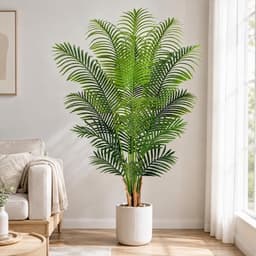
A faux floor palm is polyester, silk or plastic on wire, usually in a small starter pot. You fluff it, you ballast it, and it stays the height on the carton. The ten kept listings are this job: nine floor or desk trees and one 90 cm inflatable. They do not grow, they do not need a plant passport, and they do not become hardy because the title used the word areca. A live palm is a plant for planting. In a UK garden that means a species the RHS actually rates for cold, planted in spring into drained ground, or kept in a pot you can protect. It needs water, drainage and a winter plan. It also needs the paperwork that silk never needs. Faux is the right buy when you rent a flat, you have no outdoor tap, you want the corner dressed this weekend, or you refuse to water. It is also the right buy for a one-night party, which is the inflatable, not a Chusan palm. It is the wrong buy when you wanted a trunk in a Yorkshire bed, a plant that will gain height, or something that looks better in year five than in week one. Live is the right buy when you have a sheltered, well-drained spot and you will wait. It is the wrong buy when you picked a live areca because a faux listing used the same common name. Live Dypsis lutescens (also listed by the RHS under Chrysalidocarpus lutescens) is H1A: a houseplant, with a winter minimum around 13 °C on the RHS indoor-palms page. It is not a flower-bed plant in Leeds or Aberdeen. Indoor-or-outdoor, on the silk pages, is about UV wording. It is not an H rating. Do not read a Keeplush “outdoor” bullet as proof that a live areca will survive a frost.

Which live palms the RHS actually rates

The hardy shortlist is short, and the Canary Island date palm is the one UK pages argue about. Trachycarpus fortunei, the Chusan palm, is the widely grown garden palm. The RHS species page rates it H5, about −15 to −10 °C, in a sheltered, well-drained spot, protected from drying winds and hard frost. That is the tree people mean when they say a palm can live in the ground in much of Britain. It is not in this amazon décor set, and a faux areca is not a substitute for its fibrous trunk. Chamaerops humilis, the dwarf fan palm, is H4 on the RHS, roughly −10 to −5 °C, again sheltered and drained. It fans rather than feathers. Pots are more at risk than open ground, as the hardy-palms article notes. It is a live garden or large-patio plant, not a 71 cm silk. Phoenix canariensis is the conflict you must not average. The RHS species page rates it H2. The RHS hardy-palms article quotes about −8 °C. Those two figures both stay on the page. H2 is not H5. A mild coastal garden and a hard inland frost are different bets, and this site will not call the Canary Island date palm reliably hardy in the UK. Live areca is H1A. If a marketplace photo of silk Dypsis made you order a live areca for a border, send it back to a heated room. It will not harden to a British winter because a faux cousin sat on a patio in the search results. RHS hardy-palms advice is mid-spring planting, shelter, and drainage. Winter wet kills as many palms as cold. The article is about living plants. It does not rank Keeplush, Tuocal or ZEEOZE, and those ASINs do not borrow an H code. When the species is wrong, a nursery will tell you in one sentence. When the species is right and the site is a frost pocket on clay, an arborist or a specialist palm nursery is the next call, not a larger silk tree.

Pots, winter and plant passports

A live palm in a pot is colder than the same plant in the ground. Roots sit above the soil, the compost freezes, and winter rain sits in a saucer. The RHS hardy-palms page flags that extra risk. If your only space is a balcony, you either wrap and drain a hardy species, or you buy UV-worded faux and ballast it. A live areca on that balcony is a houseplant you take indoors by October. Distance sales of plants for planting in Great Britain still need a UK plant passport, down to the final user, under GOV.UK guidance on issuing plant passports. That includes a live palm you order for yourself. Silk, polyester and a PVC inflatable are not plants for planting. Do not email a Keeplush seller for a passport, and do not skip the passport question on a live mail-order palm because the décor listings did not mention one. Commercial live imports are a plant-health job, not a décor job. If you are stocking a garden centre or a landscape project, use a registered supplier. If you are planting a mature live palm, hire a nursery or arborist who can lift and stake it. The Consumer Rights Act 2015 still covers a live plant that arrives dead or not as described; it does not turn a faux tree into a hardy species. Stay on the main comparison when you want a finished green object this week and you will fluff and ballast it. Leave the comparison for a nursery when you want a trunk in the ground and you can name Trachycarpus fortunei or Chamaerops humilis as the plant, not “areca”. For a patio, pick UV-worded faux with a heavy pot, or a hardy live palm you can protect; do not split the difference with a live areca. Phoenix stays a maybe only if you accept H2 on the species page and about −8 °C in the other RHS article, without averaging them into a false H3.

Common questions

Can I plant an amazon “palm tree” from this set in the garden?
No. The ten kept ASINs are décor: nine faux palms and one inflatable. They have no roots that will establish. Planting the starter pot in a bed will rot the pot and leave a silk crown on a stick.
Which live palm is actually hardy in the UK?
The Chusan palm (Trachycarpus fortunei) is H5 on the RHS, the one widely grown in the ground. The dwarf fan palm (Chamaerops humilis) is H4. Both want shelter and drainage. That is not a promise they will thrive in every postcode.
Is a Canary Island date palm as hardy as a Chusan palm?
No. Phoenix canariensis is H2 on the RHS species page, while another RHS hardy-palms article quotes about −8 °C. Chusan is H5. Do not average those figures, and do not call Phoenix reliably hardy.
Is a live areca for a flower bed?
No. Live areca (Dypsis lutescens / Chrysalidocarpus lutescens) is H1A. The RHS indoor-palms page keeps it above about 13 °C in winter. It is a houseplant, not a Yorkshire border plant.
Do I need a plant passport for a silk tree?
No. A silk or polyester palm is not a plant for planting. GOV.UK passport rules do not apply to the nine faux listings or the inflatable.
Do I need a plant passport if I buy a live palm online?
Yes for distance sales of regulated plants for planting in Great Britain, including many palms sold by post. The seller should issue the passport; you still check the plant on arrival.
Patio pot: faux or live?
UV-worded faux with ballast if you want zero watering and you accept fade and rust as risks. A hardy live palm if you will drain the pot and protect it in hard frost. A live areca belongs indoors by winter, not on an open patio year-round.
When should I call a nursery instead of ordering décor?
When you want a named hardy species in the ground, a mature specimen that needs lifting, or advice on a frost pocket. Call a plant-health importer for commercial live imports. Call a fire-risk assessor for workplace foliage; that is not a nursery job and not a star rating.

Related pages

Sources

Public UK sources used for this comparison, last checked in October 2026.

  1. RHS, Hardy palms (retrieved October 2026)
  2. RHS, Trachycarpus fortunei (retrieved October 2026)
  3. RHS, Chamaerops humilis (retrieved October 2026)
  4. RHS, Phoenix canariensis (retrieved October 2026)
  5. RHS, Chrysalidocarpus lutescens (retrieved October 2026)
  6. RHS, Hardiness ratings (retrieved October 2026)
  7. GOV.UK, Issuing plant passports in Great Britain (retrieved October 2026)
  8. Kent Fire and Rescue, Artificial or dried foliage (retrieved October 2026)
  9. Leaf, Artificial palm tree guide (retrieved October 2026)
  10. Botanik, Can you use artificial plants outside? (retrieved October 2026)