Independent comparisons. We may earn from shop links. More info

Sander dust extraction UK: bags, vacuums and classes

Updated: 17 October 2026

Sander dust extraction in the UK is more than emptying the small bag supplied with a tool. Reviewers say Einhell belt bags fill or leak, detail-sander boxes miss dust, and the TE-RS bag struggles on filler unless a vacuum is connected. An onboard collector can reduce mess, but it does not state a dust class and should not be treated as proof that the air is safe. For powered wood sanding, HSE guidance points to on-tool extraction with a Class M or H unit, plus suitable respiratory protection where the assessment requires it. Compare each model’s supplied connection in the [main Einhell sander comparison](/hub/tools/einhell-sander). A qualifying purchase can earn a commission at no extra cost to you.

Sander dust extraction in the UK is more than emptying the small bag supplied with a tool.

Our top picks

On this page

What the Einhell bag actually catches

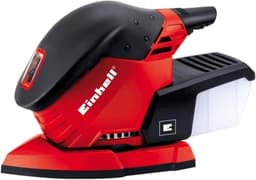
Every retained Einhell listing offers some form of box, bag, adapter or hose. The £22.99 corded detail sander has an onboard box, while the TC-OS 1520 sheet model supplies an adapter intended for a vacuum. Cordless detail and random-orbit bodies combine a small collector with an external connection. The belt machines include bags, and the 225 mm drywall tool supplies a 2 m hose, an adapter and a bag. Those components catch larger debris near the pad, but the review pattern is consistent: they do not capture everything. Several corded detail-sander reviewers find the box only partly effective, especially on vertical surfaces. TE-OS 18/150 users report weak collection, and its box has a physical clearance issue with thick batteries. TE-RS reviewers prefer a vacuum when working on filler. Belt sanding exposes the limits most clearly because it removes material quickly. Reviewers describe the TC-BS 8038 bag as weak and say collection improves with a vacuum. One TE-BS 8540 E reviewer reports that its bag fills in about 30 seconds. A full bag cannot maintain useful airflow, and leaks let fine material escape before the bag fills. None of these observations is a measured capture percentage, and none of the listings states that the built-in collector meets Class L, M or H. Dust bag included is a description of equipment, not a safety rating. Connect the tool to an appropriate extractor with a proper adaptor. Tape around an ill-fitting household hose is not the controlled connection in HSE’s guidance for hand-held sanders. The how to use an Einhell sander guide covers fitting the abrasive. Extraction should be running when sanding begins.

Wood dust calls for Class M or H extraction

HSE’s WD7 guidance for hand-held powered sanders specifies on-tool extraction connected to a Class M or H vacuum unit. It also says the extraction unit should have a thorough examination and test at least every 14 months in workplace use. These requirements sit within an employer’s duties. A householder is not automatically subject to COSHH in the same way. The health hazard does not disappear at home, so the control principle remains sensible. Wood dust can cause asthma and other harm. HSE gives workplace exposure limits, averaged over eight hours, of 3 mg/m³ for hardwood dust and 5 mg/m³ for softwood dust. Where hardwood and softwood dust are mixed, the hardwood limit applies. These are legal exposure limits for work, not targets showing that dust below them is harmless, and a DIY user cannot judge airborne concentration by how tidy the bench looks. HSE says belt sanding can produce very high dust levels. Its construction guidance indicates that respiratory protective equipment with an assigned protection factor of 20, with FFP3 given as an example, is likely to be needed for most powered wood sanding indoors. RPE supplements extraction. It does not replace capture at the tool. Correct selection, fit and use matter, particularly in a workplace programme. Do not sweep settled wood dust or blow it away with compressed air, because that puts fine particles back into the air. Use a suitable extractor and its approved emptying method. Keep other people out of the work area. A domestic vacuum that releases fine dust at its exhaust can turn visible cleanup into airborne exposure.

A household vacuum is not automatically Class M

A Henry or another household vacuum is not automatically a Class M extractor. Adding a filter described as HEPA does not by itself give the whole machine the containment, warning and certification features of an M-class unit. Check the unit’s declared dust class rather than inferring it from the filter material or brand familiarity. The tool-to-hose connection matters too. Use the proper adaptor and inspect it for leakage. The TP-RS review evidence includes a user who found a Henry hose a poor fit, which illustrates the practical problem but does not certify any alternative. If the connection cannot be made securely, choose compatible extraction rather than running the sander with a makeshift joint.

Plaster dust and the detail-sander battery problem

HSE’s CIS69 guidance distinguishes lower-toxicity dust such as gypsum in plasterboard, for which Class L may be applicable, from the usual construction dusts that require Class M or H. That does not mean every white dust produced on a wall is clean gypsum. Jointing compounds, old coatings, fillers and substrate contamination can change the hazard, so identify what is being sanded before selecting the extractor. The TP-DW 18/225 drywall sander includes a 2 m hose and is described for plasterboard walls and ceilings. Its listing does not state a dust class, and the available source material contains only one written UK review. Do not infer capture performance from the hose or from the listing’s 4.2 rating from 110 customers. Connect a suitable unit for the identified dust, and plan the work around the tool’s body-only battery demand. Wood filler creates another easy mistake. A reviewer may call the material filler, but that word alone does not establish that the dust is pure gypsum and suitable for Class L handling. If the sander moves between timber, paint and filler, choose controls for the combined hazard rather than the least demanding material in the room. The TE-OS 18/150 cordless detail sander has a separate mechanical obstacle. UK reviewers and Einhell information indicate that a thick 4 Ah Power X-Change pack blocks the dust box, while a slimmer pack lets it fit. The body still operates if the box is removed, but that is not a reason to sand without extraction. Use a compatible slim battery with the box, or connect suitable external extraction as the tool instructions allow. The Einhell sander buying guide explains why a low bare-tool price may not represent the complete setup.

Common questions

Is the dust box on an Einhell sander enough for wood?
It can reduce visible mess, but reviews say boxes and bags miss dust or fill quickly, and none of these listings states a dust class. HSE workplace guidance for powered wood sanding calls for on-tool extraction with a Class M or H unit. Treat the onboard box as a collector, not the whole control system.
What vacuum class do I need for wood dust?
HSE WD7 specifies Class M or H for hand-held powered wood sanders. Select a certified unit suitable for the task and connect it with the proper adaptor. Workplace users also need to follow examination, maintenance and COSHH arrangements rather than relying on the class label alone.
Can I use a Henry or household vacuum?
Only if the exact unit is properly classified and suitable for the identified dust. An ordinary household machine is not automatically Class M. A HEPA-labelled replacement filter does not transform the complete vacuum into a certified M-class extractor. A poorly fitting hose is another reason not to improvise.
Is plasterboard dust the same as wood dust?
No. HSE guidance allows Class L for lower-toxicity dust such as gypsum, while wood sanding calls for Class M or H. Wall dust may include jointing compound, paint, filler or other material. Identify the substance rather than assuming every pale dust is clean gypsum.
Do I need a mask when sanding at home?
HSE indicates APF 20 respiratory protection, with FFP3 as an example, is likely for most powered wood sanding indoors in work settings. A householder’s legal position differs from an employer’s, but the hazard remains. Respiratory protection should supplement suitable extraction, and it must fit and be used correctly.
Should I sweep up sanding dust?
Do not dry-sweep wood dust or blow it with compressed air, because that makes settled fine particles airborne again. Use a suitable extractor and follow its safe emptying instructions. Keep the area controlled while cleaning so other people are not exposed.

Related pages

Sources

Public UK sources for wood dust, extraction class, vibration limits, and BS 1363 plugs. Listings are the amazon.co.uk captures for these ten ASINs on 15 October 2026, not a live reload on 17 October 2026. Prices on amazon.co.uk move.

  1. HSE, Wood dust (retrieved 15 October 2026)
  2. HSE, WD7 (retrieved 15 October 2026)
  3. HSE, Cutting and sanding wood (retrieved 15 October 2026)
  4. HSE, CIS69 (retrieved 15 October 2026)
  5. Control of Vibration at Work Regulations 2005 (retrieved 15 October 2026)
  6. Electrical Equipment (Safety) Regulations 2016, regulation 35 (retrieved 15 October 2026)
  7. Einhell UK sanders (retrieved 15 October 2026)
  8. Homebuilding, types of sander (retrieved 15 October 2026)