Independent comparisons. We may earn from shop links. More info

Sanding dust extraction: what the dust bag cannot do

Updated: 17 October 2026

Sanding dust extraction matters even when the tool is small, cordless and used for only one decorating job. A cloth bag or plastic box may catch visible debris, but it does not prove that fine wood, MDF, filler or coating dust is controlled. UK Health and Safety Executive guidance for powered sanding sets a higher workplace standard: effective on-tool extraction, suitable respiratory protection and vacuum clean-up rather than sweeping. This page explains what that means in practical terms without claiming that a household job is legally governed by workplace exposure limits. For product ports and collectors, see the main [cordless sander comparison](/hub/tools/cordless-sander). A qualifying purchase can earn a commission at no extra cost to you.

Sanding dust extraction matters even when the tool is small, cordless and used for only one decorating job.

Our top picks

On this page

What the dust is

Powered sanding creates particles across a range of sizes. The visible layer on a bench is only part of the material released; finer dust can remain airborne and travel beyond the immediate work area. MDF contains wood fibre and produces fine dust when machined. Filler and old coatings add their own unknowns, so the fact that a job takes five minutes does not make uncontrolled dust harmless. HSE’s workplace exposure limits are 3 mg/m³ for hardwood dust and 5 mg/m³ for softwood dust over an eight-hour reference period. Where hardwood and softwood are mixed, the 3 mg/m³ figure applies. These are occupational limits, not a DIY permission to generate dust until a number is reached. A householder will not normally measure airborne concentration, but the physical dust is the same reason to capture it at source and protect the breathing zone. Material history also matters. Do not power-sand an unidentified old coating merely because a cordless tool is convenient. Suspected lead paint, hazardous finishes or a surface whose composition is unknown may require testing, containment or professional advice. Move children, pets and unprotected people away from the area, and avoid spreading dust through the rest of the house.

What a bag on these sanders actually does

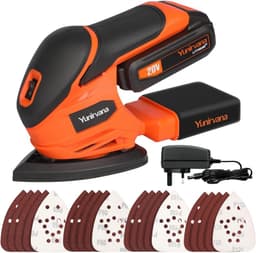
A fitted box or bag is better than leaving the outlet open, provided air can travel from the pad to the collector. The abrasive holes must line up with the extraction holes, the internal passage must be clear and the collector must remain attached. If a bag stays empty while the room becomes dusty, stop and diagnose the route. Covered holes or a blocked port cannot be corrected by increasing the tool speed. The products in this set show several practical limits. Yunirvana reviewers call its included dust bag flimsy and ineffective. One HOIIME review says its box does not stay on. Einhell supplies both a dust box and a vacuum adaptor, but reviewers report that thicker Power X-Change batteries can obstruct the box; one buyer also says a 4 Ah pack did not fit the tool. Collector design therefore has to work with the battery physically fitted to the body. A small collector mainly provides convenience and partial capture. It is not a Class M extractor and should not be described as one. Empty it according to the tool instructions before it blocks airflow, doing so in a way that does not release the contents back into the room. Disposable bags and sealed disposal can reduce the second cloud created during emptying. Where the tool accepts a hose adaptor, suitable on-tool extraction places capture closer to the point of generation. That hose reduces cordless freedom, but the trade-off is meaningful when you are sanding indoors or producing substantial dust. For pad setup and hole alignment, see how to use a cordless sander.

Mask and clean-up

HSE’s WD7 guidance for hand-held powered sanders calls for on-tool extraction using a Class M or H unit and respiratory protective equipment with an assigned protection factor of 20. Its construction sanding page gives FFP3 as an example of that protection. That does not mean any mask labelled similarly will protect you regardless of fit. Facial hair, poor adjustment and an unsuitable face shape can break the seal, and reusable equipment needs the correct filters and maintenance. Extraction and respiratory protection perform different jobs. A respirator protects the wearer when correctly selected and fitted; extraction removes dust near the pad before it spreads. One should not be used as an excuse to omit the other where the risk assessment requires both. At work, employers have duties around COSHH controls, equipment and face-fit testing that a short consumer checklist cannot replace. Clean-up can undo good capture if you use a dry broom or compressed air. HSE says not to sweep or blow wood dust, because both methods return settled material to the air. Use a suitable Class M vacuum and damp methods where appropriate for the surface. Keep work clothing and tools from carrying dust into living areas, and dispose of collected material without shaking it loose. Ventilation can supplement source control, but an open window is not sanding dust extraction. Air movement may carry dust through a house or towards another person. If you cannot connect effective extraction, isolate the area and reconsider whether the powered task should proceed indoors. The cordless sander buying guide can help you identify bodies with a box or vacuum adaptor, though no listing here is certified as safe.

When to stop

Stop when the collector detaches repeatedly, the hose blocks normal control or visible dust escapes despite the setup. Refit the abrasive, clear the system safely and check that the battery is not preventing the box from seating. If the design cannot maintain collection for the material and location, change the extraction arrangement or move the job to a properly controlled setting. Continuing because only a small area remains still creates exposure. Stop immediately for abnormal battery behaviour. One DEKOPRO review describes a pack that smoked, which is a fault signal rather than a runtime inconvenience. Switch the tool off if it is safe to do so, move away, avoid handling a hot or damaged pack unnecessarily and follow the battery manufacturer’s emergency guidance. Do not recharge or continue using a battery that has smoked, swollen or suffered visible damage. Old paint and unexplained symptoms are further stop points. Suspected lead paint needs an appropriate assessment before mechanical sanding, while wheezing, chest tightness or persistent irritation deserve medical advice. HSE notes the occupational asthma risk associated with wood dust. A dust bag on a budget sander does not turn an unsuitable task into a controlled one. For paid work, vibration is another issue alongside dust. HSE gives a daily hand-arm vibration exposure action value of 2.5 m/s² A(8) and a limit of 5 m/s² A(8), but the listings in this comparison do not publish reliable vibration magnitudes. An employer cannot calculate exposure from star ratings or motor speed. The right next step is proper equipment data and a workplace assessment, not an estimate invented from these product pages.

Common questions

Is the dust box enough?
No small box should be assumed to provide complete control. It may catch some debris when the holes align and airflow remains clear, but HSE workplace guidance expects effective on-tool extraction with a Class M or H unit for powered sanding. Treat the box as partial capture, not proof of safety.
What mask should I wear?
HSE sanding guidance calls for respiratory protection with an assigned protection factor of 20 and gives FFP3 as an example. The equipment must be suitable, worn correctly and fit the wearer; facial hair can prevent a proper seal. In paid work, selection and face-fit testing belong within the employer’s risk controls.
Can I sweep up afterwards?
Do not dry-sweep or blow wood dust. HSE warns that both methods put settled particles back into the air. Use a suitable Class M vacuum and, where appropriate for the material and surface, damp clean-up methods that avoid creating another airborne cloud.
Does MDF dust count as wood dust?
MDF contains wood fibre and releases fine dust when sanded. Control it at source rather than treating it as harmless because it is manufactured board. Coatings, adhesives or contamination on the panel may add further hazards, so check the material before disturbing it.
Do I need extraction for a five-minute scuff?
A short task can still release a visible and respirable dust cloud, particularly indoors. Duration affects total exposure, but it does not make source capture unnecessary. Align the abrasive holes, use effective extraction and suitable respiratory protection rather than relying on the job ending quickly.
Why will the Einhell box not fit my battery?
Reviewers say thicker Power X-Change packs can obstruct the Einhell dust box, and one buyer reports that a 4 Ah pack did not fit the tool. Check your exact battery and collector clearance before purchase. A compatible electrical platform does not guarantee every accessory has space.
What if the battery smokes while I am sanding?
Stop using the tool immediately if it is safe to do so, move away and follow the manufacturer’s battery-fire guidance. Do not recharge or reuse the pack. One DEKOPRO review reports smoking, but that individual account does not establish a failure rate for every unit.

Related pages

Sources

Public UK sources for wood dust, hand-arm vibration and product marking. Listings are the amazon.co.uk captures for these eleven ASINs, not a live reload on 17 October 2026. Prices on amazon.co.uk move.

  1. HSE, wood dust (retrieved 17 October 2026)
  2. HSE, WD7 hand-held sanders (retrieved 17 October 2026)
  3. HSE, cutting and sanding wood (retrieved 17 October 2026)
  4. HSE, vibration duties (retrieved 17 October 2026)
  5. HSE, INDG175 (retrieved 17 October 2026)
  6. BSI, BS EN 62841-2-4:2014 (retrieved 17 October 2026)
  7. GOV.UK, UKCA and CE marking (retrieved 17 October 2026)
  8. Homebuilding, types of sander (retrieved 17 October 2026)