Independent comparisons. We may earn from shop links. More info

Angle grinder stand vs chop saw

Updated: 22 October 2026

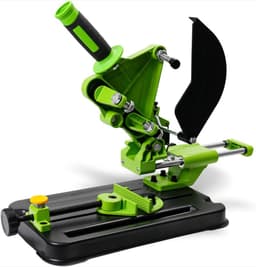
Videos of an angle grinder sliding down a stand look like a chop saw for £20, so it is fair to ask why anyone buys a metal cutting saw at all. The honest answer is depth and repeatability. A 115 mm or 125 mm stand publishes only a few centimetres of cutting height on a new disc, and the wheel wears out of that depth quickly. A metal chop saw is built for abrasive or cold-cut wheels through larger box and bar, with a fence and a trigger meant for the job. ASINs and prices are on the [angle grinder stand comparison](/hub/tools/angle-grinder-stand).

Videos of an angle grinder sliding down a stand look like a chop saw for £20, so it is fair to ask why anyone buys a metal cutting saw at all. The honest answer is depth and repeatability.

Our top picks

Generic Generic cutting base

Alternative

Generic Generic cutting base
7.4/10about £9.99
On this page

The depth you actually get

Manufacturer figures on named stands outside this ASIN batch bracket what is realistic. Wolfcraft's 5019000 cutting stand, designed for 115 and 125 mm grinders, publishes roughly 28–32 mm cutting depth at 90° on a new disc, with a 100 mm clamp width. Sealey's SMS02 lists 18 mm depth with a cast base and vice, at a UK list price of £38.34 including VAT on sealey.co.uk, again without the grinder. Those numbers are not transferable to every £10 jig in the comparison. Most clone listings stay silent on depth. Within the amazon set, KATSU reviewers describe success on small tube, rod, unistrut and curtain pole, and failure around 40 mm stainless tube in sampled text. That matches threads on mig-welding.co.uk, where users call 115 mm stands fine for tiny material and too small for serious fabrication. As the disc wears, the effective depth shrinks. Forum posts note that a vice lip or the stand's own clamp fouls the wheel before the cut finishes, which is why a worn disc feels suddenly useless on a stand. Treat published depths as upper bounds on those two reference products, not as a promise from the Generic sole plate or a tile chamfer shoe. Wood or floorboard cuts on the sole plate are reviewer behaviour. Wolfcraft explicitly limits its stand to metal cutting discs only.

Where the stand is the sensible tool

Choose the stand when you already own a compatible corded grinder, you cut small-section metal occasionally, and the section fits inside the depth your stand can deliver on a fresh wheel. Typical wins in UK reviews are curtain poles, thin-wall tube, small bolts and light unistrut, not structural posts. The stand also reuses your existing cutting discs and spare grinder rather than dedicating floor space to a second machine. Cost matters in this band. The KATSU row is £26.99 with 824 UK reviews, while the named Sealey stand lists near £38 before you buy discs. If the grinder mounts cleanly, the guard stays on, and you bolt the base down, a stand is a rational spend for a few cuts a year. Which ASIN that is, once the body fits, is on the best angle grinder stand page. Sole plates trade depth control for simplicity. They suit shallow scoring when reviewers accept flex. They are not the same as a vice-guided chop path for steel. The Esenlong drop-arm at £37.99 does not publish a depth either, and its six reviews do not turn it into a chop saw.

Where a chop saw replaces it

Move to a metal chop saw when the section exceeds the stand's depth on a new disc, when you cut batches that must be square without shimming hinge play, or when the vice blocks a worn wheel. Model Engineer threads describe Wolfcraft users criticising the vice because it fouls anything but very small stock, then moving to bandsaws for mild steel as the workload grows. mig-welding.co.uk users make the same capacity point about 115 mm stands. This research did not capture a current UK street price for chop saws, so no pound figure is quoted here. The decision is capacity and repeatability, not a precise crossover price. If you already doubt that a 115 mm grinder fits a stand, buying a saw does not solve that fit, but it removes the pivot-alignment problem for larger material. Tile mitre jigs are out of scope. They chamfer glaze. They do not solve metal capacity.

Safety is not settled by the purchase

Electrical Safety First warns that attachments which turn a grinder into another tool add risk even when the setup feels stable. Keeping the metal guard on, using a cutting disc within its marked speed, clamping the work, and unplugging before a wheel change apply whether you choose a stand or a saw. A stand is not automatically safer than freehand work. Hinge play, blocked switches and removed guards appear in UK reviews as often as praise for a heavy base. Employers and self-employed workers using a stand at work fall under PUWER in Great Britain, or the Northern Ireland 1999 regulations, with expectations of training and suitable equipment. A householder doing one cut is not that dutyholder, but the injury risk remains. If the steps on the how to use an angle grinder stand page cannot produce a square, guarded path, stop rather than forcing production.

Common questions

How deep will a grinder stand actually cut?
On named reference designs, roughly 18 mm for the Sealey SMS02 and 28–32 mm for the Wolfcraft 5019000, on a new disc at 90°. Clone ASINs in this set often publish no depth. Expect small-section limits, not masonry thickness, and treat those two figures as upper bounds for those models only.
Why does a worn disc stop cutting through?
The radius shrinks as the wheel wears, so the disc reaches less far into the work. Clamps and vice lips also block a smaller diameter sooner than buyers expect. Forum posts describe a disc that felt fine when new and then fouled the clamp before the cut finished.
Is a stand safer than a chop saw?
Neither is safe by purchase alone. Guarding, disc choice, clamping and how you set the path decide the risk. UK guidance treats a stand as an attachment that needs the same respect as the bare grinder. Hinge play and a removed guard show up in reviews beside praise for a heavy base.
When is the stand the better buy?
When the material fits the depth on a fresh wheel, the cuts are occasional, and a spare corded grinder already mounts with the guard on. Curtain pole, thin-wall tube, small bolts and light unistrut are the wins UK reviewers describe. Structural posts are not.
Can I cut 40 mm box section?
Not reliably on a 115 mm stand in this evidence. KATSU reviews and forum users report failure or binding around 40 mm stainless tube, while smaller sections succeed. A worn disc makes that limit worse, because the vice lip meets the wheel sooner.
What about wood or floorboards?
Some sole-plate owners cut shallow timber in reviews, including on the Generic base. Metal reference stands, including Wolfcraft's 5019000, specify cutting discs only. Wood blades on a grinder stand are not endorsed here.
Do I still need the grinder guard?
Yes. Spark shields on the stand do not replace the wheel guard. Sealey's SMS02 instructions say the plastic shield is for sparks only. If the guard has to come off before the body will sit in the bracket, do not cut.
Should a workplace use this instead of a chop saw?
Workplaces need suitable equipment under PUWER in Great Britain, or the Northern Ireland 1999 regulations. Occasional small-section work, with training, may justify a stand. Production metal cutting usually points to a dedicated saw with a fence and guarding designed for that task. A private householder is not that dutyholder.

Related pages

Sources

Public UK sources from the research digest, used for this page in October 2026. Prices, stars and review counts are from the ten amazon.co.uk listings captured for the shelf date 20 October 2026. PUWER 1998 applies at work in Great Britain. Northern Ireland uses S.R. 1999/305. Neither regime is a duty on a private householder.

  1. HSE, PUWER overview (retrieved 20 October 2026)
  2. legislation.gov.uk, PUWER 1998 (retrieved 20 October 2026)
  3. legislation.gov.uk, NI S.R. 1999/305 (retrieved 20 October 2026)
  4. HSE, HSG17 Safety in the use of abrasive wheels (retrieved 20 October 2026)
  5. Electrical Safety First, Angle grinders (retrieved 20 October 2026)
  6. Wolfcraft, Cutting stand 5019000 (retrieved 20 October 2026)
  7. Sealey, Angle grinder stand SMS02 (retrieved 20 October 2026)
  8. mig-welding.co.uk, Angle grinder stands (retrieved 20 October 2026)