Independent comparisons. We may earn from shop links. More info

How to use a beach parasol holder

Updated: 22.10.2026

The holder is already in the bag, the tide board at the lifeguard hut looks calm, and you still have to get a pole into sand or grass without leaving an open canopy while you swim. How to use a beach parasol holder is a sequence: choose firmer ground, plant the anchor, clamp the pole, then watch the wind. The [parasol holder comparison](/hub/sun-shades/parasol-holder-for-the-beach) is the table of eight amazon.co.uk anchors. This page is the afternoon you use one. Steps follow those listings, UK review notes, and public beach advice. We did not certify a wind speed. A purchase through our links can earn a commission at no extra cost to you.

The holder is already in the bag, the tide board at the lifeguard hut looks calm, and you still have to get a pole into sand or grass without leaving an open canopy while you swim.

Our top picks

On this page

Pick firmer ground first

Look at the surface before you unpack the canopy. Damp, packed sand above the strand line usually bites. Dry powder in the dunes spins. A lawn without bricks takes a screw. Rubble or a drought-baked pitch fights the tip. Shingle and hardstanding refuse most of this set, which the sand versus grass page maps. The RNLI leaflet asks you to check tide and weather, to swim between red-and-yellow flags on a lifeguarded beach, and to treat an orange windsock as a reason to take inflatables out of the water. An open parasol is a sail in the same wind. Plant above the high water you expect, canopy still closed.

Plant the holder, then the pole

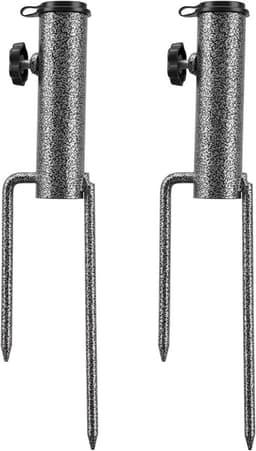
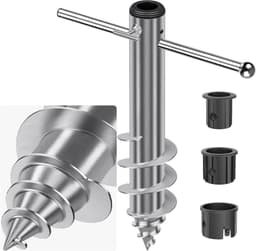
A spiral goes in by turning, not by hammering bare metal. The Dolibest handle is for a continuous twist. UK reviews needed extra bar leverage on a drought-hard lawn, and the tightening bar was awkward if the head ended below the grass. If the helix tilts, back it out. Harrms texts describe a metal rod, sharp out of the box, so wrap the tip for the journey home. A spike is a push into soft ground. Stop when the tube stands without you holding it. Slide the pole in with the canopy still furled. Clear a burr before you force the shaft. A 40 mm pole in a 35 mm tube is a size miss. If the pole is thinner than the bore, fit a sleeve.

Tighten until the pole cannot spin

Turn the screws until you cannot rotate the pole by hand. Harrms UK texts needed an Allen key and would rather have had wing screws, because the key lives in the car. Pack it in the beach bag. The Dolibest bar only helps if the head stays where you can reach it. Eidoct reviewers complain about plastic bits and a short clamp screw, so check that the screw bites the pole. Pull upward on the furled pole. If the whole anchor lifts out of powder, move to firmer ground and plant again. If only the pole creeps inside the tube, the clamp is loose or the sleeve is missing. Open the canopy only after that pull, and stay for the first few minutes. If the fabric tugs the pole, close it.

Close it before you swim

Take the canopy down before you swim, before you leave for lunch, and when the orange windsock is flying. A holder does not watch the beach for you. If a lifeguard or a local byelaw tells you to drop shade, you drop it. Close the fabric, loosen the clamp, and twist or pull the anchor out. Do not leave a steel point for the next bare foot. Rinse salt off the same day and dry the screw before the car. A UK review on the Harrms pool rusted after the first beach use. The Dolibest listing never answers its own rust question.

What a normal afternoon ends with

Firmer ground, a buried anchor, a clamp that will not let the pole spin, and a canopy you close before you swim. If an upward pull lifts the whole spike, move. If the fabric tugs, furl it. A normal day ends with a dry anchor and the key or the handle back in the same bag.

Common questions

How deep should the holder go?
As deep as the ground will grip, with the tube upright. JuYue’s bullets describe a 26 cm spike on a 46 cm stand. The Harrms and Dolibest screws are about 42–43 cm overall, and part of that length stays above the surface so you can reach the clamp. If a light upward pull removes the whole anchor, the sand is too loose or the screw is only half in.
Do I screw it in or push it?
Screw a helix. The Dolibest handle and the Harrms rod are for a continuous twist, with extra leverage on a hard lawn. Push or tap a spike. LLHONG reviews say to put wood on the head if you must drive it, rather than hammering bare metal. Four-spike stands such as the JuYue want a push into soft ground.
What if the pole wobbles?
Wobble is either a loose clamp or a tube wider than the pole. Tighten until the shaft will not spin in your hand, and fit a sleeve if you have one. Dolibest sleeves are 3.5 cm, 3.8 cm and 4.8 cm. If the whole anchor rocks, the ground is too soft. A 40 mm pole in a 35 mm tube is a size miss, not a clamp miss.
When do I close the canopy?
Close it when the fabric lifts, when you cannot stay beside it, and when an orange windsock is flying. Beaufort force 6, about 22–27 knots, is already a strong breeze. Decathlon’s 20 km/h line applies to its own canopies, not to these holders. There is no UK wind certificate in this set.
Can I leave it up while I swim?
Leave the canopy closed if you swim. An open parasol in offshore wind behaves like an inflatable the RNLI would rather you kept in hand. Drop the shade if a lifeguard asks. You can leave a closed, well-planted spike for a short time on a pitch you can still see. You cannot leave an open sail.
Do I rinse it after the beach?
Rinse fresh water over the metal the same day and dry it before the car. A UK Harrms review reported rust after the first beach use, so a coated finish is not a skip-the-rinse promise. Knock sand out of the threads and wrap a sharp tip. The key, the handle, and any sleeve go in the same bag.

Related pages

Sources

Public UK sources and the amazon.co.uk listings compared on this page. Updated 22.10.2026.

  1. amazon.co.uk listings for the eight holders (retrieved 22.10.2026)
  2. Consumer Rights Act 2015, section 9 (retrieved 22.10.2026)
  3. General Product Safety Regulations 2005 (Great Britain) (retrieved 22.10.2026)
  4. NHS: sunscreen and sun safety (retrieved 22.10.2026)
  5. Decathlon UK: parasols and sun shelters (retrieved 22.10.2026)
  6. Met Office: Beaufort scale (retrieved 22.10.2026)
  7. RNLI: on the beach safety advice (retrieved 22.10.2026)
  8. ASTM: beach umbrella sand anchor F3681 (retrieved 22.10.2026)