Independent comparisons. We may earn from shop links. More info

How to put up a garden parasol

Updated: 22.10.2026

The box is in the hall and the base may not be in it. Putting up a garden parasol safely means the pole is held before you open the cloth, the crank follows the leaflet in that box, and you close it when the wind picks up. Which listing to buy is on the [grey parasol comparison](/hub/sun-shades/grey-parasol). This page is the sequence after delivery. The Products Compared editorial team updated it on 21 October 2026 from retailer guidance and the review notes. We did not film a setup. A qualifying amazon.co.uk purchase through our links can earn a commission at no extra cost to you.

The box is in the hall and the base may not be in it.

Our top picks

On this page

Before you open it

Do not open the canopy outdoors until something holds the pole. On these listings the heavy base is not in the box. The 2.7 m VOUNOT reviews say you buy it separately, and one buyer's base was not heavy enough. The Harrier marks weights as optional. Leave the cloth folded until the base, or a table with a proper hole, is in place, on flat ground. The ranges are on the buying guide.

Opening a crank or a push-up

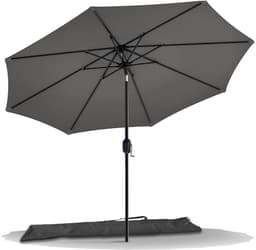
Follow the leaflet for direction. If there is a crank, keep the cloth clear of the wall and wind until it is firm. The Harrier names a crank. The 2.7 m VOUNOT is described as winding up. If there is no crank, you push the runner up the pole. The 270 cm VOUNOT does not mention a crank, and a review says that is hard for a shorter person.

Tilt and a spinning head

Tilt aims the cloth at the sun and moves weight off the centre of the pole. A base that felt solid with the canopy flat can rock after you tilt. Lock the pole first. The grey rectangle states a manual tilt. One buyer found it pointed the wrong way, which means turning the pole in the base, not forcing the joint. On a narrow balcony that turn can meet the railing. Fit is argued on the balcony page. On the Harrier, a review says the locator button is not stiff enough, so the top rotates at a light movement. Close it. If the pole turns in the base, the grip screw is loose or the sleeve is the wrong size.

Wind, rain, and overnight

Close it when the wind rises, when you go in, and overnight. Supplier numbers do not match, so they are not one legal limit. Brollies and Parasols' 2024 sheet says close above 25 km/h, about 16 mph, and store it inside above 35 km/h. None of these ASINs prints a tested wind speed. The Mansader's waterproof question is unanswered. The Harrier's optional cover is called waterproof, which describes the cover, not the open canopy. An offset arm is a different product on the centre pole vs cantilever page, and you still close the cloth.

If something breaks

A bent rib, a head that will not lock, or a parasol that arrives broken is a fault. The grey rectangle has a review of a rib distorting after it was left up. The 270 cm file has a review of one arriving broken. Stop using it. Do not bend the rib back. Under the Consumer Rights Act 2015 you claim against the amazon.co.uk seller, and you have 30 days to reject faulty goods. That is separate from the 14-day cancellation when you change your mind.

Common questions

What do you do if the base is not in the box?
Leave the canopy closed and buy a base that matches the pole, or use a table hole with a base the shop guides rate for that setup. These five listings do not include a heavy base. Opening a 2.7 m canopy in a 9 kg or 12 kg decorative stand is how it walks across the patio. Tighten the grip screw, and only then open the cloth.
How heavy a base for 2.7 m?
For a freestanding centre pole around 2.6 m to 3 m, Plia suggests 40 kg or more and Opal suggests about 40 kg to 50 kg. Through a table, Opal's lower band is about 20 kg to 25 kg. Every figure is a shop rule of thumb. None of these ASINs states a single kilogram. The Harrier's optional weights are not that 40 kg base.
Sand or water in a fillable base?
Opal's rule of thumb is about 1.5 kg of sand per litre and about 1 kg of water. A water-filled shell can look full and still weigh less than sand in the same shell. Weigh it against the 40 kg to 50 kg freestanding band before you open a 2.7 m canopy.
How do you use a crank and a tilt without a diagram?
Use the leaflet in that box for the direction. These listings do not share one. Wind until the cloth is spread and firm, not until the ribs bow. Tilt only after the pole is locked, and bring the canopy back toward upright before you close it. If the head rotates under a light touch, as one Harrier review describes, stop and close it. If there is no crank, as on the 270 cm VOUNOT, ask someone to help.
Can you leave it up overnight?
No. Close it when you go in, and before the wind gets up. Supplier sheets say 15 mph, about 16 mph, or 25 mph, and they do not agree, so close earlier than the highest figure. Store it inside above 35 km/h, the 2024 Brollies figure.
What if a rib bends?
Close the parasol, photograph the rib, and stop using it. A review on the grey rectangle describes a rib distorting after the canopy was left in a breeze. Bending it back can snap it and can weaken a claim. You can reject faulty goods with the amazon.co.uk seller within 30 days under the Consumer Rights Act 2015. Wind damage is often outside a manufacturer warranty.

Related pages

Sources

Public UK sources and the amazon.co.uk listings compared on this page. Method scored 21 October 2026. Updated 22.10.2026.

  1. NHS: sunscreen and sun safety (retrieved 22.10.2026)
  2. Cancer Research UK: sun safety (retrieved 22.10.2026)
  3. NHS Tayside: sun protective products (retrieved 22.10.2026)
  4. GOV.UK: General Product Safety Regulations 2005 (retrieved 22.10.2026)
  5. GOV.UK: accepting returns and giving refunds (retrieved 22.10.2026)
  6. Which?: faulty products (retrieved 22.10.2026)
  7. Brollies and Parasols: parasol guidance (retrieved 22.10.2026)
  8. Opal Retail: cantilever versus centre pole (retrieved 22.10.2026)