Independent comparisons. We may earn from shop links. More info

How to use welding magnets

Updated: 18 October 2026

You have cut two pieces of mild steel for a square corner and want the magnet to hold them while you make the first tack. How to use welding magnets is mainly preparation and timing: clean the faces, set and check the joint, tack, then remove the magnet before the bead. The holder is an extra hand, not a square, a fume control system or a lifting device. If you are still choosing a set, start with our [welding magnet comparison](/hub/soldering-and-welding/welding-magnet). The steps below assume you already have a suitable fixed or switchable holder. Prices on the table were noted on 16 October 2026. A qualifying purchase can earn us a commission at no extra cost to you.

You have cut two pieces of mild steel for a square corner and want the magnet to hold them while you make the first tack.

Our top picks

AB Tools AB Tools AT847_4PK

Best overall

AB Tools AB Tools AT847_4PK
9.1/10about £11.03
S&R S&R 290.803.000

Best value

S&R S&R 290.803.000
8.7/10about £11.95
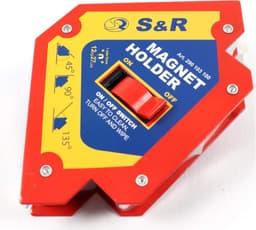
S&R S&R 290.103.100

Alternative

S&R S&R 290.103.100
7.2/10about £28.98
On this page

Set the joint before you strike an arc

First confirm the workpiece is magnetic. These holders are for ferrous material such as mild steel. Aluminium, copper and common austenitic stainless grades such as 304 and 316 will not give a useful hold. Test an offcut when the grade is uncertain. Brush loose scale, rust, filings and weld spatter from the workpiece and the magnet faces. Dirt creates an air gap, and even a small gap can cut the pull sharply. Rest the work on a bench or trestle. A 25 lb packet figure is a favourable pull value, not a safe load for a 25 lb assembly. Offer the pieces together and seat the holder on the 45°, 90° or 135° faces. Keep the body clear of the tack so you can reach the joint and lift the holder afterwards. Check with a square or by measuring diagonals, because a joint that looks seated is not automatically accurate. For a switchable holder, position it while off and engage the lever only when both faces sit flat. With a fixed arrow, approach one face at a slight angle and control the snap. The switchable or fixed welding magnet page explains when that easier placement is worth the extra cost.

Tack, then take the magnet away

Make one or more small tacks that stabilise the joint, using the process that suits the material. Do not run the full bead with the magnet in the corner. Heat can damage permanent magnets, and none of the ten amazon.co.uk listings publishes a maximum working temperature. Taking the holder away also reduces the chance of magnetic interference with the arc. TWI explains that residual magnetism can contribute to arc blow in DC welding, but that does not mean every consumer arrow causes a measurable defect. Tack, remove the magnet, check the joint, then continue without it beside the bead. Clamp the work before you remove the holder if the tacks alone will not keep it still. Long plate, upright box and round tube put more leverage on the joint than a small flat frame. Never put a hand under a part that would fall if the magnet or a tack let go. Welding fume is a separate hazard. HSE says all welding fume, including mild-steel fume, can cause lung cancer. Indoors, use local exhaust ventilation and respiratory protection where extraction does not control the remaining fume.
AB Tools AB Tools AT847_4PK

Testsieger

AB Tools AB Tools AT847_4PK
9.1/10about £11.03

Remove filings and store the holder clean

An always-on arrow collects grinding dust, wire fragments and swarf. Those particles stop the face sitting flat next time, so cleaning is part of the hold, not a cosmetic extra. Do not scrape the magnet with bare fingers. Sharp steel whiskers can cut skin and may jump as you brush. Put a thin plastic bag over the magnet, brush the particles together, then pull the bag away so the filings leave with it. A stiff brush or adhesive tape can take the rest. Compressed air works only with eye protection, and not in a way that fires debris at someone else. A switchable permanent magnet is easier to clean because much of the swarf drops when the lever is off. It is not an electromagnet and needs no plug. If a holder is cracked, distorted or will no longer sit flat, take it out of service. Store fixed arrows away from grinding dust, small tools and electronic or medical equipment. One QWORK listing carries a truncated pacemaker warning, and the product data gives no safe distance. If you have a pacemaker or another active implant, ask your clinician or the device manufacturer.

Soldering claims and when to stop

Several listings say the holders can assist with soldering or brazing. That means positioning magnetic workpieces. It does not make the holder a heat sink or prove a safe temperature for the magnet. The parts must still be ferrous, and the holder should come off before prolonged heating once the joint will stay put. Move to a clamp or a V-pad when the workpiece is round, long, upright or poorly supported. Welding magnets for sheet and pipe explains why a curved tube offers less contact than flat plate. If the magnet slips in a dry setup, do not expect the tack to save it. Stop and use a competent professional for load-bearing work such as stair strings and trailer chassis, for steering, brake or suspension repairs, and for tanks, sills or other confined spaces. A magnet can position steel. It cannot validate joint design or structural integrity. For a first set, the welding magnet buying guide covers force and angles.

Common questions

Where should I put the magnet relative to the joint?
Seat it on clean faces at the required angle, close enough to control the pieces but clear of the planned tack and easy to remove. Support the work independently, then verify the angle with a square or measurements. Do not trap the magnet behind a completed weld.
Can I leave a welding magnet on while running the bead?
Use it to establish the joint and make stabilising tacks, then remove it before the full bead. This limits heat exposure and reduces the chance of magnetic arc interference. The listings compared here do not publish safe operating temperatures, so a precise distance or heating limit would be invented.
How do I remove filings from a fixed arrow magnet?
Covering the magnet with a thin plastic bag before brushing lets you lift many filings away together. A stiff brush or adhesive tape can collect the remainder. Compressed air is another workshop method, but wear eye protection and control where the sharp debris goes.
Can welding magnets cause arc blow?
Magnetism can contribute to arc blow in DC welding, particularly where residual magnetism affects the joint. It does not follow that every arrow causes a defect. Tack with the holder, remove it and reassess the arc rather than leaving a strong magnet beside the full weld.
Can heat ruin a welding magnet?
Excess heat can reduce permanent-magnet performance, but these ten listings do not state a model-specific maximum temperature. Do not borrow a temperature rating from a different industrial clamp. Removing the holder after tacking is the sensible way to limit exposure.
When should I call a professional?
Use a competent professional for structural, safety-critical or confined-space work, or whenever the assembly cannot be securely supported and clamped. Seek individual medical advice if you have an active implant and are uncertain about magnetic fields. A consumer arrow magnet is not evidence that a joint is safe.

Related pages

Sources

Public UK sources and the amazon.co.uk listings in this set, last checked on 16 October 2026.

  1. HSE, Protect your workers from welding fume (retrieved 16 October 2026)
  2. HSE, Change in enforcement expectations for mild steel welding fume (retrieved 16 October 2026)
  3. HSE, Guidance on the safe use of magnetic lifting devices (retrieved 16 October 2026)
  4. Consumer Rights Act 2015, section 9 (retrieved 16 October 2026)
  5. Eclipse, heavy-duty welding clamp data (retrieved 16 October 2026)
  6. Euromag, ferrite magnets (retrieved 16 October 2026)
  7. Tec Products, welding magnets (retrieved 16 October 2026)
  8. Goudsmit, feasible forces for magnetic grippers (retrieved 16 October 2026)