Independent comparisons. We may earn from shop links. More info

Welding rod size: choosing 1.6 mm or 2.5 mm

Updated: October 2026

You have a small inverter, mild-steel sheet and packets labelled 1.6 mm and 2.5 mm. Welding rod size controls how much current the electrode needs, how quickly it deposits metal and how easily you put too much heat into a thin edge. Choose diameter before brand or pack count, then stay inside the electrode maker’s current range. The [welding electrodes comparison](/hub/soldering-and-welding/welding-electrodes) lists the sizes currently found on amazon.co.uk. The bands below come from named manufacturers and buyer examples. They are not universal settings, and they do not prove that stick welding suits every thickness. We did not run a laboratory weld.

You have a small inverter, mild-steel sheet and packets labelled 1.6 mm and 2.5 mm.

Our top picks

GYS GYS E6013 2.5 mm

Best overall

GYS GYS E6013 2.5 mm
9.2/10about £16.65
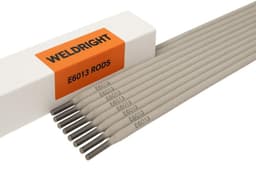
Weld Right Weld Right E6013

Alternative

Weld Right Weld Right E6013
8.4/10about £9.99
GYS GYS E6013 1.6 mm

Preis-Tipp

GYS GYS E6013 1.6 mm
9.0/10about £7.63
On this page

Why diameter comes first

A larger electrode has a larger core and normally needs more current. It deposits more metal and puts more heat into the work. A smaller electrode runs lower and can be easier on light steel, though it burns down quickly. A 2.5 mm rod may suit a gate frame and still be aggressive on a thin panel. A 1.6 mm rod lowers the current requirement and is inefficient on thick plate. Diameter is heat management, not a delicate-versus-strong choice. Check stable output and duty cycle. A display of 100 A may not be sustainable, and open-circuit voltage affects how easily a rod starts. The welding rods buying guide explains why “inverter compatible” is not a current range.

Using 1.6 mm electrodes

The 1.6 mm E6013 packs here are GYS at £7.63, MKGT 30 at £10.97 and MKGT 50 at £14.97. One UK review mentions about 40 A for a light 1.6 mm electrode. Treat that as an example and start from the band on the packet you receive. Hold a short arc. A long arc spreads heat and increases spatter, and a pause at an edge can open a hole even at a low setting. A 1.6 mm rod holds little metal, so it burns down quickly. On a thick bracket, move to a suitable 2.5 mm rod when the joint needs more deposition.
GYS GYS E6013 2.5 mm

Testsieger

GYS GYS E6013 2.5 mm
9.2/10about £16.65

Using 2.5 mm electrodes

For general workshop mild steel, 2.5 mm is a common E6013 size. Weld Right publishes 50–90 A for its 2.5 mm product, Böhler publishes 60–100 A, and ESAB OK 46.30 is sold at 70–100 A. That 20 A gap at the bottom matters. Use the band for your exact rod, polarity and joint. The displayed 2.5 mm options include Weld Right at £9.99, MKGT at £14.97, GYS at £16.65 and Saker at £19.99. Weld Right’s title says 2.5 mm and the model number says 1.6 mm, so check the packet. GYS reviewers describe work from around 60 A. On thin sheet, the extra deposition becomes a burn-through risk.

Understanding 3.2 mm and inch sizes

A 3.2 mm electrode normally needs more current than 2.5 mm. Weld Right lists 80–130 A for 3.2 mm E6013, against 50–90 A for its 2.5 mm version. Confirm the inverter’s sustained output, not the maximum on the front panel. TRQWH selects 3/32 inch, about 2.38 mm, near but not identical to 2.5 mm, and the same listing also names 1/8 inch, about 3.18 mm. Those sizes need different current. Weld Right states a 300 mm length; the GYS 2.5 mm item length is 35 cm. Diameter remains the heat decision.

What to change when sheet burns through

Burn-through means heat enters the edge faster than the joint can hold the pool. Lower the current inside the maker’s stable range, shorten a long arc and travel a little faster. Short runs and spaced tacks let heat leave. A clean fit-up beats filling a hole with extra metal. Moving from 2.5 mm to 1.6 mm can help, and it does not remove the limit of stick welding on very thin automotive-style sheet. MIG or TIG can control heat better below that range. Jasic’s broad arc guide is about 0.5 to 1.0 times diameter. Striking and travel are in the how to use welding rods guide. Pack trade-offs are in the best welding rods UK guide.

Common questions

Should I use 1.6 mm or 2.5 mm for a gate?
It depends on the gate section and joint, not the word gate. Light sheet may favour 1.6 mm for heat control, while typical thicker frame sections often suit a 2.5 mm E6013. Inspect corrosion and practise on matching steel before repairing the gate.
What amps should I use for a 2.5 mm E6013?
Published examples vary: Weld Right gives 50–90 A, Böhler 60–100 A and ESAB OK 46.30 70–100 A. Use the band for your exact rod and adjust for polarity, position and joint on scrap. There is no single correct setting for all 2.5 mm E6013 products.
Why does thin sheet blow through?
The arc is melting the edge faster than travel and surrounding metal can carry the heat away. Excess current, a long arc, slow travel, poor fit-up and an oversized electrode can all contribute. Lower the heat input, or move to a process better suited to thin sheet.
Can a small inverter run 3.2 mm rods?
Some can, but check continuous output, duty cycle, polarity and open-circuit voltage rather than maximum advertised amperage. A 3.2 mm E6013 may require roughly 80–130 A according to one UK supplier. Sustained welding near the machine’s limit can trigger thermal protection.
Is 3/32 inch the same as 2.5 mm?
Not exactly. Three thirty-seconds of an inch is approximately 2.38 mm, though it occupies a similar practical size class. Buy and set current from the actual manufacturer designation. Do not confuse it with 1/8 inch, which is approximately 3.18 mm.
Does a thinner rod need a shorter arc?
Yes, as a broad practical guide. Jasic suggests an arc roughly 0.5 to 1.0 times electrode diameter, so a smaller rod needs a correspondingly short gap. An overlong arc increases spatter and heat spread and weakens shielding.

Related pages

Sources

Public UK sources and the amazon.co.uk listings in this set, last checked on 17 October 2026.

  1. HSE, mild steel welding fume (retrieved 17 October 2026)
  2. HSE, health risks of welding (retrieved 17 October 2026)
  3. HSE WL3, welding fume control (retrieved 17 October 2026)
  4. ESAB OK 46.00 (retrieved 17 October 2026)
  5. ESAB, storing and redrying stick electrodes (retrieved 17 October 2026)
  6. TWI, thoriated tungsten electrodes (retrieved 17 October 2026)
  7. TWI, rutile and cellulosic electrodes (retrieved 17 October 2026)
  8. The Welding Store, ESAB OK 46.30 2.5 mm (retrieved 17 October 2026)