Independent comparisons. We may earn from shop links. More info

Cordless soldering iron vs USB-C: where should the battery sit?

Updated: 18 October 2026

Choosing a cordless soldering iron vs USB-C handpiece sounds like comparing two connectors, but the real decision is where the battery sits. A rechargeable pen carries its cell in your hand; a PD iron such as a TS101-style model has no cell and draws power through a cable. Both travel easily, yet their weight, runtime and sustained output differ. Our [USB soldering iron comparison](/hub/soldering-and-welding/usb-soldering-iron) labels each architecture rather than grouping every USB product together. Choose the internal cell only when working without a pack or socket matters more than runtime and power.

Choosing a cordless soldering iron vs USB-C handpiece sounds like comparing two connectors, but the real decision is where the battery sits.

Our top picks

KAIWEETS KAIWEETS KETS02

Best overall

KAIWEETS KAIWEETS KETS02
9.3/10about £76.49
Beizkna Beizkna 3200 mAh

Best value

Beizkna Beizkna 3200 mAh
9.1/10about £49.98
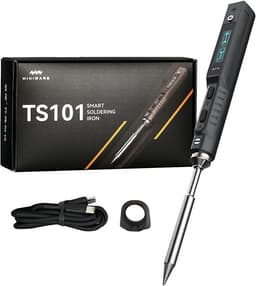
Offfay Offfay TS101

Alternative

Offfay Offfay TS101
8.0/10about £58.64
On this page

What cordless and USB-C mean here

A cordless iron can heat while no cable is attached. Fanttik, Beizkna, SZ-KARIDGE and the cheaper battery pens meet that practical definition because their listings state an internal cell. USB-C may simply be the charging connector on those products. Their usable time then depends on cell capacity, heater demand, sleep behaviour and battery condition. A USB-C PD handpiece is different. The Offfay TS101 listing states corded electric power through USB-C or DC 5525 and no internal battery. KAIWEETS similarly needs external power but includes a GaN charger. These irons are portable, and a power bank can make the whole system independent of a wall socket, but a lead still joins the handpiece to the source. Buyers who expected a cell in the TS101 were understandably disappointed. Offfay lists the handpiece at 33 g, while the Fanttik kit is 470 g and the Beizkna kit 570 g, though those kit weights are not necessarily the bare iron. An external battery moves mass off your wrist but adds a cable and a separate object on the bench. Our buying guide covers the other checks once that decision is made.

When a cell in the handle is worth it

Choose the internal cell for a few small joints where arranging a power bank would be more trouble than the job. A thin trailer-light wire, a small lead in a loft, or one connector away from a socket are plausible examples. The limit is firm. Fanttik’s listing shows 16 W in an attribute and 11 W DC in a bullet. Beizkna shows 16 W and 12 W. Those figures suit light work and leave little reserve when thick copper sinks heat. Review themes for cheap pens include cells running flat quickly. Beizkna states 3200 mAh, Fanttik 2600 mAh and SZ-KARIDGE 1600 mAh. Capacity does not convert into runtime without heater demand. Choose this format when cable-free use is a requirement.
KAIWEETS KAIWEETS KETS02

Testsieger

KAIWEETS KAIWEETS KETS02
9.3/10about £76.49

When the power source should stay separate

Choose a cell-free USB-C iron if you can keep a suitable PD supply on the bench or in the bag. KAIWEETS states 65 W and includes its charger; Offfay also states 65 W but expects you to provide a compatible source. Their external-power design can avoid pauses for an integrated battery to recharge and keeps a consumable cell away from the hot handpiece. Compatibility is the cost. USB-C fit alone is insufficient: the source and iron must negotiate a supported voltage-current pair, and the cable must carry it. PINE64 recommends roughly 20 V at 3 A or more for a normal Pinecil experience, while KAIWEETS gives its own 12 V/3 A or 9 V/2 A outdoor requirement. These are product-specific examples, not universal settings. A multi-port charger marked 65 W may reduce one port when another device is connected, and some supplies reset when the heater jumps from idle to full load. Do not connect USB-C and a barrel jack simultaneously unless the manufacturer explicitly allows it. TS101 mechanism documentation says to use one input at a time. Also check the UK mains side: the charger is a 230 V appliance, and a suitable BS 1363 plug is not clearly stated for every listing. If you already own a reputable laptop charger and rated cable with the correct profiles, the external-power option is often the cleaner choice.

Dual-mode claims and the conditional recommendation

Some products try to combine both approaches. HOTO states up to 60 W from its cell and 140 W when wired, so it offers genuine reasons to change mode if those listing figures hold. Fanttik and Beizkna also claim wired operation, but their lower figures remain modest and one Beizkna UK review reports shutdowns while plugged in. Use while charging should therefore be treated as a feature to verify, not assumed from the presence of a socket. Choose a USB-C iron with no internal cell when you can carry a compatible PD source and want longer, more predictable powered sessions. Choose a battery pen when the job is only a few small joints and having no lead or separate pack is the main benefit. Choose neither as your only tool for ground planes, thick lugs or repeated high-mass joints; a temperature-controlled station is better suited to sustained heat delivery. Within this set, KAIWEETS is the more complete external-power package because the charger is included, while Offfay makes sense for someone who already owns the supply. Beizkna is the strongest-value self-contained kit based on price, named C210 tips and its 1,339-review sample. HOTO covers both modes at the highest price, but its 43-review sample and battery complaints make the £89.99 premium conditional. See the job-based picks before treating any one of them as a universal winner.

Common questions

Is a USB-C soldering iron cordless?
Not necessarily. USB-C can charge an internal cell or power a handpiece continuously with no battery inside. Check for a stated battery capacity and whether the power source says corded electric. A power bank makes a cell-free iron portable, but a cable remains attached during use.
Which type is lighter in the hand?
A cell-free handpiece can be lighter because the battery sits elsewhere; the Offfay TS101 listing gives 33 g. Kit weights for battery models exceed 400 g, although they may include accessories. Handle weight is only one factor, because the external model adds cable drag.
Which lasts longer on a job?
A cell-free USB-C iron can run as long as its external supply has energy, and you can swap the power bank without replacing the handpiece. An internal-cell pen has a fixed capacity and may pause for charging. Actual runtime needs comparable testing, which these listings do not provide.
Can I use my phone charger?
Only if the charger’s PD profiles and the cable match the iron. A basic 5 V charger is unlikely to deliver a stated 65 W, even though the connector fits. Check voltage and current on the exact port, including reduced output when other ports are occupied.
Can I connect USB-C and the DC jack together?
Do not do so unless the manufacturer explicitly instructs you to. TS101 documentation used to explain this architecture says to use one port at a time. Feeding both inputs can damage the iron or supplies and offers no legitimate shortcut to more power.
What should I buy if I already own a laptop charger?
If its single-port PD profiles match the iron and you have a rated cable, a cell-free USB-C model is usually the logical choice. It avoids buying and ageing another battery. Confirm compatibility first; a high total charger wattage does not guarantee the required output on every port.
Which type fails first on a ground plane?
Low-power battery pens usually lose temperature first because the copper removes heat faster than their heaters replace it. A capable PD iron may cope better with a broad tip, but a station remains the safer recommendation for regular ground-plane work. Raising the set-point alone is not a fix.

Related pages

Sources

Public UK sources and the amazon.co.uk listings in this set, dated 15 October 2026.

  1. HSE INDG249, rosin flux fume (retrieved 15 October 2026)
  2. HSE soldering sheet oce4 (retrieved 15 October 2026)
  3. Electrical Equipment (Safety) Regulations 2016 (retrieved 15 October 2026)
  4. GOV.UK, Electrical Equipment (Safety) Regulations 2016 (retrieved 15 October 2026)
  5. GOV.UK, product safety for businesses (retrieved 15 October 2026)
  6. Electrical Safety First, USB chargers (retrieved 15 October 2026)
  7. PINE64 Pinecil (retrieved 15 October 2026)
  8. Rapid Electronics, soldering iron tips guide (retrieved 15 October 2026)