Independent comparisons. We may earn from shop links. More info

Stick welder on a 13 A plug

Updated: 21 October 2026

You are about to plug a stick inverter into the same BS 1363 socket that feeds the kettle, and the listing still shouts 250 A in the title. This page explains fuse rating, input versus welding amps, and when a normal ring final is enough. A headline amp number is not continuous output. Product rows sit on the [electrode welding machine comparison](/hub/soldering-and-welding/electrode-welding-machine). Kit and rod choice sit in the [buying guide](/hub/soldering-and-welding/electrode-welding-machine/sub/electrode-welding-machine-buying-guide). Technique sits on [how to use a stick welder](/hub/soldering-and-welding/electrode-welding-machine/sub/electrode-welding-machine-how-to-use).

You are about to plug a stick inverter into the same BS 1363 socket that feeds the kettle, and the listing still shouts 250 A in the title.

Our top picks

Bimson Power Bimson Power 120 A

Best overall

Bimson Power Bimson Power 120 A
9.4/10about £37.99
HITBOX HITBOX ARC200S

Rank 2

HITBOX HITBOX ARC200S
9.0/10about £47.49
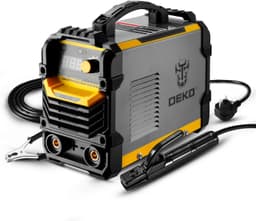
DEKO DEKO 200 A

Alternative

DEKO DEKO 200 A
9.0/10about £69.99
On this page

What a 13 A ring final can deliver

Most UK domestic sockets sit on a 32 A ring final circuit protected at the consumer unit, but each plug still contains a BS 1362 fuse sized for the flex. Electrical Safety First expects a 13 A fuse for a high-load appliance on a standard plug. The fuse protects the cable. When you weld, the inverter draws a pulsing load. The welding amps on the front dial describe arc current, not a steady kettle-style draw. Even so, holding a high dial on a 250 A headline machine can blow a proper 13 A fuse or heat a cheap extension lead. That is the fuse doing its job, not a reason to insert a nail or a 30 A cartridge.

Nameplate welding amps are not wall draw

Manufacturers print 200 A or 250 A because it sells inverters. None of the eight machines in the current amazon.co.uk comparison prints a duty cycle, so you cannot convert a headline into minutes per hour at that current. Treat the dial as peak capability for short beads, then rest when the fan or the thermal cut-out tells you. Input current is rarely shown. The 120 A Bimson matches hobby tacks on a 13 A socket. A 250 A DEKOPRO or LIROPAU still ships with a 13 A plug, so the carton is not unlimited fabrication current.
Bimson Power Bimson Power 120 A

Testsieger

Bimson Power Bimson Power 120 A
9.4/10about £37.99

Practical current on a garage socket

Forum experience, not statute, often lands around 140–150 A of welding current as an upper band that sometimes survives on a 13 A supply for brief beads. Fuses blow when the dial goes higher. Installation age, lead length and other loads change that. Start lower on 2.5 mm E6013 and step up on scrap. Hinge tacks can sit happily on a sound ring. Long runs on 3.2 mm rod at the top of the dial trip fuses or heat the plug unless you upgrade the circuit. VRD on HITBOX or SOARFLY lowers open-circuit voltage before you strike. It does not feed the socket more current.

Check the plug on arrival

DEKO 200 A and DEKOPRO 250 A rows collect repeated UK review themes: open the plug and find a bridged link, a fuse marked 20 A or 30 A, or a loose cord grip. That pattern appears across budget stick inverters, not as one bad batch. Replace it with the correct BS 1362 rating, typically 13 A for these plugs, and tighten the grip so the flex cannot pull out. If the fuse blows with a genuine 13 A fitted and a sensible dial, your circuit or lead is telling the truth. Do not bridge it. Reduce the amps, shorten extension leads, or ask an electrician about a dedicated welder circuit. A hot plug, discoloured flex, or a melting earth braid — reported on XIAZIR in at least one UK review — means stop, cool down, and fix the lead before you continue.

When to stop using a 13 A plug

Leave a 13 A plug behind when you weld several times a week, live in the top third of the dial, rely on a long reel, or share the ring with other heavy loads. Trade catalogues such as Crosarc show 16 A or 32 A plugs and a printed duty cycle because site work expects them. An electrician fits a dedicated radial. A bigger fuse in a domestic plug is not that circuit. A generator still needs bonding and RCD awareness. DEKO reviews mention small petrol sets, and HSE still warns about a live holder. For which row is worth buying once the fuse is honest, see best electrode welding machines.

Common questions

Should I replace a 30 A fuse with 13 A?
Yes, if the plug and flex are designed for 13 A operation, which these BS 1363 plugs are. The fuse must protect the cable, not the seller’s marketing. UK reviews on DEKO and DEKOPRO repeatedly report a 20 A, 30 A or bridged fuse. Fit a genuine 13 A BS 1362 fuse before the first arc.
Will a 250 A welder trip my house fuse?
It may blow the plug fuse, or occasionally the circuit breaker, if you hold a high dial. A 250 A headline does not mean the ring can sustain that welding current. Output amps are not the current drawn from the wall, and none of these listings prints a duty cycle.
Is it safe to use a reel extension lead?
Only if the reel is fully unwound and rated for the load. A coiled reel heats under welding pulses. If the plug or the flex gets hot, stop. Heat is a warning. Shorten the lead or move the inverter closer before you strike again.
What welding amp can I expect on 13 A?
Start modest on 2.5 mm rod and increase on scrap. Forum bands near 140 A appear in practice, and your installation may differ. Treat that figure as experience, not a guarantee and not a statute. A 120 A class machine is the honest match for hobby tacks.
When do I need a 16 A or 32 A circuit?
When welding becomes regular high-output work, or when you buy a machine that leaves the factory with a 16 A or 32 A plug and a printed duty cycle. The budget amazon stick rows in this comparison are not that class. An electrician fits the radial. A larger fuse in a 13 A plug does not.

Related pages

Sources

Sources taken from the research digest. Listings were captured on 19 October 2026. This page did not run a lab test.

  1. HSE — Welding controls (retrieved 20.10.2026)
  2. HSE — WL3, LEV and RPE for MMA (retrieved 20.10.2026)
  3. HSE — Other welding risks (retrieved 20.10.2026)
  4. HSE — Welding in motor vehicle repair (retrieved 20.10.2026)
  5. HSE — Avoid or reduce welding fume (retrieved 20.10.2026)
  6. GOV.UK — Electrical Equipment (Safety) Regulations 2016 (retrieved 20.10.2026)
  7. Jasic — MMA guide (retrieved 20.10.2026)
  8. Crosarc — Product catalogue (retrieved 20.10.2026)