Independent comparisons. We may earn from shop links. More info

How to use a grinding disc

Updated: 21 October 2026

You have a new depressed-centre wheel and a grinder that already has a guard, and the risky moment is the first minute after the nut is tight. This is how to use a grinding disc: check the wheel, fit the grinding guard, set the flanges, run a trial spin, then work at a shallow angle and stop when the disc or the machine tells you to. Ranking stays on the [grinding discs comparison](/hub/sanders/grinding-discs). Nothing below is a lab procedure, and it is not training for people who mount wheels at work. Peter F. checked the notes against public guidance on 19 October 2026. A qualifying purchase can earn a commission at no extra cost to you.

You have a new depressed-centre wheel and a grinder that already has a guard, and the risky moment is the first minute after the nut is tight.

Our top picks

On this page

Before the wheel goes near the spindle

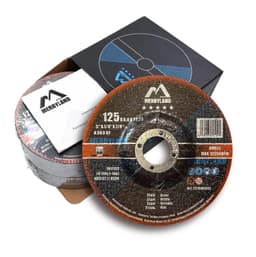
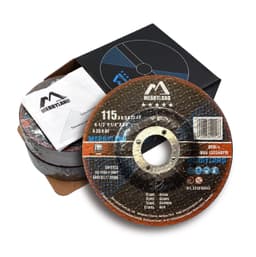
Read the ring before the star rating. You want about 6 mm of thickness, a diameter that matches the guard, and a maximum rpm at least as high as the grinder. Merryland prints 13,300 rpm on the 115 mm ten-pack and 12,250 rpm on the 125 mm ten-pack. Hilka prints EN 12413 and does not print rpm or bore, so those figures come off the ring or the wheel stays off. HSE's HSG17 treats resin-bonded hand-held wheels as carrying about a three-year use-by date. A missing, rubbed or past date means the disc stays in the box. Look for cracks, a chipped edge and a damp label. If a review describes 3 mm when you ordered 6 mm, measure before you mount. A disc about 1 mm thick is a cutting wheel: read grinding disc vs cutting disc.

Guard, flanges and the trial run

Fit the grinding guard, not the open guard used for cutting, and do not remove it because the wheel looks tight. A 125 mm disc on a 115 mm guard is the wrong disc. The side handle stays on. For a depressed-centre wheel, the raised centre of the outer flange faces the disc, so the flange supports the depressed centre. If your flanges are a cutting set, do not stack washers to invent a fit. Tighten the nut with the pin spanner while the spindle lock is in, then take the spanner off. Hold the wheel clear of the bench and your legs, and let it run at full speed for about half a minute, with nobody in line with the wheel. A new vibration, or a disc that wobbles, means you stop and unmount it.

Working angle on the face

Cutwel puts the working angle at about 15–30 degrees, so the face does the work and the edge is not jammed into the steel. Pressing harder does not turn Hilka grit 180 into a coarse A30 wheel. Let the abrasive cut, and move along the weld instead of dwelling until the metal blues.

When you stop, and when someone else should mount it

Stop when the wheel is worn towards the flanges, when the next date is unclear, or when the guard no longer covers it. Stop if a disc has broken in that box. A UK review of the 115 mm Merryland pack says the first disc broke into pieces. The rest of the box is not automatically sound. Clear rags and solvent, and wear eye protection as HSG17 expects. At work, PUWER expects trained people, and HSE treats mounting abrasive wheels as that training. Call a competent person when nobody has been trained to mount wheels, when the guard or spindle is damaged, when discs are past the date, or when the steel is structural or the pipe might be a gas line. Diameter and grit are on the grinding disc buying guide. Which size matches the guard is on 115 mm vs 125 mm.

Common questions

How do I mount a depressed-centre grinding disc?
Fit the grinding guard and the side handle, place the wheel so the raised centre of the outer flange faces the disc, tighten with the spindle lock and pin spanner, then remove the spanner. Run a short trial with the wheel clear of the bench before you touch the steel. If a cutting flange set does not seat, do not pack it with washers.
What angle should I hold the grinder at?
About 15–30 degrees, so the face of a 6 mm wheel is working and you are not stabbing the edge in. A steeper angle loads the wheel in a way a grinding disc is not shaped for. Ease off if the grinder bogs or the disc glazes.
How long should the trial run last?
About half a minute at full speed, with the wheel in free air and nobody in line with it, is long enough to hear a wobble or see a crack open. It is not a cutting test on the workpiece. A dropped or crushed disc is thrown away. The trial does not rescue it.
Can I grind with the cutting guard fitted?
Use the grinding guard. A cutting guard leaves more of a thick wheel exposed, and it is the wrong shield once you work on the face at 15–30 degrees. If the only guard you have does not cover the wheel, the job waits. Do not run the grinder with the guard off.
What if the first disc in the pack breaks?
Stop, unplug or remove the battery, and do not treat the next disc as proven. One UK review of Merryland's 115 mm pack describes a first disc breaking into pieces. Inspect the rest for cracks, check you used the grinding flanges, and check the disc was not past its date. Repeated breakage is a reason to abandon the box.
When should a professional take over?
When wheels are being mounted at work by people without that training, when the guard or spindle is damaged, when every disc is past the use-by date, or when the metal is structural or may contain gas. A comparison page can tell you what 6 mm and 13,300 rpm mean on a listing. It cannot certify the joint you are about to grind.

Related pages

Sources

Sources taken from the research digest. Prices, stars and review counts are the stored amazon.co.uk listing figures.

  1. HSE HSG17 — safety in the use of abrasive wheels (retrieved 19.10.2026)
  2. HSE — PUWER overview (retrieved 19.10.2026)
  3. FEPA — safety leaflet, bonded abrasives (retrieved 19.10.2026)
  4. Cutwel — expert guide to grinding discs (retrieved 19.10.2026)
  5. Cutwel — Klingspor A 24 R grinding wheels (retrieved 19.10.2026)
  6. Abrasives Safety — reinforced bonded wheels (retrieved 19.10.2026)